
Industry
GPS Fleet Tracking for Junk Removal & Hauling
GPS tracking for junk removal and hauling fleets that sends the closest truck to a same-day booking and records every pickup and dump run with times.
Updated September 21, 2026
A junk removal company sells speed and a clean driveway: the customer books a two-hour window, the truck arrives, the crew loads, and the truck leaves for the transfer station, the recycler or the donation centre. Margins live in how many jobs a truck runs a day and how much of each is spent driving to the dump. GPS tracking for junk removal fleets puts every truck on one live map for the dispatcher, with the job it is on, the load it is carrying and the closest disposal site. A same-day booking goes to the truck that can take it without breaking the afternoon. Geofences around each customer address and each disposal site record the arrival, the time on site and the departure, which is the record behind a per-job cost, a dump-fee reconciliation and a disputed invoice. The GPS tracking device also reads the truck's own circuits through IOX-AUXM auxiliary inputs, and a dump-bed lift or a tailgate opening is logged at the landfill, not at the side of a road. Driver scoring and AI dash cams cover a fleet of heavy, high-sided trucks driven through residential streets by crews hired for their backs, and engine-hours maintenance, fault codes and fuel-card integration keep those trucks on the road. High Point GPS installs the hardware, maps the customer and disposal zones and sets up the reports a junk removal owner reads at the end of the day.
Common challenges
- Same-day bookings sent to whichever truck answers, while a closer truck with room in the box is two streets over
- Dump fees and fuel that cannot be matched to the job that generated them
- Customers disputing the volume billed or the time the crew spent, with no record beyond the crew's word
- Loads that were supposed to go to the recycler or the transfer station and ended up somewhere cheaper
- Heavy, high-sided trucks driven hard on residential streets by crews who were hired to lift, not to drive
- Trucks that miss oil changes and brake service because nobody tracks the hours between jobs
How High Point GPS helps
- Live location of every truck on one map, with the job it is on and the nearest disposal site beside it
- Nearest-truck dispatch for same-day bookings through the driver app, with the address and the customer's notes
- Geofence arrival and departure records at each customer address and each disposal site, with minutes on site
- Dump-bed lift and tailgate status read from the truck's own circuits through IOX-AUXM inputs, tied to the location
- Trip replay that shows every pickup, every dump run and the kilometres between them for any truck on any day
- Driver scoring for speeding, hard braking and cornering, weighted for loaded box trucks on residential streets
- Engine-hours and mileage maintenance reminders with fault codes sent to the shop as they appear
- Fuel-card integration that matches each fill-up to the truck, the driver and the location, for a per-job cost
The same-day booking and the truck that can take it
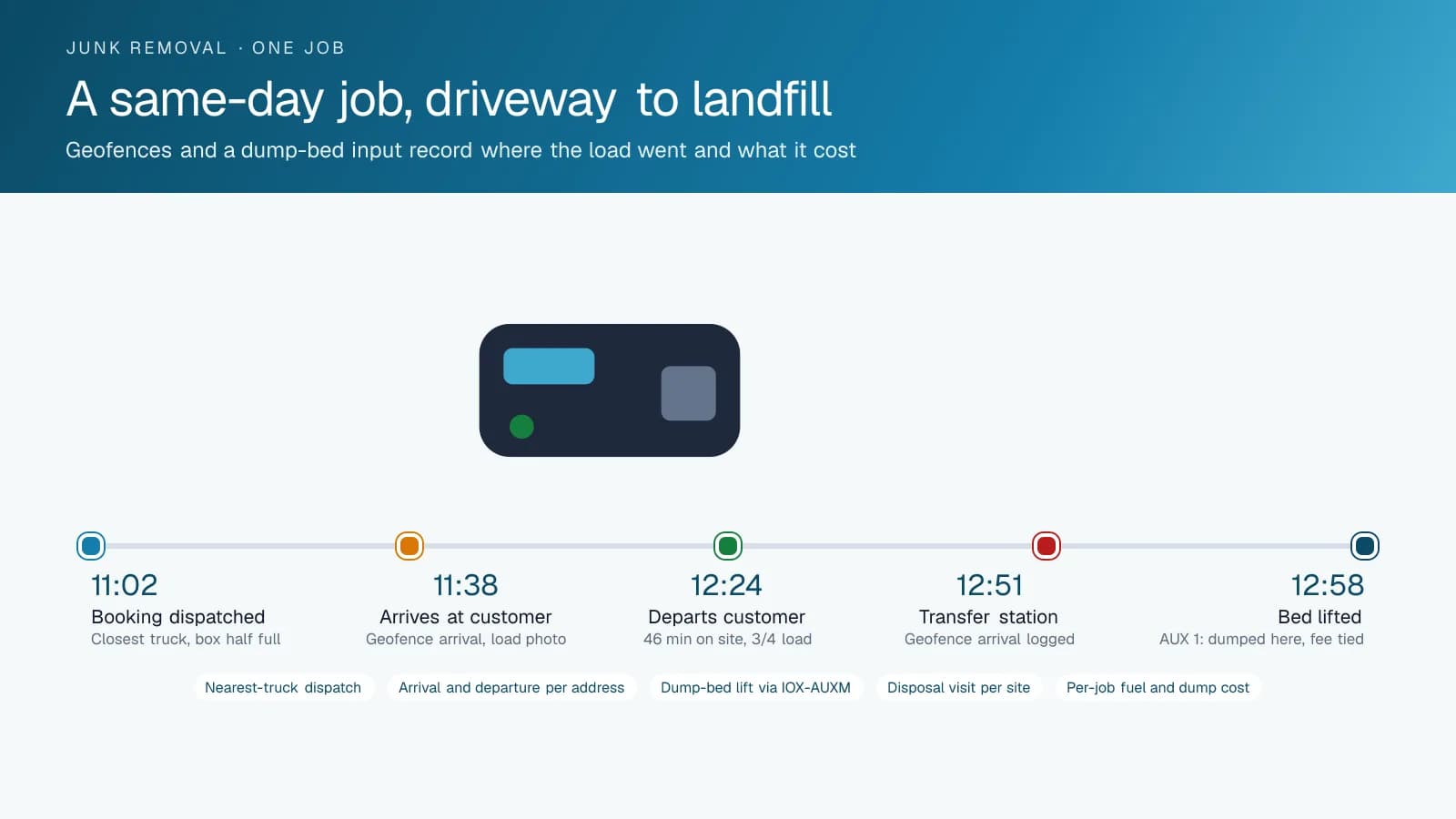
The phone rings at 11:00 with a customer who wants a garage emptied this afternoon. The dispatcher sees every truck on the live map, the job each is on, how full the box is from the last load note and how far each is from the nearest transfer station. The booking goes to the truck that can dump, drive to the customer and still make its 3:00 job, and the customer gets a window the office can keep. The crew gets the job in the driver app with the address, the customer's description of the load and any gate codes or parking notes.
The record of the day shows what the reshuffle cost: the extra dump run, the kilometres to reach the customer, the job that slipped to tomorrow. Over a month, that record shows which trucks run the most jobs per day, which neighbourhoods generate the most driving per job and whether a fourth truck would pay for itself. High Point GPS sets up the dispatch view and the daily reports so a two-person office can run a busy Saturday without a second dispatcher. The open API lets a company that books online push the truck's live status into its own customer notifications.
Every load, from the driveway to the landfill
A junk removal invoice is built on volume and time, and a customer who thinks a quarter-load was billed as a half-load will say so. A geofence around each customer address records the truck's arrival, the time on site and the departure without the crew logging anything, so the office can answer with the times. The dash cam's road-facing view and a photo taken in the driver app at the driveway add the load to the record when a company wants the volume dispute settled by more than the crew's word.
The dump run is the other half. Geofences around each transfer station, recycler, donation centre and landfill record every visit, and an IOX-AUXM input on the dump-bed lift or the tailgate logs the moment the box was emptied and where. A load that was supposed to go to the recycler and went somewhere cheaper shows up on the zone report the same day. The dump-fee receipts reconcile against the disposal visits, and the per-job cost the owner sees at the end of the month is built from the truck's own record rather than from a crew's recollection.
Crews who were hired to lift, not to drive
A junk truck is a heavy, high-sided box on a cutaway chassis, loaded unevenly and driven through residential streets by a crew hired for their strength and their manners with customers. Driver scoring reports speeding, hard braking and fast cornering per driver and per trip, and a supervisor's coaching conversation begins from a specific corner on a specific street rather than a general reminder to slow down. Speed rules per geofence keep the trucks slow in the school zones and cul-de-sacs where a neighbour with a phone is watching, and the report on those zones tells a supervisor which driver keeps tripping them.
AI dash cams add the video. A road-facing camera records the moment a customer's car pulled out in front of the truck, and a driver-facing camera with distraction and fatigue detection flags the moments a supervisor should see. Video is retrieved by event, so an incident review is a few clips rather than a day of footage, and a claim against the company for a scraped car in a driveway is answered with the recording. High Point GPS sets the scoring rules and the camera policy for the fleet and the drivers it actually has.
Fuel, maintenance and the truck's hours
A junk removal truck's day is short trips, long idles at the curb while the crew loads, and a heavy run to the dump. The GPS tracking device reports idling time by truck and by location, and the fuel-card integration matches every fill-up to the truck, the driver and the odometer, flagging the fill-up that does not match the truck's location or exceeds its tank. The per-job fuel number that results is what the owner needs to price a job by distance rather than by guess, and to see which neighbourhoods are quietly losing money on every load.
Maintenance is where a box truck fleet loses days. Brakes, cooling systems and transmissions wear on stop-and-go residential driving and heavy loads, and a truck that misses its service goes down on a Saturday with three jobs booked. The GPS tracking device reports engine hours and mileage for each truck and sends its fault codes to the shop as they appear, so a charging or cooling problem is fixed before it strands a crew. Electronic pre-trip inspections in the driver app catch the lift that is leaking and the tailgate latch that is bent before the truck leaves the yard.
Frequently asked questions
How does it help with same-day bookings?
The dispatcher sees every truck's live position, the job it is on and its distance to the nearest disposal site. The booking goes through the driver app to the truck that can take it without breaking its afternoon. The customer gets an arrival window based on the truck's real position.
Can we prove where a load was dumped?
Yes. Geofences around each transfer station, recycler, donation centre and landfill record every visit, and an IOX-AUXM input on the dump-bed lift or tailgate logs where and when the box was emptied. The zone report shows every disposal visit by truck and by day, which reconciles the dump-fee receipts and flags a load that went somewhere it should not have.
How do we answer a customer who disputes the time or the volume?
A geofence around the customer's address records the truck's arrival, minutes on site and departure automatically. For volume, a photo taken in the driver app at the driveway or the dash cam's road-facing view adds the load to the record. The office answers with the times and the image.
Does it track fuel and dump costs per job?
Fuel-card integration matches each fill-up to the truck, the driver and the odometer, and the trip record shows the kilometres and idling for each job and each dump run. With the disposal visits from the zone report and the dump-fee receipts matched to them, the office builds a per-job cost from the truck's own record rather than an estimate.
What does the crew have to do differently?
Log in to the driver app so trips are attributed to the driver, accept dispatched jobs there, run a short electronic pre-trip inspection and, if the company wants it, take a photo of the load at the driveway. Tracking, geofence visit records, disposal visits and dump-bed lift status all work without any input from the crew.
Related solutions
Related guides
Get a free quote
What are you looking for?