
GPS Fleet Tracking & Telematics
Fleet Fuel Management: How to Reduce Fleet Fuel Costs
Fleet fuel management comes down to four levers: cut idle time, coach aggressive drivers, route better and check fuel-card buys against real vehicle data.
Where Does Fleet Fuel Go?
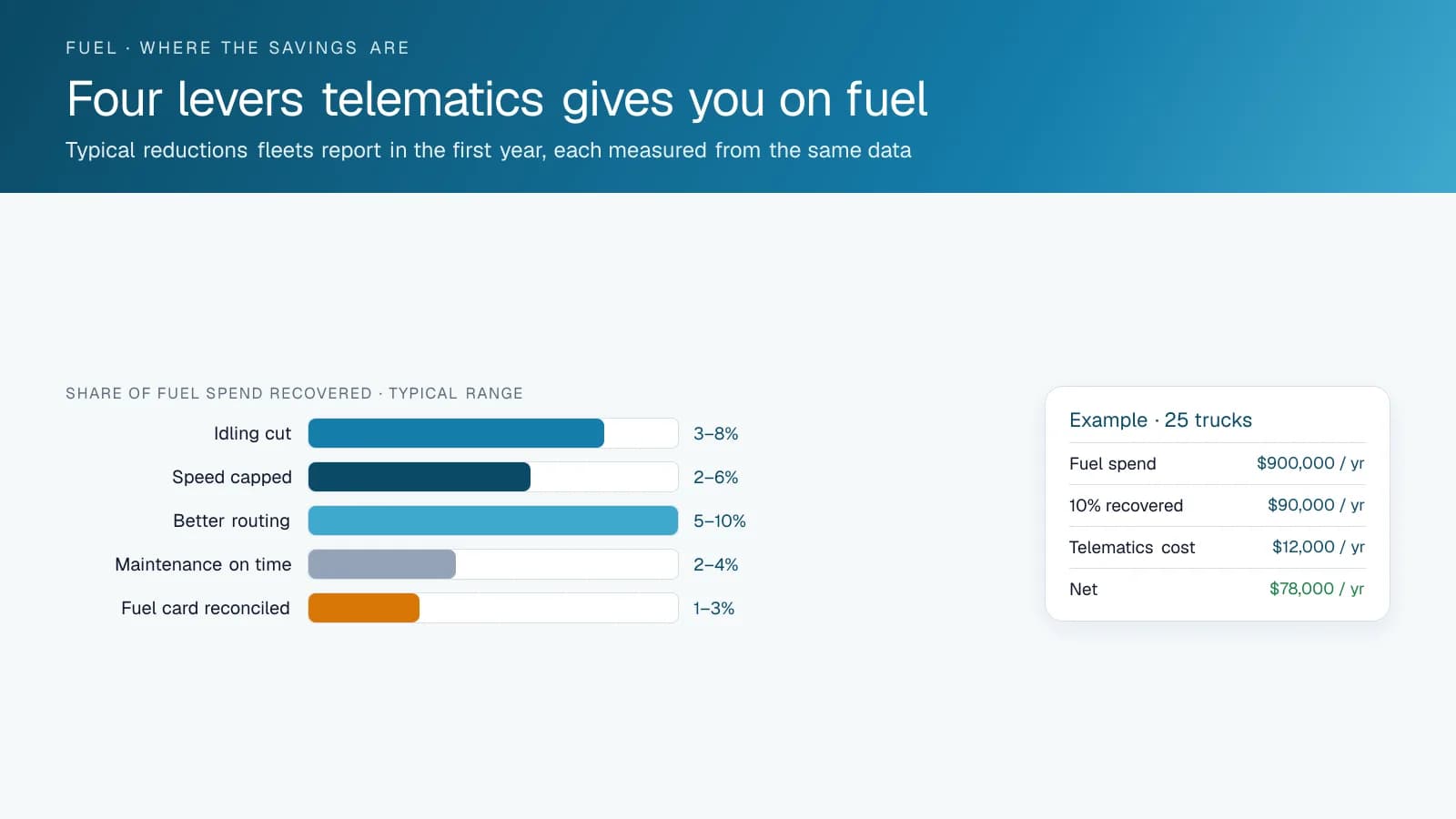
Fleet fuel management comes down to four levers that reduce fleet fuel costs: cut idle time, coach aggressive driving, route more efficiently, and check fuel-card purchases against real vehicle data. None of them needs new trucks or cheaper fuel. Each one changes how you use the vehicles you already have, and telematics data shows you where each lever stands as soon as you start collecting it.
Fleets tend to underestimate idling. Fuel burned while a vehicle sits still produces no miles and no revenue, and across a fleet it adds up without anyone noticing. The US Department of Energy estimates a heavy-duty truck burns roughly 0.8 US gallons (about 3 litres) of fuel for every hour its main engine idles. If your drivers leave trucks running at job sites and stops, that is a direct cost you can measure and cut without touching the routes.
How Do You Cut Idling and Aggressive Driving?
Start by measuring idle time per vehicle and per driver, since you can't reduce what you can't see. Telematics separates the idling drivers can't avoid, like sitting in traffic, from the idling they can, like an engine left running at a stop for no reason. Once drivers know someone measures and reviews it, the avoidable share tends to drop by itself. A simple, fair idle target with the numbers shared openly usually works better than a blanket no-idling rule that ignores legitimate reasons to keep an engine running.
Driving style is the other habit you can change. Hard acceleration, speeding and heavy braking burn measurably more fuel than smooth driving, and telematics flags each event by vehicle and driver. Use those reports to find the drivers whose habits cost the most fuel and coach them first. Coaching that continues week after week, based on the data, keeps the saving in place long after a one-time memo would have been forgotten.
Fleet Fuel Management: Routing and Fuel-Card Reconciliation
You pay for every unnecessary mile. Better routing cuts total distance through fewer backtracks, better stop sequencing and sending the closest available vehicle. You don't need a full optimization engine to start: a dispatcher who can see every vehicle on a live GPS map makes better routing calls than one working blind. Over a month, trimming avoidable miles across a fleet is one of the more reliable fuel savings you can find.
The last lever is fuel spending itself. Connect your fuel cards to telematics and the system matches each purchase against the vehicle that was there, its location and its tank capacity, flagging any fill that doesn't line up with a real vehicle at that place and time. Fuel-card fraud and misuse cost fleets real money. Reconciliation catches purchases no vehicle needed, so your fuel-card data becomes a control you can enforce as well as a bill you pay.
A 30-Truck Plan to Reduce Fleet Fuel Costs
The table applies the four levers to a regional fleet of thirty trucks, with what to measure for each one and where the data comes from. Savings depend on your starting point, so record a baseline month before you change anything.
| Lever | Action | What to measure | Where the data comes from |
|---|---|---|---|
| Idling | Measure by truck, set a target, share weekly; APUs on the worst sleeper idlers | Idle hours per truck per week | Engine and idle data from the tracking device |
| Driving style | Coach the five drivers with the most speeding and harsh events | Speeding and harsh events per driver | Driver safety scorecards |
| Routing | Nearest available truck, fewer backtracks, stop sequencing | Distance per job and backtracking | Trip history on the GPS platform |
| Fuel card reconciliation | Match every purchase to a vehicle, position and tank | Purchases flagged as mismatched | Fuel card integration |
| Total | Fuel spend per kilometre, month over month | Fuel card statements against GPS distance | |
| Cost of the program | Tracking for the 30 trucks plus a manager's hour a week | Quote on request; prices are not published |
Frequently asked questions
How much fuel does idling waste?
The US Department of Energy estimates a heavy-duty truck burns roughly 0.8 US gallons (about 3 litres) of fuel per hour of main-engine idling. Those hours produce no miles and no revenue, so avoidable idling across a fleet is a direct, measurable cost. Telematics lets you track it by truck and driver and cut it without changing any routes.
Does driver behaviour affect fuel costs that much?
Yes. Hard acceleration, speeding and heavy braking burn measurably more fuel than smooth driving. Telematics data shows which drivers have the most of those events, so you can coach those specific drivers first and track whether their numbers improve over the following weeks.
How does fuel-card integration reduce fuel costs?
Connecting fuel cards to telematics matches each purchase against the vehicle that was at that location at that time, and against its tank capacity. Any purchase that doesn't fit a real vehicle need gets flagged. That catches fraud and misuse you would never spot from a stack of card statements alone.
Can I reduce fuel costs without route optimization software?
Yes. Real-time GPS visibility lets dispatchers send the closest vehicle and avoid backtracking, which cuts avoidable miles without a full optimization engine. Idle reduction and driver coaching save fuel whatever your routing looks like, so most fleets can start right away with the telematics data they already collect.
Related solutions & products
Related terms
Continue reading
- GPS Fleet Tracking & Management Software overview →
- Benefits of GPS Fleet Tracking: What Changes When You Can See Your Fleet →
- What Is Fleet Maintenance Software (CMMS)? Preventive Service on Real Engine Hours and Kilometres →
- Fleet Maintenance Schedule: Engine Hours vs Calendar and Mileage →
- Asset Data Display: A Fleet Dashboard of Ten Vehicle Metrics in the High Point GPS Platform →
- More in GPS Fleet Tracking & Telematics →
Get a free quote
- Over 500 fleets
- Since 2013
- 4.9 on Google (19 reviews)
What are you looking for?
Prefer to talk?Call 1-800-613-6323[email protected]