
Industry
GPS Fleet Tracking for Locksmiths & Security Installers
GPS fleet tracking for locksmiths and security installers: closest-van dispatch for lockouts, time on site for every invoice and vans kept secure.

Updated September 21, 2026
A locksmith or security installer runs two businesses out of the same vans: emergency calls that have to be answered in minutes, and scheduled installs of alarm, camera and access-control systems that have to be finished on the date promised. Both depend on knowing where the vans are. GPS tracking from High Point GPS puts every service van on one live map in the High Point GPS platform, with the technician logged in and the jobs of the day beside it. When a lockout call comes in, dispatch sees which van is closest and how long it is likely to take. When a property manager disputes the hours on an install invoice, the geofence record shows the van arriving at 8 h 12 and leaving at 16 h 40. The same GPS tracking device logs after-hours use of a van that holds master keys, restricted blanks and a key-cutting machine, and a door sensor on the rear cargo area records every opening. Bluetooth asset tags follow the ladders, drills and demo panels that move between vans. Engine-hours maintenance keeps the fleet on the road, and driver scoring gives the owner a way to talk about speeding on the way to an emergency call before it becomes a claim. Everything runs from one database that the office can reach from a phone.
Common challenges
- Lockout and break-in calls dispatched to whichever technician answers the phone first, not the one who is closest
- Time-on-site disputes on installation invoices with nothing but the technician's word to back the hours billed
- Vans full of master keys, restricted blanks, alarm panels and tools that are attractive to thieves and hard to prove secured
- After-hours use of company vans that nobody notices until the fuel bill or a speeding ticket arrives
- Tools and test equipment that move between vans and jobs and go missing without anyone knowing when
- Speeding on the way to an emergency call that shows up as a ticket or a collision claim months later
How High Point GPS helps
- Live location of every service van on one map, with the logged-in technician and the day's jobs beside it
- Closest-vehicle dispatch for lockout, break-in and alarm-failure calls, with a realistic arrival estimate for the customer
- Geofence arrival and departure records at every customer address, giving time on site for each invoice
- Rear cargo door openings recorded through the GPS tracking device's auxiliary inputs, with the time and location of each one
- After-hours and weekend movement alerts for vans carrying keys, blanks and security hardware
- Bluetooth asset tags on ladders, drills, key machines and demo panels, showing which van each one was last seen in
- Driver scoring for speeding, hard braking and idling, weighted for the urgency of emergency calls
- Engine-hours and mileage maintenance reminders with engine fault codes sent to the office as they appear
Getting the closest van to the lockout
A lockout customer standing outside their door does not care how the call was routed; they care about the minutes. With every van on a live map, the dispatcher sees which technician is nearest, whether they are still on a job or driving between two, and what a realistic arrival time is. The estimate given on the phone is one the technician can meet. High Point GPS sets up the map with the day's scheduled installs marked as geofences. Dispatch sees at a glance that the van in the next street is on a four-hour access-control job and the one two blocks farther is free.
Emergency work creates pressure to drive fast. The driver score reports speeding, hard braking and hard cornering by technician and by trip. An owner who sees three speeding events on one Saturday night run can address it with the specific trip in hand, before an insurer does. A road-facing AI dash cam is an option for shops that have had a claim: the video of the moments before a collision, retrieved by event, often ends a dispute about who did what.
Proving the hours on an installation invoice
An alarm or camera install billed by the hour invites the question of how many hours it really took. A geofence around the customer's address records the van's arrival and departure, and the invoice can carry those times. A property manager who says the crew was gone by lunch is answered with the record: the van on site from 8 h 12 to 16 h 40, and a second van arriving at 13 h 05 to help with the pull. Multi-day installs show the same thing for each day, with the trip replay for anyone who wants to see the drive between site and shop.
The IOX-NFCREADERA driver ID reader ties each trip to a technician. A van used by two people during the week shows who drove it on which day, and the time on site is attributed to the right person for payroll and for the invoice. Shops that dispatch from a scheduling system connect it to the High Point GPS platform through the open API, and the arrival stamp lands in the job record without anyone typing it.
Securing a van that is a target
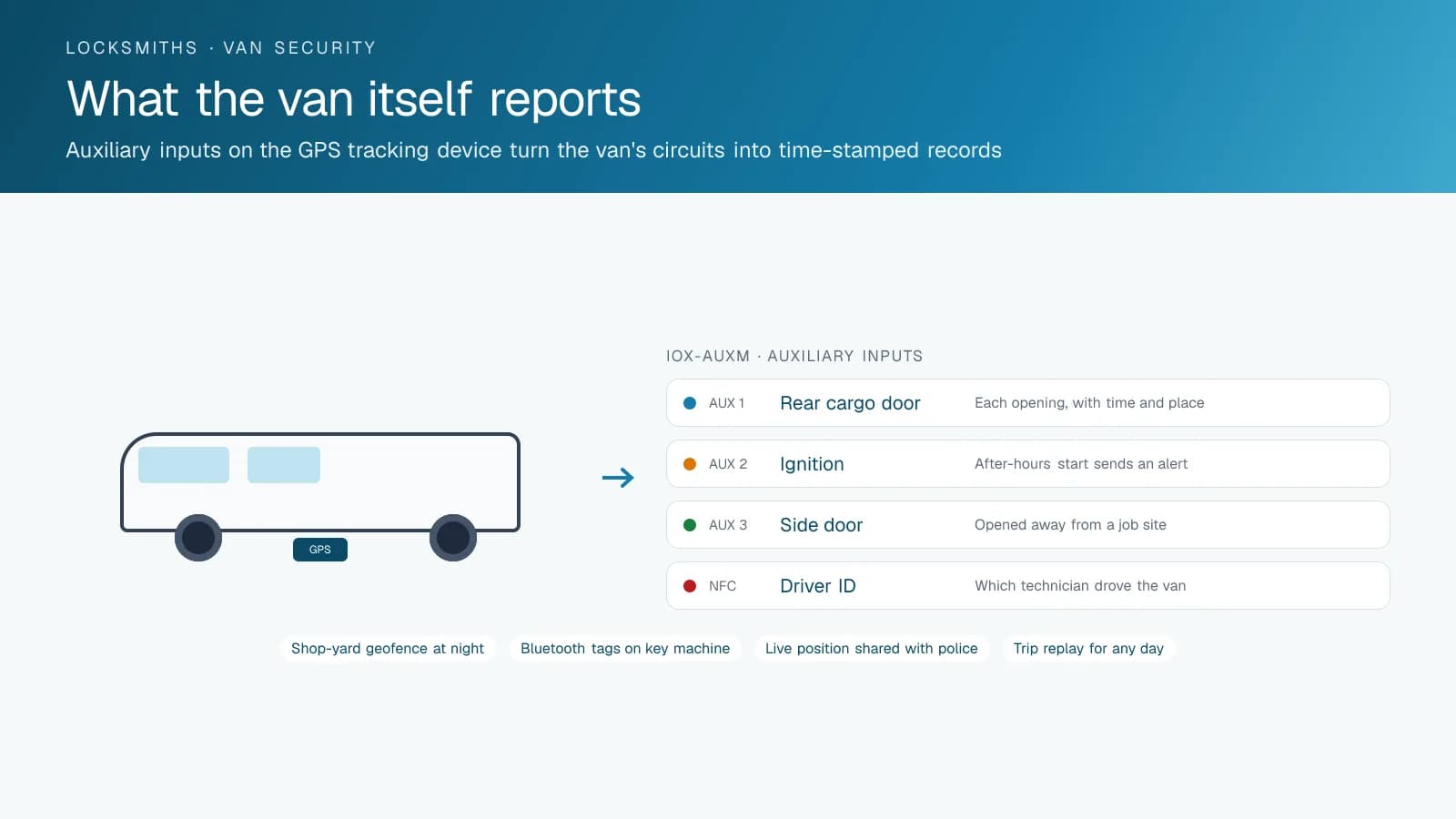
A locksmith's van is unlike other trade vehicles: it carries master keys, restricted keyways and blanks, a key-cutting machine and, on a security install, alarm panels and card readers that have not yet been registered to a customer. The GPS tracking device records every movement, and a rule that fires on ignition outside working hours or on any movement while the van should be parked at the shop sends an alert to the owner's phone. A geofence around the shop yard turns a van leaving at 2 h 30 into a text message rather than a discovery in the morning.
An IOX-AUXM auxiliary input wired to the rear cargo door sensor adds when the doors were opened, and where. That record shows the van's doors stayed shut overnight, or that they opened in a parking lot the technician had no job in. If the van is stolen, the live position goes to police with the GPS tracking device still reporting. Bluetooth asset tags on the key machine and the tool cases show whether the equipment left with the van or was already in another vehicle.
Keeping tools, vans and records in order
Installation crews share equipment: extension ladders, hammer drills, cable pullers, fish tapes and demonstration panels for sales visits. A Bluetooth asset tag on each one is read by whichever GPS tracking device passes near it, and the High Point GPS platform shows the van it was last seen in and when. A missing drill is looked up in a minute instead of by calling every technician. Battery-powered trackers go on the trailer or the scissor lift that only leaves the yard for the larger commercial jobs.
Maintenance runs on engine hours and mileage rather than on whoever remembers. Oil changes, brake inspections and tire rotations come up as reminders for each van, and engine fault codes reach the office when they are logged, not when the van will not start on a Monday. The electronic DVIR in the driver app gives technicians a quick pre-trip checklist on their phone, with a defect going to the shop the same morning. High Point GPS installs the hardware, builds the rules and trains the office, and stays on the phone afterwards.
Frequently asked questions
Can I see which van is closest to an emergency call?
Yes. Every van appears on a live map in the High Point GPS platform with the logged-in technician and the job they are on. Dispatch sees which van is nearest to the caller's address and whether that technician is free, and gives the customer an arrival estimate the technician can meet.
How does it prove time on site for an installation invoice?
A geofence around each customer address records when the van arrived and when it left. Those times, and the technician logged in on the driver ID reader, go on the invoice. Trip replay shows the drive to and from the site if the customer wants to see the whole day.
Will it alert me if a van moves after hours?
Yes. A rule on ignition or movement outside working hours, or on leaving the shop geofence at night, sends an alert to a phone or email within a minute. If the van is stolen, its live position keeps reporting and can be shared with police.
Can it record when the cargo doors were opened?
Yes. An IOX-AUXM auxiliary input on the GPS tracking device reads a door sensor on the rear cargo area and logs each opening with the time and location. The record shows whether a van carrying keys, blanks and security hardware stayed closed overnight or was opened away from a job.
How do I keep track of shared tools and ladders?
Bluetooth asset tags on ladders, drills, key machines and demo panels are read by any GPS tracking device nearby, and the High Point GPS platform shows which van each item was last seen in and when. Larger items like a trailer or lift get a battery tracker that reports on its own.
Related solutions
Related guides
- How Geofencing Works for Fleet Tracking →
- GPS Asset Tags vs. Powered Trackers: Which to Use →
- Equipment Theft Recovery: How GPS Gets Stolen Machines and Trailers Back →
- IOX-NFCREADERA: Driver ID by NFC Tap, So Every Trip Has a Name on It →
- GPS Fleet Tracking for Small Business: What a 3 to 20 Vehicle Fleet Needs →
- What Is an IOX Port and What Does It Do? →
Get a free quote
What are you looking for?