
Industry
GPS Fleet Tracking for Masonry Contractors
GPS fleet tracking for masonry contractors: boom trucks, mixers and forklifts by job site, timed deliveries and hours on site behind every invoice.
Updated September 21, 2026
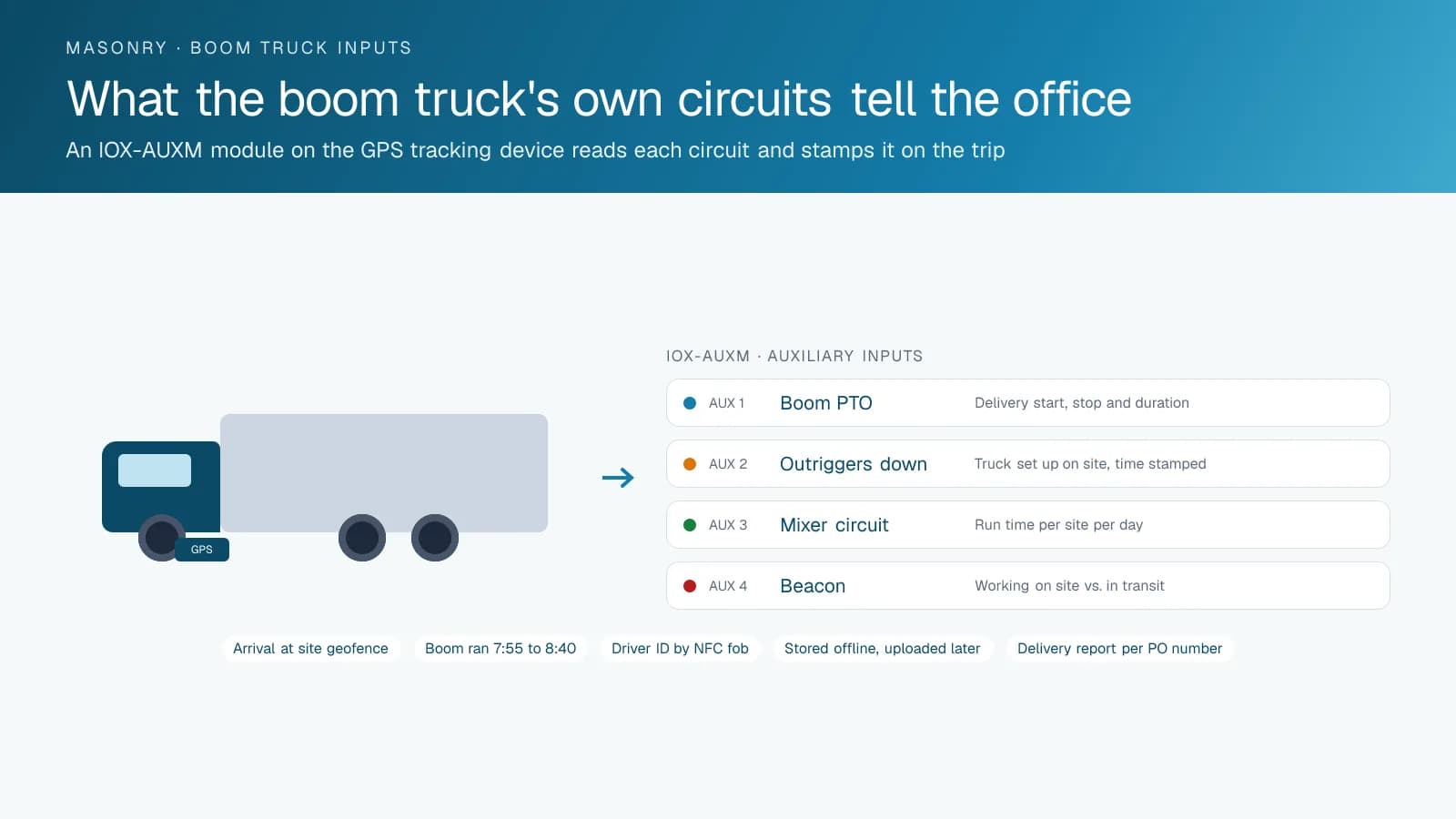
A masonry contractor's fleet is heavier than most trades'. A boom truck delivers pallets of block and brick to the scaffold line, a flatbed brings the mortar mixer and the saw, a rough-terrain forklift stays on the site for the duration and a fleet of pickups carries the bricklayers between jobs. The office schedules crews and deliveries against a general contractor's timeline and learns what happened from the foreman at the end of the day. High Point GPS puts every truck on one live map, with a geofence around the yard, the block supplier and each job site. The GPS tracking device stamps the departure, the arrival and the hours on site. An IOX-AUXM module reads the boom's PTO and the mixer's circuit, which turns each delivery and each pour into a record with a time and a duration. The High Point GPS platform totals hours on site per crew and per job for the estimator and the bookkeeper. Bluetooth asset tags and battery trackers follow the forklift, the mixers, the saws and the scaffold trailers left on site for weeks. Driver ID through the IOX-NFCREADERA attributes each trip to the crew leader when trucks change hands. When a general contractor back-charges for a late block delivery, the trip replay and the PTO record answer with times. Engine-hours maintenance keeps the boom trucks and forklifts working, and driver scoring keeps loaded trucks driving the way the insurer expects. Contractors across Canada and the United States run it from one High Point GPS platform database.
Common challenges
- General contractors back-charging for a late block or brick delivery with no independent record of when the boom truck arrived
- Hours billed per job resting on the foreman's time sheet when a client or a general contractor disputes them
- Forklifts, mixers, saws and scaffold trailers left on sites for weeks and not where the next crew expects them
- Boom-truck deliveries and mixer time never recorded, so a dispute over a short pour or a missed drop comes down to memory
- Boom trucks and forklifts that miss engine-hours service intervals because the schedule is tracked by the calendar
- Crews swapping pickups and flatbeds during the week, with trips and driving events attributed to the wrong person
How High Point GPS helps
- Every crew truck, boom truck and flatbed on one live map with a geofence around the yard, the supplier and each job site
- Boom PTO and mixer circuits read through the GPS tracking device's IOX-AUXM auxiliary inputs, with a time and duration for each delivery and each batch
- Arrival, departure and hours on site recorded for every truck and every job without the crew logging anything
- Bluetooth asset tags and battery trackers on forklifts, mixers, saws and scaffold trailers left on site
- Driver ID from an NFC key fob that attributes each trip to the crew leader, whichever truck the crew took
- Hours-on-site and delivery reports per job that the estimator compares to the bid and the bookkeeper attaches to the invoice
- Engine-hours maintenance reminders for boom trucks and forklifts, with fault codes sent to the shop as they appear
- Driver scoring on speeding, harsh braking and idling for crews driving loaded trucks between sites
Deliveries and pours with a time on each one
The boom truck is the masonry contractor's most contested vehicle. A general contractor's schedule depends on the block arriving before the bricklayers run out, and a late drop turns into a back-charge. An IOX-AUXM module on the GPS tracking device reads the boom's PTO, and every delivery in the trip record carries the arrival at the site, the moment the boom went to work and the time it took to unload. The mixer's circuit is read the same way, and a report shows how long the mixer ran on each site each day. Trips and inputs are stored on the device when a site has no coverage and uploaded when the truck returns to signal.
That record ends most disputes before they start. A general contractor who says the block arrived at ten gets the boom truck's arrival at 7 h 48 and the boom running from 7 h 55 to 8 h 40. A superintendent who says the mixer was idle all afternoon gets the mixer's run time. High Point GPS builds the delivery report with the job numbering the contractor uses and the general contractor's purchase order number. It runs on a schedule from then on and lands in the project manager's inbox each Monday morning.
Crews, hours and the estimate behind the bid
Masonry is bid by the block, the square foot of veneer or the linear foot of wall, and every bid is a guess about labour hours. High Point GPS draws a geofence around each job site and names it after the job number, and the GPS tracking device stamps every crew truck's arrival and departure. The High Point GPS platform totals hours on site per job and per crew, and the estimator sees whether the four-day bid for a foundation took four days or six. Over a season the report shows which crews are fast on block and which are better on brick veneer, and which kinds of jobs are being underbid.
For billing, the same report goes on the invoice, and the trip replay backs it when a client goes further. A homeowner who says the crew was not there on a billed Tuesday gets the truck's arrival at 7 h 05 and departure at 15 h 30 for that Tuesday. Driver ID through the IOX-NFCREADERA ties each trip to the crew leader, and a crew that swaps between the flatbed and a pickup during the week still has its hours attributed correctly. The reports export through the open API to the accounting software the contractor already uses.
Forklifts, mixers and scaffold left on site for weeks
A rough-terrain forklift lands on a site at the start of the job and stays until the last course is laid. The mixers, the saws and the scaffold trailer stay with it. None of them plug into anything, and none of them is where the next crew expects when the job ends. Bluetooth asset tags reporting through any truck that passes nearby, and battery-powered trackers for the forklift and the trailers, keep them on the same map as the trucks. A crew leader who needs the second mixer sees which site it is sitting on, and a report lists every asset that has not moved in a set number of days.
The record also settles the rental question. When a forklift is rented for a job, the tracker shows the day it arrived and the day it left, and the rental invoice is checked against it. When a forklift is the contractor's own, the tracker's engine hours feed the maintenance schedule. A trailer of scaffold that leaves a site at two in the morning triggers an alert, and the tracker reports until it is recovered. High Point GPS sets the alert rules for after-hours movement, off-site departures and low battery once, and the office hears about a problem before the crew does.
Keeping heavy trucks and their drivers in order
A boom truck and a loaded flatbed are maintained by engine hours as much as by mileage, and a schedule kept on the calendar misses both. The High Point GPS platform tracks mileage and engine hours per truck and raises a reminder when an oil change, a hydraulic service or a DOT inspection comes due. Engine fault codes reach the shop the day they appear, which is how a hydraulic pressure fault on the boom truck gets looked at before it fails mid-delivery with a pallet in the air. Electronic DVIR in the driver app replaces the clipboard for the trucks that cross a scale, and a defect on the boom or the outriggers reaches whoever fixes it before the truck leaves the yard.
The driver side is the insurer's concern. A flatbed loaded with block driven hard between sites, or a pickup full of bricklayers on the highway at seven in the morning, is where the contractor's liability sits. Speeding, harsh braking and idling are scored per driver through the NFC fob rather than per truck, and the coaching conversation starts from a specific trip. An AI dash cam on the boom truck and the flatbeds adds the road view when a claim is disputed, and the footage is pulled by event. For trucks that cross into the United States or run long distances, the driver app handles ELD hours of service and IFTA mileage by jurisdiction.
Frequently asked questions
Can it record when the boom truck delivered and how long the boom ran?
Yes. An IOX-AUXM module on the GPS tracking device reads the boom's PTO circuit. Each delivery in the trip record then carries the arrival at the site, the moment the boom started and the time it ran. The same module reads a mixer's circuit, and a report shows its run time per site per day.
A general contractor is back-charging us for a late delivery. What do we have?
The delivery report shows the boom truck's arrival at the site geofence and the boom's start and stop times, with the driver identified. The office replies with those times and the trip replay if the question goes further. The record comes from the GPS tracking device rather than a recollection.
Can it track the forklift, the mixers and the scaffold trailer left on site?
Yes. Battery-powered trackers cover the forklift and the trailers that sit on a site for weeks, and Bluetooth tags on mixers and saws report through any truck that passes nearby. Each piece appears on the map, an alert fires when a trailer moves after hours, and a report lists assets that have not moved.
How does it record hours on site for the crews?
High Point GPS draws a geofence around each job site. The GPS tracking device stamps every truck's entry and exit with the time and the crew leader from the NFC fob. The High Point GPS platform totals the hours per job and per crew, and the estimator or the bookkeeper reads or exports the report without a time sheet.
Do our boom trucks need an ELD?
It depends on the truck's weight class and how far it travels, and High Point GPS reviews that with each contractor. Where a truck falls under the US or Canadian ELD mandate, the driver app on the same GPS tracking device records hours of service, and the same platform handles IFTA mileage for trucks that cross jurisdictions.
Related solutions
Related guides
- GPS Fleet Tracking for Construction Companies →
- What Is an IOX Port and What Does It Do? →
- PTO On/Off Reader: Proving the Winch Ran, for Tow Billing and Hydraulic Maintenance →
- Construction Asset Tracking Software: Equipment, Attachments, Materials and Tools in One System →
- GPS Asset Tags vs. Powered Trackers: Which to Use →
- Fleet Maintenance: Engine Hours vs. the Calendar →
Get a free quote
What are you looking for?