
Industry
GPS Fleet Tracking for Medical Courier & Lab Logistics
GPS tracking for medical couriers and lab logistics: chain-of-custody stop records, cooler temperature alerts and STAT runs sent to the closest driver.
Updated September 21, 2026
GPS tracking for medical courier and lab logistics fleets from High Point GPS records every specimen and pharmacy stop for chain of custody, logs cooler temperature on the road and sends STAT runs to the closest driver. It is built for courier companies, hospital networks and reference labs that move things nobody can replace: blood and tissue specimens on their way to the lab, chemotherapy and compounded medications on their way to a patient, and pharmacy totes on a route that hits forty clinics before noon. The lab wants to know when a specimen left the clinic, when it arrived, at what temperature, and who had it in between. A hospital pharmacy wants the STAT delivery in forty minutes, and the courier company wants to prove it made it in thirty-eight. The system produces those records without asking the driver to write anything down. A GPS tracking device in each vehicle logs every stop with its time, and a geofence around each clinic, lab and hospital dock turns those stops into arrival and departure entries the lab can match to its own manifest. A Bluetooth temperature puck in the cooler reports continuously, and a reading that drifts outside the range raises an alert while the driver can still act on it. Dispatch sees every driver on one map, sends a STAT run to the closest one and watches it arrive. When a specimen is questioned weeks later, the trip record, the geofence entries and the temperature log answer the chain-of-custody question in one report. High Point GPS installs the hardware and sets up the reports.
Common challenges
- A lab rejecting a specimen because nobody can show when it was picked up, how long it travelled or how warm it got
- STAT runs assigned by phone to whoever answers first instead of the driver who is actually closest
- Temperature logs kept on a clipboard and filled in from memory at the end of the shift
- Clinics saying the courier never came, and no record of the van at their door at 10:14
- Drivers on fixed routes who finish early some days and run late on others, with no data to rebalance the routes
- Client reporting assembled by hand every month from manifests, timesheets and guesswork
How High Point GPS helps
- Every stop logged automatically with its time, duration and location, and matched to the clinic, lab or hospital by geofence
- Chain-of-custody stop records with the driver identified by NFC key, exported per specimen route or per client
- Bluetooth temperature pucks in coolers and totes that report through the GPS tracking device, with alerts on excursions
- STAT dispatch that shows the nearest available driver and sends the job to the driver app in one step
- Hospital and lab dock geofences that record arrivals and departures for on-time reporting and detention
- Live ETAs for the lab receiving desk and the pharmacy waiting on a delivery, with no phone call to the driver
- Route review by trip replay, showing where fixed routes run long and which stops could move
- Client-ready reports on stops served, on-time rate and temperature compliance, scheduled by email or pulled through the API
How does GPS tracking create a chain-of-custody record?
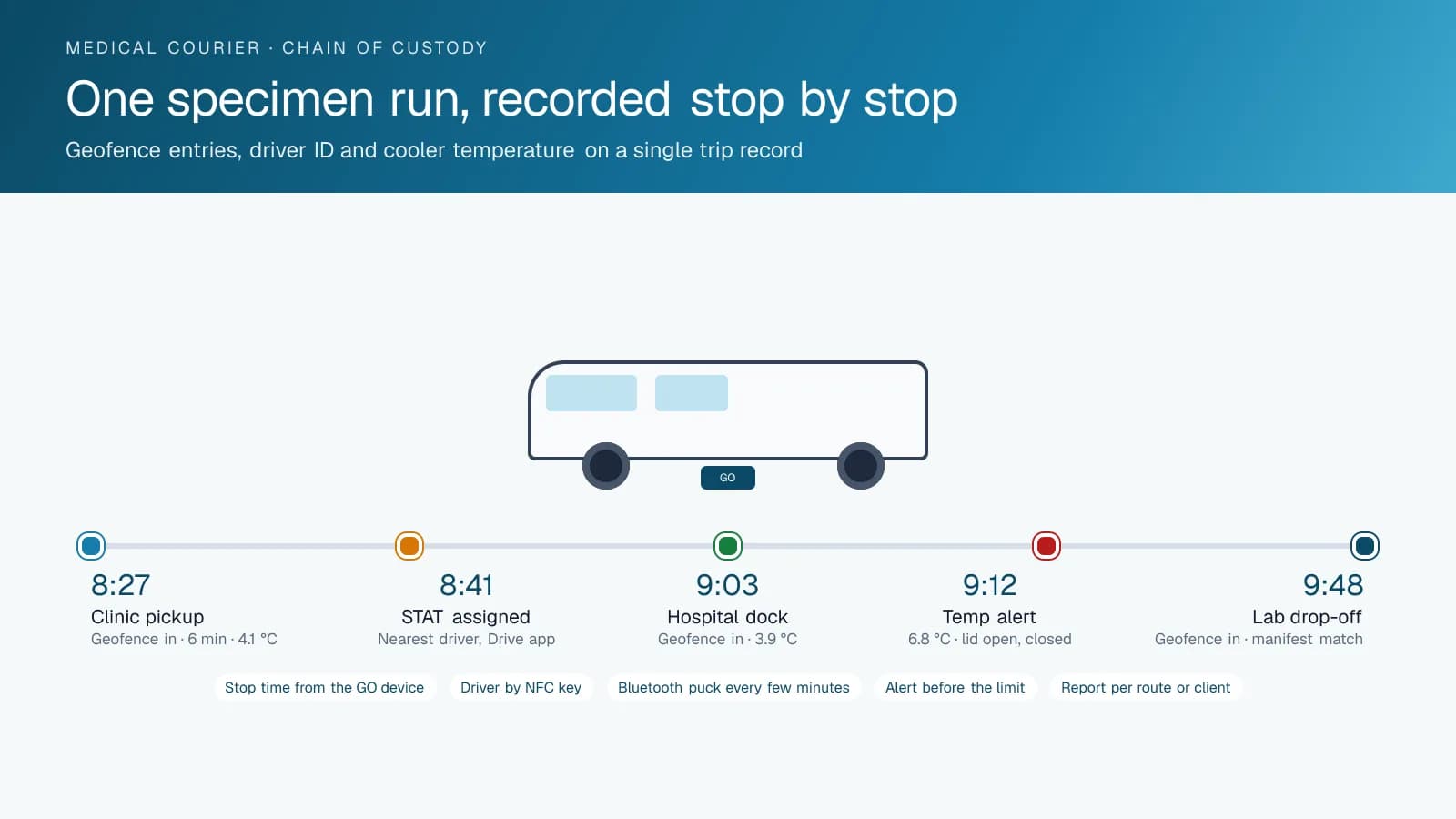
The GPS tracking device records each stop on its own: the vehicle arrived at 10:14, stayed six minutes and left. A geofence around each clinic names the stop, and the driver's NFC key ties it to a person, which covers what a chain-of-custody record needs at every hand-off: who had the specimen, where and when. Without it, a courier route with sixty pickups means sixty entries a driver is expected to write while standing at a reception desk. The lab's own manifest lists which specimens were collected at each clinic, and the two records line up on the time.
When a result is challenged, the courier's report shows the pickup time, the route to the lab, the drop time at the dock and the temperature in between. High Point GPS sets up the report so it can be pulled per route, per client or per day, and exported in a form the lab's quality team accepts. The same records show a clinic that a courier was at their door on the day they say nobody came. They also show the courier company which of its own drivers skipped a scheduled pickup on a route that looked complete on paper.
Temperature monitored through the whole trip
Refrigerated specimens and medications have a range they must stay in, and a reading taken at pickup and another at drop-off says nothing about the two hours between. A Bluetooth temperature puck in each cooler or tote reports to the GPS tracking device every few minutes, and the reading is stored with the vehicle's position and the time. A cooler left in the sun at a clinic, a lid that was not closed, a failing ice pack on a summer afternoon: each shows up as a curve on the trip, and an alert reaches the driver and dispatch when the reading moves toward the limit.
The log is what the lab or the pharmacy asks for when a shipment is questioned. It shows the temperature over the whole trip, not two points, and it is tied to the stops the specimen passed through. Pucks are small, battery-powered and move with the cooler, so a company that swaps totes between vans keeps a continuous record for each tote. High Point GPS pairs the pucks, sets the thresholds by product and builds the excursion report, and the same setup covers a wired sensor in a refrigerated van for companies that run one.
STAT runs to the closest driver
A STAT request arrives with a clock already running. The dispatcher who has to call three drivers to find out where they are has lost ten minutes before the first one moves. With every vehicle on the map, dispatch sees who is closest, who is between stops and who is loaded with something that cannot wait, and sends the job to the right driver's driver app with the address and the instructions. The driver accepts, the ETA shows on the dispatch screen, and the hospital's receiving desk can be told a time that will hold.
The hospital geofence records the arrival. That entry is the on-time proof the courier company puts in front of the client at contract review, and it is the record that ends a dispute about a late delivery. On routes that cross a hospital campus with several docks, a geofence per dock shows which one the driver used and how long the van waited there, which is what detention billing needs. A courier company that bills waiting time from those records rather than from the driver's estimate finds the invoices go through with fewer questions from the hospital's accounts payable.
Routes, drivers and the monthly report
Fixed medical routes drift. Clinics change hours, a lab moves its cut-off, a new site is added at the end of a route that was already tight. Trip replay shows where each route actually runs long: the stop that takes twenty minutes because the courier waits at reception, the detour a driver takes to avoid a bridge at rush hour. Dispatch rebalances with data instead of complaints, and a driver whose route runs light picks up the overflow. When a lab moves its afternoon cut-off, the replay from the previous month shows which routes can absorb the change and which will need a second van.
Driver scoring keeps the fleet's insurance and its reputation intact: speeding on a STAT run is still speeding, and dash cams with event-based clips settle the collision question before the other party's story does. Maintenance reminders on engine hours and mileage, and fault codes sent to the shop as they appear, keep a van from failing on a route with specimens aboard. The monthly client report on stops served, on-time percentage and temperature compliance comes out of the High Point GPS platform on a schedule, and the open API feeds the same data into the courier's own dispatch or billing system.
Frequently asked questions
How does the system produce a chain-of-custody record?
It logs each stop automatically with its arrival time, duration and location, names it by the geofence around the clinic, lab or hospital, and ties it to the driver through an NFC key. The report per route or per client lines up with the lab's manifest on the time, with the temperature log attached.
Can it monitor the temperature inside coolers and totes?
Yes. Bluetooth temperature pucks placed in each cooler report to the GPS tracking device every few minutes, and the readings are stored with the position and the time. Alerts go to the driver and dispatch when a reading approaches the limit, and the full curve for the trip is available to the lab or pharmacy.
How does STAT dispatch work?
Dispatch sees every vehicle on the map, picks the closest available driver and sends the job to the driver app with the address and instructions. Once the driver accepts, the ETA appears on the dispatch screen, and the hospital geofence records the arrival time as proof for the client.
Can our clients get their own reports?
Yes. Reports on stops served, on-time rate and temperature compliance can be scheduled by email for each client, and the open API pulls the same data into your own dispatch or billing system. High Point GPS builds the report layout to match what your lab and hospital clients ask for.
Do the records survive when the van loses coverage?
Yes. When there is no coverage, in a hospital basement dock for example, the GPS tracking device stores trips, stops and sensor readings and uploads them once the signal returns. The chain-of-custody and temperature records are complete either way, and only the live map lags until the van reconnects.
Related solutions
Related guides
- Bluetooth Temperature Sensor Puck: A Ten-Year Wireless Thermometer for Reefers and Coolers →
- What Is Geofencing? How It Works in Fleet Tracking →
- IOX-NFCREADERA: Driver ID by NFC Tap, So Every Trip Has a Name on It →
- Route Optimization Software: What It Does and When It Pays →
- Detention Time in Trucking: What It Costs and How to Bill Detention Pay With GPS →
- What Is Dispatch Software? How It Works and Who Uses It →
Get a free quote
- Over 500 fleets
- Since 2013
- 4.9 on Google (19 reviews)
What are you looking for?
Prefer to talk?Call 1-800-613-6323[email protected]