
Industry
GPS Fleet Tracking for Tire Dealers & Mobile Tire Service
GPS tracking for tire dealers and mobile tire service trucks: nearest-truck dispatch, shared ETAs, and time on site and compressor hours for every call.
Updated September 22, 2026
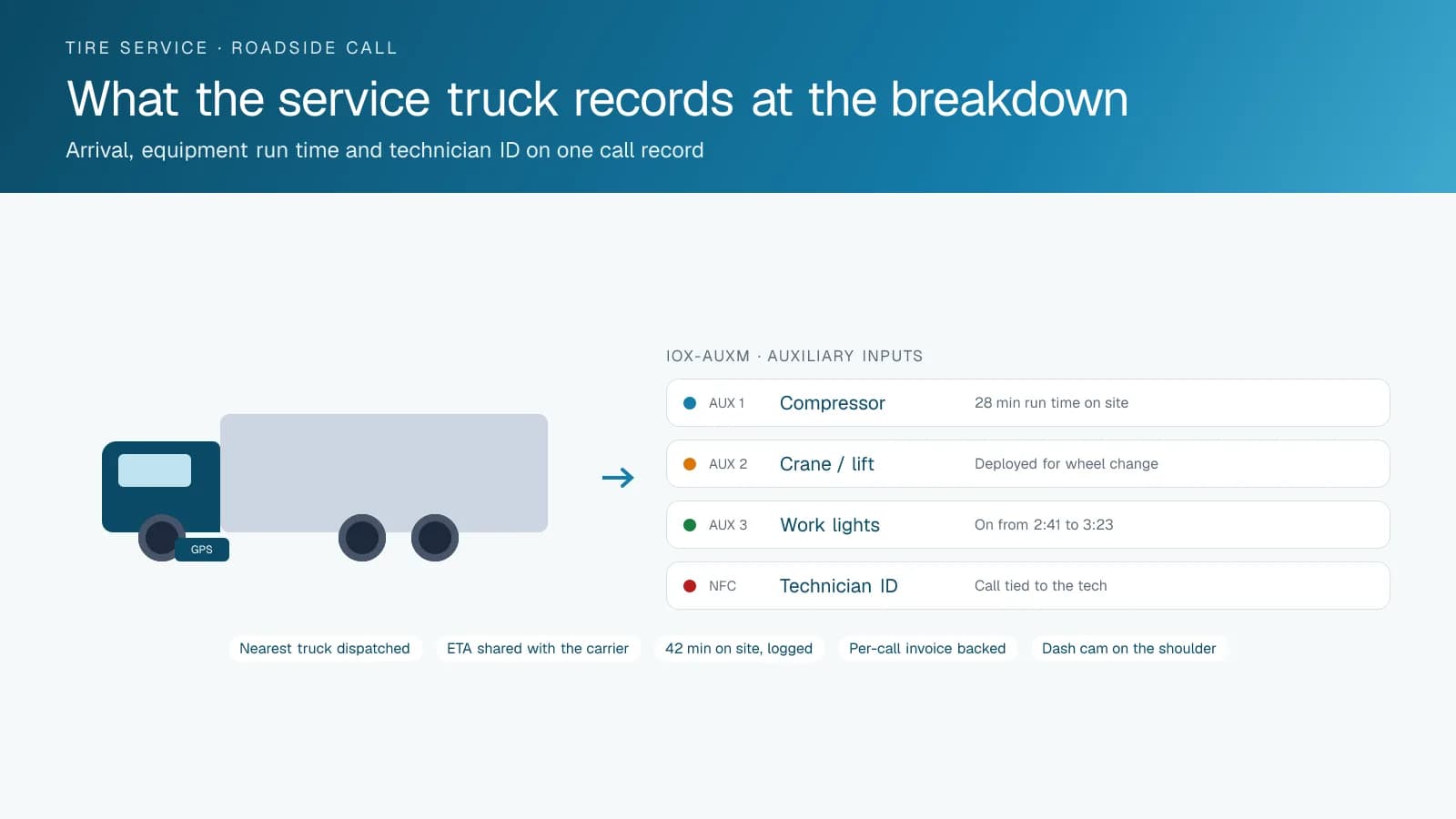
A commercial tire dealer's service trucks live on the phone. A carrier's dispatcher calls at 2:15 in the morning with a tractor on the shoulder of the highway, a flat outside dual and a load that has to be in Toronto by seven. The questions come in order: how fast can you get there, how long will it take, and what will it cost. GPS tracking for mobile tire service answers all three with records instead of estimates. Every service truck is on one live map with its current job. The night dispatcher sends the nearest available truck and quotes an ETA from real traffic and distance, then shares it with the carrier. The GPS tracking device in the truck logs the arrival at the breakdown location, and an IOX-AUXM module reads the truck's own circuits: the compressor running, the crane or lift deployed, the work lights on. Time on site and time under compressor become part of the call record, which is the basis for per-call billing that a fleet customer's accounts payable department cannot argue with. National account programs ask for response-time and completion records by call; the platform produces them without anyone transcribing a paper work order. Seasonal changeover weeks strain the whole operation, and the same data shows which trucks are overbooked and which could take more calls. Dash cams protect the technician working on the shoulder and the dealer when the story of a call is disputed. High Point GPS sets it up for the shop, the dispatch desk and the accounting office in one High Point GPS platform database.
Common challenges
- A 2 a.m. breakdown call with no way to know which truck is closest or when it can actually arrive
- ETAs quoted from memory and missed, with the carrier's dispatcher calling back every twenty minutes
- Per-call invoices disputed by fleet customers because the time on site and the work done rest on the technician's handwritten ticket
- National account service-level reports assembled from paper work orders days after the fact
- Changeover season when every truck is booked and nobody can see where the capacity really is
- Technicians working on the shoulder of a highway at night with no record of what happened if a passing vehicle hits the truck
How High Point GPS helps
- Live map of every service truck with its current call, letting dispatch send the nearest available unit to a stranded truck
- ETA calculated from the truck's real position and route, shared with the carrier's dispatcher as a link or a text
- Compressor, crane or lift and work-light circuits read through the IOX-AUXM module, logged with the time on site
- Call records that combine arrival, departure, compressor time and technician ID for per-call billing and dispute review
- Response-time and completion reporting by customer, ready for national account service-level reviews
- Utilization by truck and by day that shows where changeover-season capacity is tight and where it is idle
- AI dash cams facing the road and the cab that record the approach, the roadside stop and any near miss with passing traffic
- Engine-hours and mileage maintenance for trucks that idle for hours running compressors, with fault codes sent to the shop
The nearest truck and an ETA the carrier believes
The dispatcher's first job on a breakdown call is to pick the truck. With every service truck on one map, marked with its current call and its status, the choice is made by looking rather than by calling three technicians to ask where they are. The platform draws the route from the nearest available truck to the breakdown location and gives an ETA from current traffic. That is the number the dispatcher quotes to the carrier, and it is a number the dealer can stand behind. When the carrier's dispatcher wants an update, a shared link shows them the truck moving toward their driver, and the twenty-minute callbacks stop.
The roadside location itself goes into the record with the call. A stranded truck is rarely at an address; it is at a mile marker or a highway exit. The dispatcher drops the pin from the carrier's description or the driver's own phone location, the technician navigates to it and the arrival is logged the moment the service truck stops inside the zone. High Point GPS builds the dispatch view so a night dispatcher working alone can run twelve trucks across two provinces from one screen.
Time on site and compressor time that prove the invoice
A roadside call is billed by the call-out, the time on site and the work done, and a fleet customer's accounts payable clerk will question any of the three. The GPS tracking device records when the service truck arrived at the breakdown and when it left. An IOX-AUXM module wired to the compressor circuit, the crane or lift and the work lights records when each ran. The call record then shows forty-two minutes on site, twenty-eight of them with the compressor running and the crane deployed for the wheel change. The technician's ID from the NFC reader is on the same record. That is the invoice's supporting document, produced by the truck rather than written afterward.
Disputes then take minutes rather than a week of phone calls. The customer says the truck was only there for twenty minutes; the record shows the arrival and departure. The customer says the technician just plugged the tire; the compressor and crane times show a wheel came off. High Point GPS sets up the report so the billing clerk pulls the call record by invoice number, and the same report answers the customer's own fleet manager when they ask why the truck was down for two hours.
National accounts, service levels and the changeover peak
National account programs and large carrier contracts come with service-level commitments: a response time by region, a completion time by call type, and a monthly report proving both. Assembling that from paper work orders is a clerical job nobody has time for after a busy month. The platform already holds every call's dispatch time, arrival time and departure time by customer, and High Point GPS configures the report to match the format the account program asks for. The dealer sends it on the first of the month. When a call missed the target, the record shows why: the truck was on another call, the highway was closed, the location given was wrong.
Changeover season tests capacity twice a year. Every truck is booked, every technician is running long, and the question is whether to add a truck or move calls. Utilization reports by truck and by day show which units ran fourteen-hour days and which finished at four, and the time-on-site history by call type shows where the schedule is unrealistic. The dispatcher plans the next week's yard changeovers around real cycle times, and a rental truck is added for the two weeks that need it instead of a purchase for the year.
Protecting the technician on the shoulder
A tire technician working beside a highway at night is in one of the most exposed positions in the trade. A road-facing AI dash cam records the approach to the scene, how the service truck was positioned and every vehicle that passed too close. A driver-facing camera records the technician's own driving on the way to the call after a long shift. If a passing vehicle strikes the truck or the technician, the video and the position record are the evidence for the police report and the insurer. If the technician is accused of causing a hazard, the same video shows the lights, the cones and the truck's position on the shoulder.
The trucks themselves need care that the odometer does not capture. A service truck idles for hours running the compressor and the crane, and engine hours climb far faster than mileage. Maintenance reminders keyed to engine hours, with fault codes from the engine sent to the shop as they appear, keep a truck from failing on the way to a call. Electronic DVIR in the driver app records the technician's start-of-shift inspection of the truck, the crane and the tire-handling gear, with defects routed to the shop the same morning.
Frequently asked questions
Can we share the ETA with the carrier's dispatcher?
Yes. Once a truck is assigned to a call, the platform provides a link or a text message that shows the carrier where the service truck is and its estimated arrival, updated as it moves. The carrier's dispatcher stops calling for updates and can pass the ETA to their own driver.
How does it record compressor or crane time?
An IOX-AUXM module on the GPS tracking device is wired to the truck's own circuits, such as the compressor, the crane or lift and the work lights. Each one's on and off time is logged with the position, and the call record shows how long the equipment ran while the truck was at the breakdown.
Will it produce the reports our national account program asks for?
Yes. Dispatch, arrival and completion times are recorded for every call by customer. High Point GPS configures a monthly report in the format the program requires, showing response time and completion time against the targets, with the call-level detail behind each line.
Does it work in the middle of the night, outside cell coverage?
The GPS tracking device keeps recording trips, arrivals and auxiliary inputs when there is no cellular signal and uploads them when coverage returns, so a call on a remote stretch of highway is still fully logged. The dispatch map shows the last known position and the time it was received.
Can technicians see their own call records?
Yes. Each technician logs in with an NFC key or the driver app, so the calls, the time on site and the driving score are tied to them. They can review their own records, which makes the monthly billing reconciliation and any dispute conversation a shared set of facts rather than one person's word.
Related solutions
Related guides
- What Is an IOX Port and What Does It Do? →
- PTO On/Off Reader: Proving the Winch Ran, for Tow Billing and Hydraulic Maintenance →
- Dispatch Software for Towing Companies: Real-Time Routing and Driver Assignment →
- Fleet Dash Cams With Live View: What Live Streaming Shows and When It Is Actually Used →
- Fleet Maintenance: Engine Hours vs. the Calendar →
- How Geofencing Works for Fleet Tracking →
Get a free quote
What are you looking for?