
Industry
GPS Fleet Tracking for Moving & Storage
GPS tracking for moving and storage fleets that keeps customer arrival windows honest, records loading and delivery times for damage and delay claims, tracks trailers and containers between jobs, and handles ELD, hours of service and IFTA on the interstate side of the business.

Updated September 21, 2026
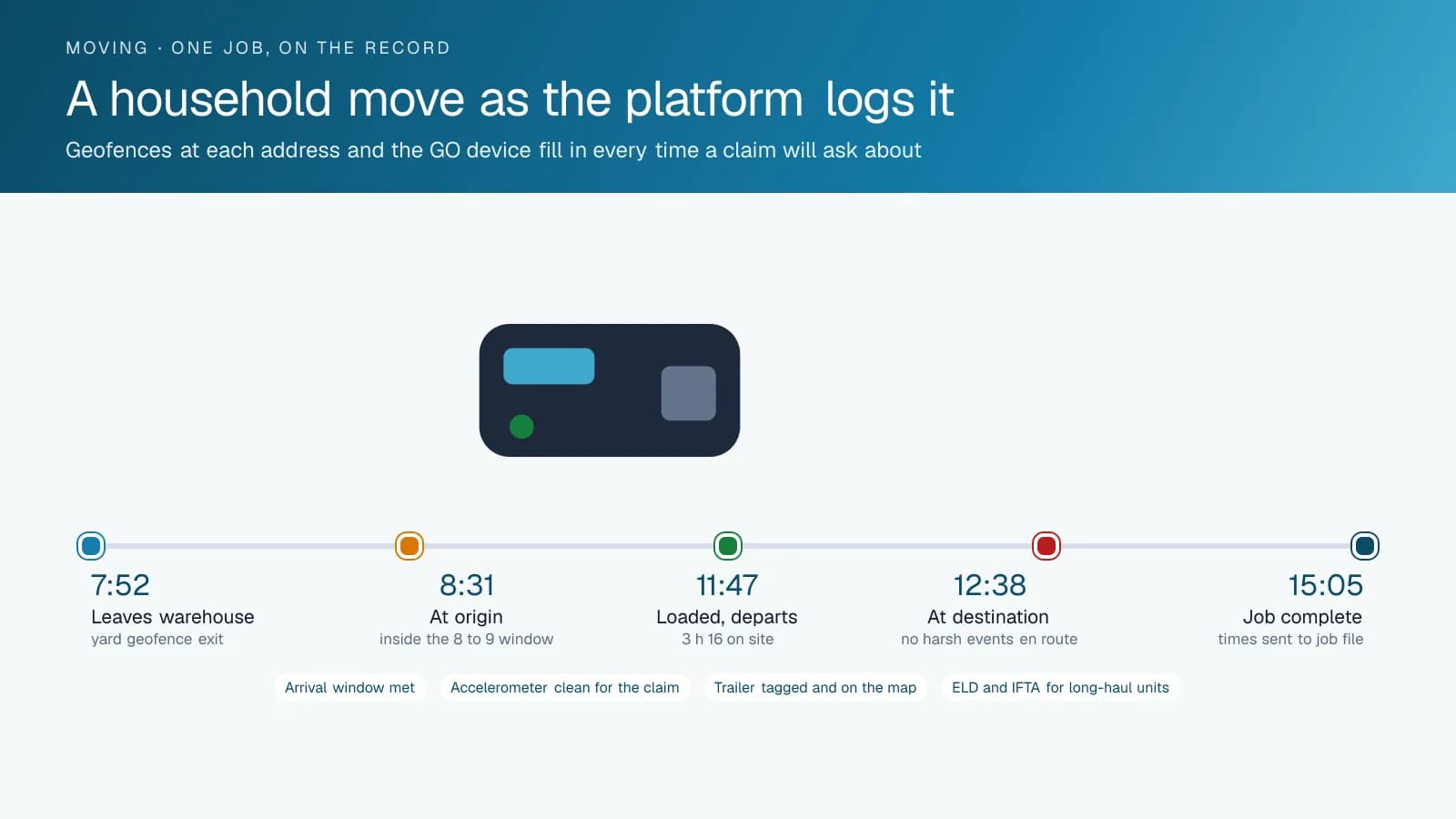
A moving company runs two fleets under one name: the local straight trucks that do three household moves a day, and the tractors and trailers that carry a long-distance shipment across a border or across the continent. Both are judged by the customer at the door. GPS tracking for moving and storage puts every truck, tractor, trailer and container on one live map, and the office can tell a customer when the crew will arrive rather than guessing from the last phone call. Every job carries a record: departure from the warehouse, arrival at origin, time on site, departure with the load, arrival at destination and time at the door. When a customer files a claim for a damaged dresser or a late delivery, that record shows how long the truck was at each address and how it was driven in between, with accelerometer data from the GO device and dash-cam video where the company has fitted it. On the long-distance side, the Geotab Drive app provides the ELD record for hours of service in the US and Canada, automated IFTA mileage by jurisdiction, and electronic DVIR inspections. Trailers and storage containers carry powered trackers or Bluetooth asset tags, which ends the search for the trailer left in a customer's yard. High Point GPS builds the MyGeotab database for the company's mix of local and long-haul work and connects it to the moving software the office already runs.
Common challenges
- Customers waiting at an empty house for a truck the office cannot locate any more precisely than "on the way"
- Damage and delay claims decided on the customer's account against the crew's, with no record of time on site or how the truck was driven
- Interstate tractors on paper logs or a separate ELD that does not share data with the local fleet's tracking
- IFTA mileage compiled from driver trip sheets every quarter, with the errors a jurisdiction audit will find
- Trailers and containers that go missing between jobs, left at a customer's property or a partner's yard
- Long-distance crews driving tired to hit a delivery window, with the company exposed if something happens
How High Point GPS helps
- Live position of every straight truck, tractor, trailer and container on one map, with the day's jobs and arrival windows beside them
- Per-job records built from geofences at origin and destination: arrival, time on site and departure at each address
- Accelerometer and trip data that show how the load was driven, with dash-cam video by event where the company has cameras fitted
- ELD hours of service in the Geotab Drive app for interstate and cross-border crews, with the roadside inspection view ready
- Automated IFTA mileage by jurisdiction from the GO device, matched to fuel-card purchases for the quarterly return
- Trailer tracking with powered trackers on the fleet's trailers and Bluetooth asset tags on containers, crates and pads
- Electronic DVIR inspections on trucks and trailers, with defects sent to the shop before the unit is loaded
- Job records and arrival times passed to the company's moving software through the open API
The Arrival Window and the Customer at the Door
A moving customer has taken the day off, the building has booked the elevator for two hours and the truck is somewhere between the last job and this one. With every truck on a live map, the office answers the call with a position and an estimate rather than a promise to call back. Geofences at the origin and destination addresses record arrival and departure for each job, so the dispatcher sees the previous job run long before the next customer notices. Arrival windows are set against real traffic and real drive times from the trip history, not against the crew's optimism.
The same records drive the day's dispatch. A crew that finishes a small move early is visible and can take an add-on job nearby; a crew stuck at a fourth-floor walk-up shows a longer time on site, and the office reschedules the afternoon before the phone starts ringing. High Point GPS connects those arrival and departure records to the company's moving software through the open API; the job file carries the times without anyone typing them. For a customer who wants to know where the truck is, the office can send a link or read the estimate from the map, and the estimate is drawn from the vehicle rather than from the crew's phone.
Claims: What Happened to the Dresser and Why the Truck Was Late
A damage claim on a household move comes down to two questions: how was the load handled, and how was it driven. The trip record answers the second. The GO device's accelerometer records hard braking, sharp cornering and impacts along the route, and a claim that the truck was driven roughly is confirmed or refuted by the data. A road-facing dash cam adds the video, retrieved by trip and by event, and a driver-facing camera covers the crew's conduct in the cab. Time on site at origin and destination shows whether the crew rushed the load or had the hours the estimate allowed.
Delay claims are simpler still. The record shows when the truck left the previous job, the route it took and when it arrived. When a customer claims the truck was three hours late, the office sees a two-hour delay at the previous customer's address and can show it. When the crew was late through their own choice of route, the office sees that too and settles the claim with the facts in hand rather than after a dispute. Time on site at each address, the crew on the job through driver ID and the route in between are the whole record, and the office has it the day the claim arrives.
Long-Distance Work: ELD, Hours of Service and IFTA
The interstate and cross-border side of a moving company falls under the ELD mandates in both the United States and Canada. The Geotab Drive app on a tablet in the cab provides the hours-of-service record with the ruleset the crew is operating under, and the roadside inspection view a driver hands to an officer. Dispatch sees remaining hours for every long-distance driver before assigning the next leg, and a crew that would have to drive tired to make a window is rescheduled rather than sent. Electronic DVIR inspections cover the tractor and the trailer with time-stamped defects that reach the shop.
IFTA mileage comes from the GO device rather than from trip sheets. Distance is recorded by jurisdiction as the tractor crosses each state or provincial line, and fuel-card integration matches purchases to the unit and the jurisdiction. The quarterly return is a report, and the record behind it survives an audit. For a company that runs a few tractors alongside a local fleet, that alone removes a day of work a quarter. Distance by jurisdiction also feeds any IRP apportioned registration the company holds, from the same trip data, with no second system to reconcile.
Trailers, Containers and the Yard
A moving company's trailers and storage containers spend their lives dropped at customers' properties, at partner agents' yards and at storage facilities. Powered trackers on the fleet's trailers report position on a schedule when unhitched and continuously when moving, so the trailer left at a customer's driveway for a week shows up on the map and on the dormant-asset report. Bluetooth asset tags on containers, crates and equipment report through any GO device that passes within range, which is how the office finds the container a partner agent swears was returned.
In the yard, the same tags and geofences show what came back and what did not. Utilization reports show which trailers sit idle and which are turned every day, which is the number that decides whether the company buys another one. High Point GPS sets up the trackers and tags to match how the company actually moves its equipment, and builds the reports the operations manager reads on Monday morning. When a trailer or container leaves a yard geofence after hours, the alert names it and the tag or tracker follows it, which is the difference between a theft report and a recovery.
Frequently asked questions
Can it help with damage and delay claims?
Yes. Each job carries geofence records of arrival, time on site and departure at each address, and the GO device's accelerometer records how the truck was driven in between. Dash-cam video by event adds the picture where the company has cameras fitted. The office settles claims with that record rather than with two conflicting accounts.
Do we need ELD on our long-distance trucks?
Interstate and cross-border tractors are covered by the ELD mandates in the United States and Canada. The Geotab Drive app provides the hours-of-service record and roadside inspection view, and High Point GPS configures the ruleset for the work. Local moves within a short radius may be exempt, and High Point GPS helps confirm which vehicles need it.
How does it track trailers and containers?
Powered trackers on the fleet's trailers report position when parked and continuously when moving. Bluetooth asset tags on containers, crates and pads report through any GO device within range. Both show on the same map as the trucks, with a dormant-asset report for anything that has not moved in a set number of days.
Does it produce IFTA reports?
Yes. The GO device records distance by jurisdiction as a tractor crosses each state or provincial line, and fuel-card integration matches purchases to the unit. The quarterly IFTA return comes from a report in MyGeotab, with the trip-level record behind it available for an audit.
Will it work with our moving software?
The open Geotab API carries vehicle position, arrival times and job records to the company's moving or dispatch software. High Point GPS builds the connection, or a custom add-in where the vendor has no existing integration, and the job file carries the times without manual entry.
Related solutions
Related guides
- What Is an ELD? A Plain-English Guide for Fleets →
- Geotab IFTA Reporting: How Automated Fuel Tax Reports Save Fleets Hours →
- Trailer GPS Tracking: How to Track Trailers With and Without a Truck Attached →
- Dash Cam Footage and Insurance Claims →
- Hours of Service Rules Explained: The 11 and 14 Hour Limits →
- GPS Asset Tags vs. Powered Trackers: Which to Use →
Get a free quote
What are you looking for?