
Industry
GPS Fleet Tracking for Nurseries & Greenhouse Growers
GPS fleet tracking for nurseries and greenhouse growers: every delivery truck in the spring rush, trailer temperature on the road and carts accounted for.
Updated September 21, 2026
A grower's year compresses into a few weeks of spring when every truck runs from before dawn and every garden centre wants its order on the day it was promised. A load of annuals that sat in a hot trailer or a cold one arrives as a credit note rather than a sale. High Point GPS puts every delivery truck on one live map in the High Point GPS platform with its stop list beside it, and a geofence at each customer records the arrival, the departure and the unloading time, which is where a day's schedule is won or lost. A Bluetooth temperature sensor in the trailer reports the air around the plants for the whole trip, with an alert the moment it leaves the range the grower sets. Back on the farm, the same platform follows what a nursery actually owns: tractors and loaders on engine hours, sprayers through their own circuits, and the rolling carts and racks that go out with every delivery and come back when the customer remembers. Driver ID assigns the seasonal drivers to their trucks, dash cams settle the parking-lot claims at the garden centre, and hours of service run in the driver app for the trucks that need ELD. When the season ends, the reports show what the fleet cost per delivery, which customers took the longest to unload, and which trucks earned their keep.
Common challenges
- Garden centres calling to ask where their order is on the busiest morning of the year
- Credit notes for plants damaged by heat or cold in a trailer, with no record of the temperature on the road
- Unloading that takes an hour at one customer and ten minutes at the next, with no data to plan the route around it
- Rolling carts and racks that leave with every delivery and come back weeks later, or not at all
- Seasonal drivers on unfamiliar trucks and routes, with no way to know who drove what
- Tractors, loaders and sprayers maintained on guesswork because nobody tracks their hours
How High Point GPS helps
- Live location of every delivery truck on one map, with the stop list and an ETA for each garden centre and landscaper
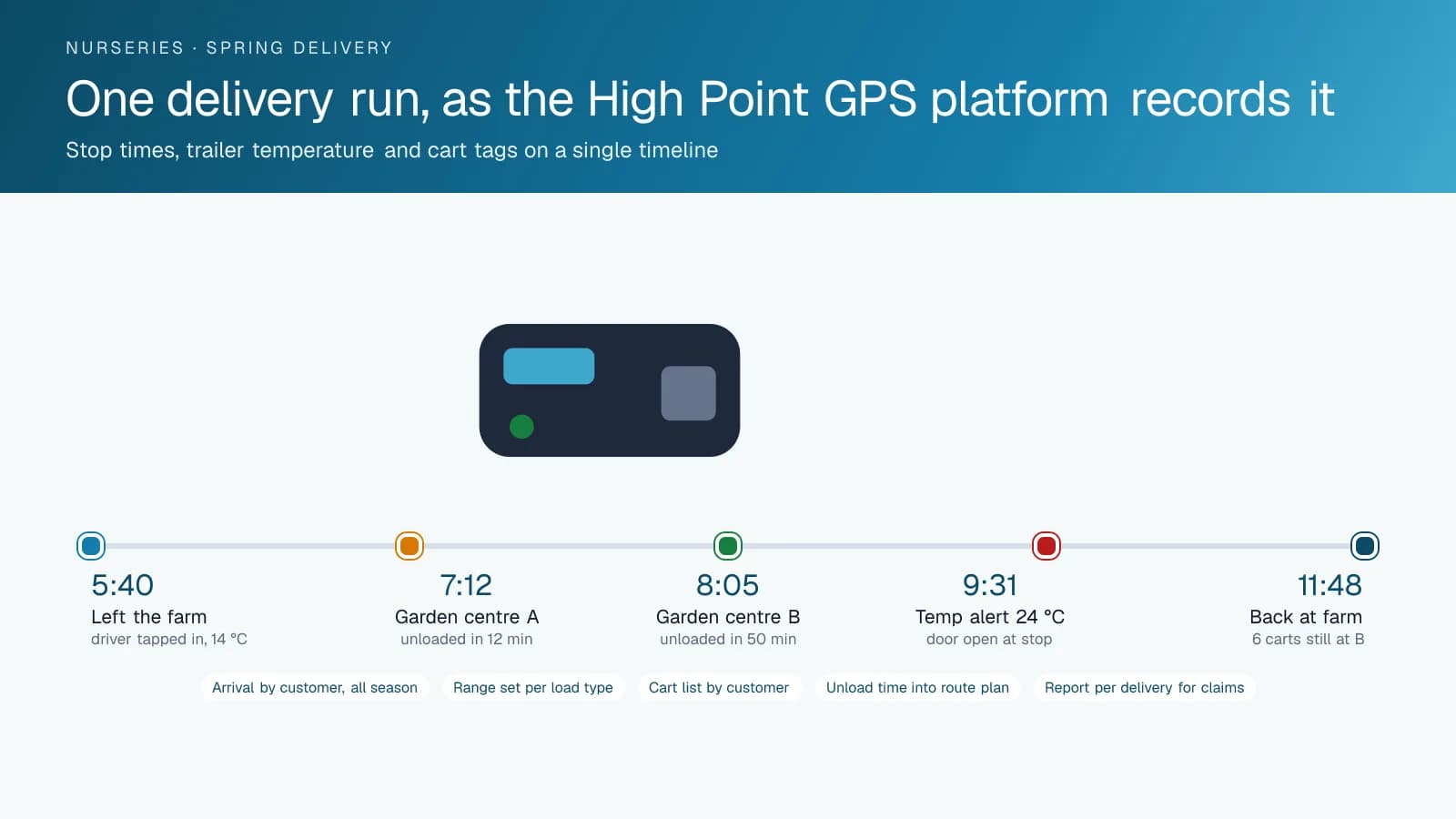
- Geofences at each customer that record arrival, departure and unloading time, feeding the next day's route plan
- Bluetooth temperature sensors in the trailer, with alerts when the air around the plants leaves the set range
- Bluetooth asset tags on rolling carts and racks, so the platform knows which customer still has them
- Engine-hours maintenance for tractors and loaders, with sprayer and PTO status read through IOX-AUXM inputs
- Driver ID with an IOX-NFCREADERA reader, so seasonal drivers are matched to their trucks and their trips
- AI dash cams for the garden-centre parking lot and the two-lane road between farms
- Hours of service and electronic DVIR in the driver app for the trucks that fall under ELD
The spring rush on one map
For six weeks a nursery runs a delivery company. Trucks leave before dawn, garden centres want their order before they open, and landscapers want theirs before the crew reaches the site. High Point GPS puts every truck on one live map in the High Point GPS platform with the day's stops beside it. When a garden centre calls at 7:40 to ask where its order is, the office sees the truck two stops away and gives a time. When a truck is running late, the dispatcher sees it before the customer does and moves the afternoon stops to another truck. The plan and the position sit on the same screen.
The geofence at each customer is what makes next year's plan better than this year's. Every delivery records the arrival time, the departure time and the minutes between. By the end of the season the office knows that one garden centre unloads in twelve minutes and another takes fifty because the receiving dock is shared. Those numbers go into the route plan. A customer who disputes a late delivery gets the arrival time from the trip record, and the conversation ends there.
Temperature between the greenhouse and the customer
Plants that left the greenhouse in good condition and arrived wilted or frost-bitten cost the grower a credit note and a customer's confidence. A Bluetooth temperature sensor in the trailer reports through the GPS tracking device on the same timeline as the trip, and the grower sets the range for the load: one for tender annuals in May, another for nursery stock in October. When the reading leaves the range, an alert goes to the dispatcher and the driver, whether the cause is a reefer that quit, a door left open at a stop or a trailer parked in the sun during lunch. The temperature history for the trip prints as one report.
That report is what settles a claim. A customer says the plants arrived heat-stressed; the record shows the trailer held 16 degrees from the farm to the dock, and the plants sat on the customer's lot for two hours before anyone moved them. Or it shows the reefer failed forty minutes out and the grower issues the credit without a fight. High Point GPS installs the sensors and adds the alerts to the dispatcher's rules.
Carts, racks and the equipment on the farm
Rolling carts and shipping racks are the nursery's most-lost asset. They go out with every delivery, they are supposed to come back on the next run, and a season later a quarter of them are behind a garden centre somewhere. A Bluetooth asset tag on each cart reports to the GPS tracking device of whichever truck is near it, so the platform records the cart leaving on a truck, arriving at a customer and staying there when the truck leaves. The report of carts by customer is the collection list, and a customer that has held forty carts for three weeks gets a call.
On the farm, tractors, loaders and sprayers run on engine hours rather than kilometres, and maintenance built on the calendar misses the machines that worked hardest. The GPS tracking device reads engine hours and fault codes on the equipment that has a diagnostic port, and a battery tracker or an IOX-AUXM reading of the PTO or sprayer pump circuit covers the rest. The maintenance reminder comes from hours worked, and a sprayer's pump hours by field are a record for the spray log as well as the shop.
Seasonal drivers, dash cams and the trucks that need ELD
The spring fleet is driven by whoever the nursery could hire in March, on trucks they had not seen before. An IOX-NFCREADERA reader assigns each trip to the driver who tapped in. The driver scoring High Point GPS sets up flags the habits worth a conversation in the first week rather than the last: hard braking with a loaded trailer, speed on the two-lane roads between farms, idling at the dock. AI dash cams record the road ahead and the cab, and a parking-lot claim from a garden centre is answered with the clip for that stop.
Trucks that fall under the ELD mandate run hours of service in the driver app, with the electronic DVIR before the shift in the same app. Trucks that are exempt still get the inspection, because the trailer lights and the load straps matter either way. When the season ends, the office runs the reports: cost per delivery, unloading time by customer, kilometres by truck and fuel by driver. The fleet decisions for next spring are made on those numbers.
Frequently asked questions
Can it monitor the temperature in the trailer?
Yes. A Bluetooth temperature sensor in the trailer reports through the GPS tracking device on the same timeline as the trip. The grower sets the range for each type of load, an alert goes out when a reading leaves it, and the temperature history for any delivery prints as a report for a claim or a customer.
How does it track rolling carts and racks?
A Bluetooth asset tag on each cart reports to the GPS tracking device of any truck nearby. The platform records the cart leaving on a truck, arriving at a customer and staying there when the truck leaves. A report of carts by customer shows who still has them and for how long.
Does it work on tractors and loaders?
Yes. Equipment with a diagnostic port reports engine hours and fault codes through a GPS tracking device, and maintenance reminders run on those hours. Equipment without a port gets a battery tracker for location and, where useful, an IOX-AUXM reading of the PTO or sprayer pump circuit.
Can we see how long each customer takes to unload?
Yes. A geofence at each customer records the arrival and departure of every delivery, and the report of unloading time by customer builds over the season. Those numbers go into the route plan and answer a customer who says a delivery was late.
What do seasonal drivers have to do?
Tap in with a driver card at the start of the shift and run the pre-trip inspection in the driver app. On trucks that need ELD, hours of service run in the same app. Location, stop times, temperature and cart tracking record without any input from the driver.
Related solutions
Related guides
- The Bluetooth Temperature Puck: A Ten-Year Wireless Thermometer for Reefers and Coolers →
- IOX-BT and Bluetooth Asset Tags: How They Work and What to Tag →
- How Geofencing Works for Fleet Tracking →
- Fleet Maintenance: Engine Hours vs. the Calendar →
- Delivery Fleet Management: How Last-Mile Companies Hit Delivery Windows →
- IOX-NFCREADERA: Driver ID by NFC Tap, So Every Trip Has a Name on It →
Get a free quote
What are you looking for?