
Industry
GPS Fleet Tracking for Pharmaceutical Distribution
GPS fleet tracking for pharmaceutical distributors: load temperature, driver identity and every stop time-stamped, for chain-of-custody evidence on demand.
Updated September 21, 2026
A pharmaceutical distributor delivers products whose value and regulatory weight sit far above anything the size of the box suggests. A cooler of vaccines, a tote of controlled substances and a pallet of biologics all leave the depot under the same expectation. The distributor must be able to show where the product was, how warm it got and who had it at every moment until a pharmacist or a hospital receiver signed. High Point GPS builds that record with the GPS tracking device in every van and truck, Bluetooth temperature pucks riding in the cooler or the reefer body, and driver ID at the ignition. The result is one trip record per route with the temperature curve laid over it, every stop time-stamped inside a geofence around the customer, and the driver's name attached from the first kilometre. When a hospital pharmacy rejects a shipment as out of range, the distributor pulls the curve for that route and settles the question in minutes. When a controlled-substance count comes up short, the stop record shows exactly where the vehicle was and for how long. Route-based dispatch, delivery windows, AI dash cams for incident review and engine-hours maintenance round out a platform that a regional distributor runs from one High Point GPS platform database and hands to quality assurance without a second system.
Common challenges
- Temperature excursions discovered only when the receiver rejects the shipment, with no record of when the load went out of range
- Chain-of-custody gaps between the depot and the pharmacy counter that a licence inspector or an auditor can point to
- Controlled-substance deliveries with no independent record of where the vehicle stopped and how long the door stayed open
- Drivers sharing vans across shifts, with no reliable way to say who was driving a specific route on a specific day
- Delivery-window commitments to hospitals and clinics missed without dispatch knowing until the customer calls
- Paper temperature logs that depend on a driver reading a dial at the right moment and writing it down
How High Point GPS helps
- Bluetooth temperature pucks in coolers and reefer bodies, reporting through the GPS tracking device with the trip and each stop
- Alerts when a compartment drifts toward the edge of its range, sent to dispatch before the product is compromised
- Driver ID at the ignition through an NFC reader, tying every trip and stop to a named, authorized driver
- Geofences around every pharmacy, clinic and hospital, recording the arrival, the departure and the dwell time at each
- A temperature and stop report per route that quality assurance can hand to an inspector or attach to a deviation file
- Unplanned-stop and after-hours-movement alerts for vehicles carrying controlled substances
- AI dash cams with road- and driver-facing views for incident and theft review, retrieved by trip and by event
- Engine fault codes and engine-hours maintenance reminders that send a refrigeration or charging fault to the shop early
A temperature record that travels with the product
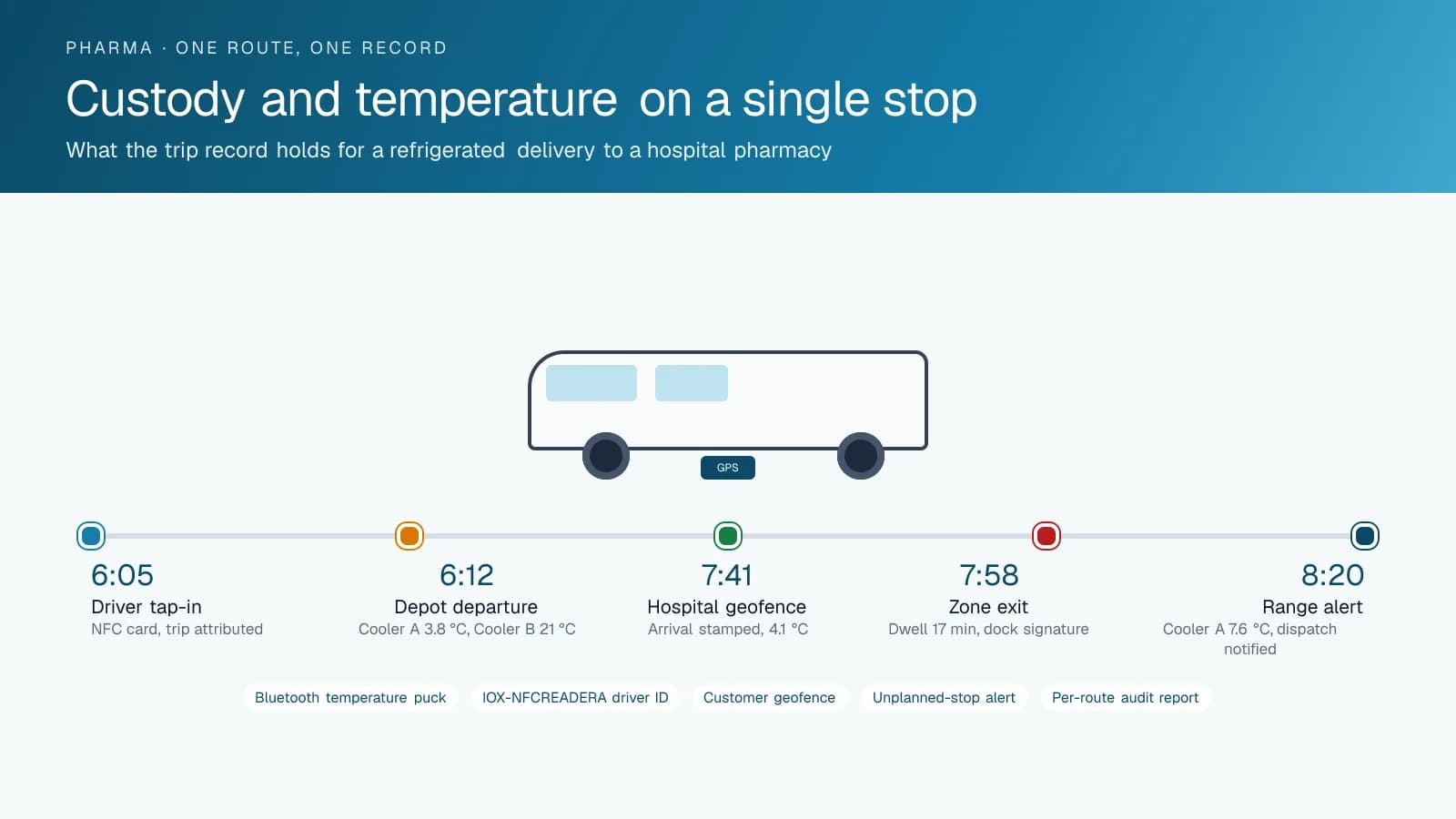
A paper log records what the driver saw at the moment they looked. A Bluetooth temperature puck records the compartment every few minutes whether anyone looks or not, and the GPS tracking device carries those readings into the trip record alongside the vehicle's position. High Point GPS places a puck in each cooler, tote or reefer zone that holds product with its own range; a van carrying refrigerated vaccines and ambient stock in the same run produces two separate curves. When a compartment drifts toward the edge of its range, dispatch receives the alert while the driver is still on the road and can decide whether to reroute, swap the cooler or return to the depot.
The value of the record shows on the day something goes wrong. A hospital pharmacy refuses a case of insulin because the receiver believes it arrived warm. The distributor opens the route in the High Point GPS platform, sees the curve holding at 4 degrees from the depot to the loading dock and the reading at the moment the vehicle entered the hospital geofence, and sends the report. The dispute closes on evidence rather than on who sounds more certain, and the same report is what a quality-assurance team attaches to a deviation file when the curve shows the product really did go out of range.
Chain of custody from the depot to the counter
Custody has three questions: who had the product, where it was and for how long. Driver ID answers the first. An IOX-NFCREADERA reader at the dash requires a card tap before the trip is attributed, and vehicles can be configured to alert dispatch when they move without an identified driver. Geofences around every customer answer the second and third. The record for each stop shows the time the vehicle entered the zone, the time it left and the minutes in between, which is the dwell that a pharmacist's signature should sit inside. A stop outside any customer zone appears as an unplanned stop with its own duration.
For controlled substances the same records become the distributor's defence. A count discrepancy at a clinic triggers a review, and the review starts with the trip: every stop, its duration, the driver's identity and any door-open reading from an auxiliary input wired to the cargo door. High Point GPS configures after-hours movement alerts and a geofence around the depot yard, and a vehicle leaving outside its shift is reported the minute it happens. Trips are stored on the device when cellular coverage drops and uploaded when it returns, and the record is never missing a segment.
Delivery windows and the dispatch board
Hospitals, long-term care homes and clinics receive on their own schedule, and a pharmacy that takes deliveries before opening wants the van there at 7 h 30, not at 9. Routes are planned in the dispatch tool with each customer's window, and the live map shows which vehicles are ahead of schedule and which are running late against it. A customer asking when the delivery will arrive gets an answer from the dispatcher's screen rather than a call to the driver. When a vehicle breaks down or a driver calls in sick, the remaining stops can be reassigned while the coolers still hold temperature.
The stop record feeds the customer relationship as well as the audit. A distributor can show a hospital procurement team the on-time rate for the last quarter, stop by stop, from the same geofence data that produces the custody report. High Point GPS sets up the reports so that a route supervisor sees late arrivals as they happen and an account manager sees the month in one view. A repeated late stop at the same customer usually points to a loading sequence or a traffic pattern that the route can be adjusted around.
Drivers, vehicles and the quality system
The vehicle itself is part of the cold chain. A refrigeration unit that stalls or a charging system that fails will take the product with it, and the GPS tracking device reports engine fault codes as they appear and drives maintenance reminders on engine hours and kilometres. An auxiliary input on the reefer unit shows whether it is running, so a stopped compressor is an alert rather than a warm surprise at the next stop. Electronic pre-trip inspections in the driver app include a check of the temperature equipment and reach the shop before the van leaves the yard.
Driver scoring is tuned to the load. Hard braking with fragile biologics aboard is weighted heavily, speeding in hospital zones is flagged through geofence speed limits, and idling at a loading dock is reported separately from idling on the road. AI dash cams add the view from the cab for incident review and for the rare theft attempt at a stop, with video retrieved by event rather than by scrubbing a day of footage. Everything lands in one High Point GPS platform database that quality assurance, dispatch and the shop use together. The open API carries the temperature and stop records into the distributor's own quality system when that is where the audit trail lives.
Frequently asked questions
How is the temperature recorded during a delivery?
A Bluetooth temperature puck rides in each cooler, tote or reefer zone and reports readings to the GPS tracking device every few minutes. The readings are stored with the trip, so every stop has the compartment temperature at arrival and departure. Alerts fire when a compartment drifts toward the edge of its range.
Can we prove who was driving a specific route?
Yes. An NFC reader on the dash attributes each trip to the driver who tapped in, and the platform can alert dispatch when a vehicle moves without an identified driver. The custody report for a route lists the driver, each stop and its dwell time, and the temperature readings for the whole run.
What does the record look like for a controlled-substance delivery?
Each stop shows the time the vehicle entered the customer's geofence, the time it left and the minutes between, with the driver's name. Any stop outside a customer zone appears as an unplanned stop with its duration. A cargo-door input adds door-open times, and after-hours movement alerts cover the vehicle in the yard.
Will the records satisfy a licence inspector or an auditor?
The platform produces a per-route report with the temperature curve, every stop and the driver's identity, which quality assurance can attach to a deviation file or hand to an inspector. High Point GPS does not certify compliance with a specific regulation, but the records are the evidence those reviews ask for.
Can the temperature data go into our quality management system?
Yes. The High Point GPS API exposes temperature readings, stop records and driver identity, and High Point GPS can build an integration or a custom add-in that pushes them into the distributor's quality or ERP system. Many distributors keep the High Point GPS platform as the operational view and export the audit trail on a schedule.
Related solutions
Related guides
- The Bluetooth Temperature Puck: A Ten-Year Wireless Thermometer for Reefers and Coolers →
- Wired Temperature Monitoring for Multi-Compartment Refrigerated Trucks →
- Cold Chain Compliance: What GPS Monitoring Does →
- IOX-NFCREADERA: Driver ID by NFC Tap, So Every Trip Has a Name on It →
- How Geofencing Works for Fleet Tracking →
- The High Point GPS API: What You Can Actually Build →
Get a free quote
What are you looking for?