
Industry
GPS Fleet Tracking for Property Management & Maintenance Fleets
GPS tracking for property management and building maintenance fleets that proves when a technician arrived for a work order, answers tenant complaints with a record, verifies snow and landscaping contractors through geofences at each property and accounts for after-hours callouts.

Updated September 21, 2026
A property management company runs technicians across dozens or hundreds of buildings, and every building has tenants who notice when nobody shows up. A work order says the plumber was on site Tuesday morning; the tenant says the leak was not looked at until Thursday. The snow contractor invoices for clearing eleven properties after the storm; the manager of two of them says the lot was never plowed. An after-hours callout is paid at premium rates and nobody can say how long the technician was actually there. GPS tracking from High Point GPS puts every service vehicle on one map and a geofence around every building in the portfolio, so that each visit becomes a record with an arrival time, a departure time and a duration, tied to the technician who was logged in. The work order in the maintenance system and the visit in MyGeotab line up on the time, and a tenant complaint is answered with the record rather than a phone call to the tech. Contractors who plow, mow or clean under contract can be tracked with a small device on their own equipment, on the property manager's terms, and the geofence at each property shows which ones they visited and for how long. Driver scoring, maintenance reminders and dash cams keep the vans and the people in them safe. High Point GPS installs and supports it for residential, commercial and condominium portfolios.
Common challenges
- Tenants and boards complaining that a technician never came, with only the work order's closing note to answer them
- Snow, landscaping and cleaning contractors invoicing for properties they may or may not have visited
- After-hours callouts billed at premium rates with no record of when the tech arrived or how long the visit took
- Technicians dispatched by phone to whoever is free, not to whoever is closest to the building
- Vans parked at home overnight with tools aboard, and no way to know when they move outside working hours
- Monthly reporting to owners and boards assembled from work orders, invoices and memory
How High Point GPS helps
- A geofence around every building in the portfolio, recording each service vehicle's arrival, departure and time on site
- Work-order arrival proof: the visit record matched to the ticket by time and technician, exportable for tenants, boards and owners
- Dispatch that shows the closest available technician to the building and sends the job to the Geotab Drive app
- Contractor oversight: snow, landscaping and cleaning vehicles tracked on the property manager's terms, with a visit log per property
- After-hours callout records with arrival time, duration and departure, for billing to the owner and paying the technician
- Unauthorized-use alerts when a van moves outside working hours, with tools and equipment tagged by Bluetooth inside
- Driver behaviour scoring and optional AI dash cams for a fleet that spends its day in residential streets and parking garages
- Maintenance reminders on engine hours and mileage, with fault codes reaching the fleet coordinator as they occur
Proof the Technician Was There
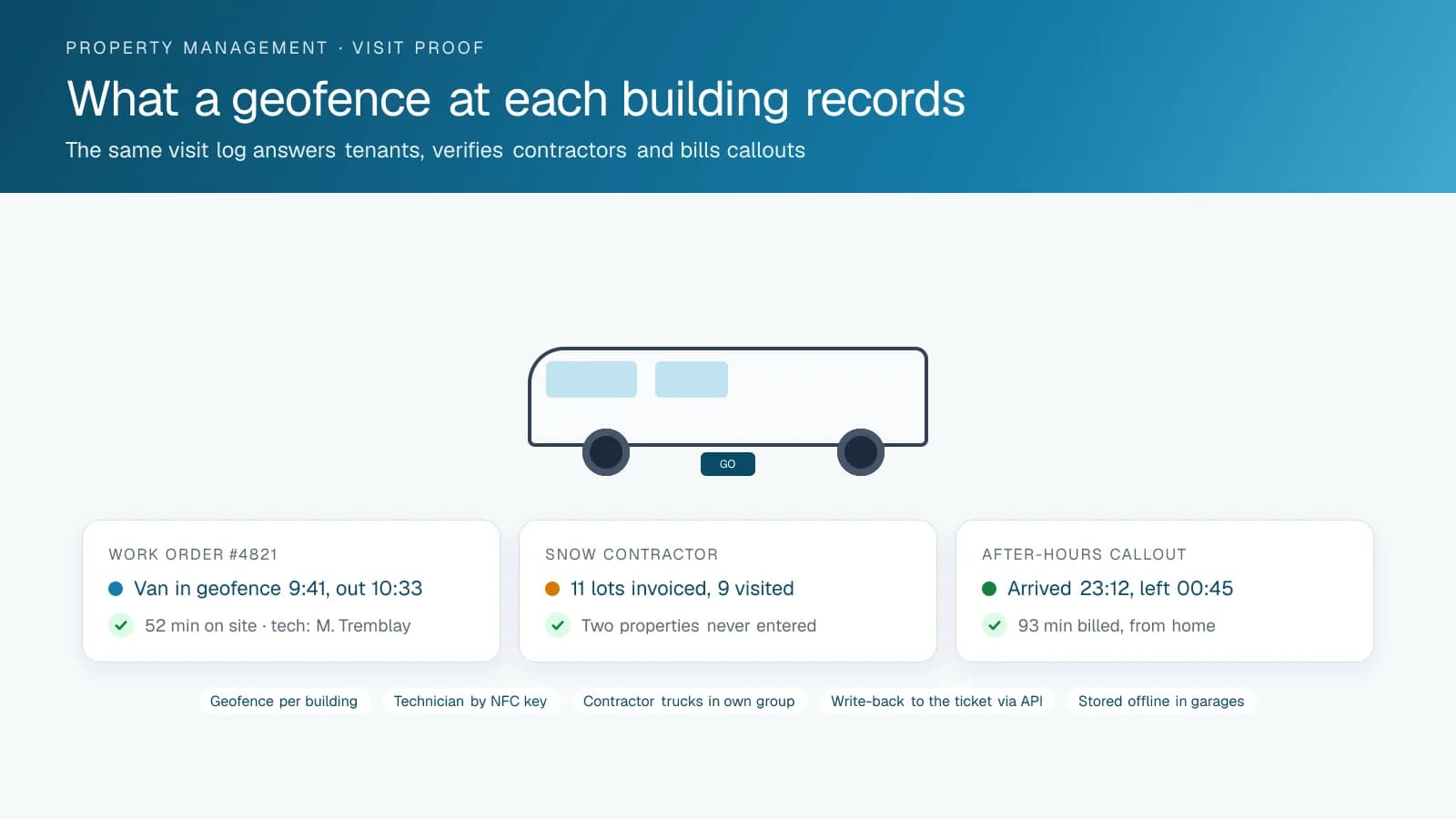
The complaint arrives the same way every time: the tenant says nobody came, the technician says they did, and the property manager is in the middle. With a geofence around each building, the visit is a record. The van entered the geofence at 9:41, stayed 52 minutes and left. The technician who was logged in through the NFC key or the Drive app is named on the record. The work order in the maintenance system carries the same time, and the manager forwards the record to the tenant or the board without calling anyone.
The same record settles the other direction: a work order marked complete in four minutes at a building where the van stayed forty prompts a different conversation with the technician. High Point GPS builds the geofences from the portfolio's property list, names them by building, and sets up the visit report so it can be pulled per property, per technician or per day. Where the maintenance system has an API, the visit record can be written back to the ticket automatically, and the closing note carries the arrival and departure times without the technician typing them.
Contractors Who Get Paid for the Properties They Visited
Snow removal is the clearest case. A storm ends at 3 a.m., the contract says every lot is cleared by 7, and the invoice lists all of them. A property manager who wants to check has to drive the portfolio. With a small GPS device on each of the contractor's trucks, provided under the contract, the geofence at each property records the visit and its duration, and the report at the end of the storm lists which properties were plowed, when and for how long. The two lots that were missed are visible before the tenant calls come in.
Landscaping, cleaning and pest control contractors are the same problem on a slower clock. Weekly mowing that becomes every ten days shows up in the visit log. A contractor who spends eight minutes at a property that is invoiced for an hour shows up too. High Point GPS sets up the contractor's vehicles in a group the property manager sees and the contractor manages, so the contractor's own dispatch is not affected and the property manager's report is complete. Contractors who agree to it tend to be the ones whose invoices were already honest, and the ones who refuse have told the property manager something too.
After-Hours Callouts and the Van That Went Home
An after-hours callout is expensive on both ends: the owner is billed at a premium and the technician is paid one. Both rest on the time the technician was on site. The geofence record gives it: the van arrived at the building at 23:12, left at 00:45, and the callout is billed and paid on 93 minutes rather than a round number. The trip before and after shows whether the technician came from home or from another call, which matters when travel time is paid. Over a year, the difference between rounded callouts and recorded ones is usually large enough to notice on both the owner's statement and the payroll summary.
The vans go home at night with tools and parts aboard. An alert when a van moves outside working hours tells the coordinator before the loss is discovered in the morning, and Bluetooth asset tags on the expensive tools show whether they left with the van or stayed on a job site. Trips are stored on the device in an underground garage and uploaded when the van surfaces, so the record is complete even for buildings where the signal is poor. Vans that are supposed to return to the yard at night are checked against a yard geofence, and the ones that did not are listed each morning.
Dispatch, Driving and the Owner's Report
A portfolio spread across a metro area rewards dispatching by distance. With every technician on the map, the coordinator sends a no-heat call to the tech who is ten minutes away rather than the one who is next on the list and forty minutes out, and the job lands in the technician's Geotab Drive app with the unit number and the access instructions. Live ETAs let the office tell the tenant when to expect someone. Trip replay at the end of the week shows which technicians are covering ground efficiently and which are doubling back.
The fleet's driving happens in residential streets and parking garages, where collisions are low-speed and disputes are frequent. Driver scoring and dash cams with event clips keep the fleet's insurance record clean. Maintenance reminders on engine hours and mileage, with fault codes sent to the coordinator, keep vans on the road. The monthly report to owners and boards, with visits per property, response times and contractor compliance, comes out of MyGeotab on a schedule that High Point GPS sets up. A board that receives it every month before its meeting asks fewer questions at the meeting.
Frequently asked questions
How does it prove a technician arrived for a work order?
A geofence around each building records the service vehicle's arrival time, departure time and time on site, with the technician identified by NFC key or the Drive app. The record matches the work order by time and can be exported for a tenant, board or owner, or written back to the ticket through the API.
Can we track our snow and landscaping contractors?
Yes, with a small GPS device on each contractor vehicle under the terms of the contract. The geofence at each property records the visit and its duration, and the report lists which properties were serviced, when and for how long. The contractor manages its vehicles; the property manager sees the visits.
How are after-hours callouts documented?
The geofence record shows when the van arrived at the building and when it left, which gives the time on site for billing the owner and paying the technician. The trips before and after show where the technician came from, which matters when travel time is paid.
Will it work in underground garages and dense buildings?
The GO device stores trips and stops when there is no signal and uploads them when the vehicle surfaces. The geofence entry and exit are recorded from the stored data, and the visit record is complete even where coverage is poor.
Can it connect to our maintenance or work-order system?
Yes. Through the open API, visit records can be pulled into the maintenance system or written back to the ticket, and work orders can be sent to the Geotab Drive app as jobs. High Point GPS scopes the integration with your system's vendor.
Related solutions
Related guides
- How Geofencing Works for Fleet Tracking →
- HVAC and Plumbing Dispatch Software →
- GPS Fleet Tracking for Landscaping and Lawn Care: Crew Time, Equipment and Snow Season →
- Geotab IOX-BT and Bluetooth Asset Tags: How They Work and What to Tag →
- What Is Dispatch Software? How It Works and Why Fleets Use It →
- The Geotab API: What You Can Actually Build →
Get a free quote
What are you looking for?