
Industry
GPS Fleet Tracking for Public Sector
GPS tracking for public works and municipal fleets: plow and spreader records, public plow maps, salt data and tender-ready reporting in one platform.
Updated October 21, 2026
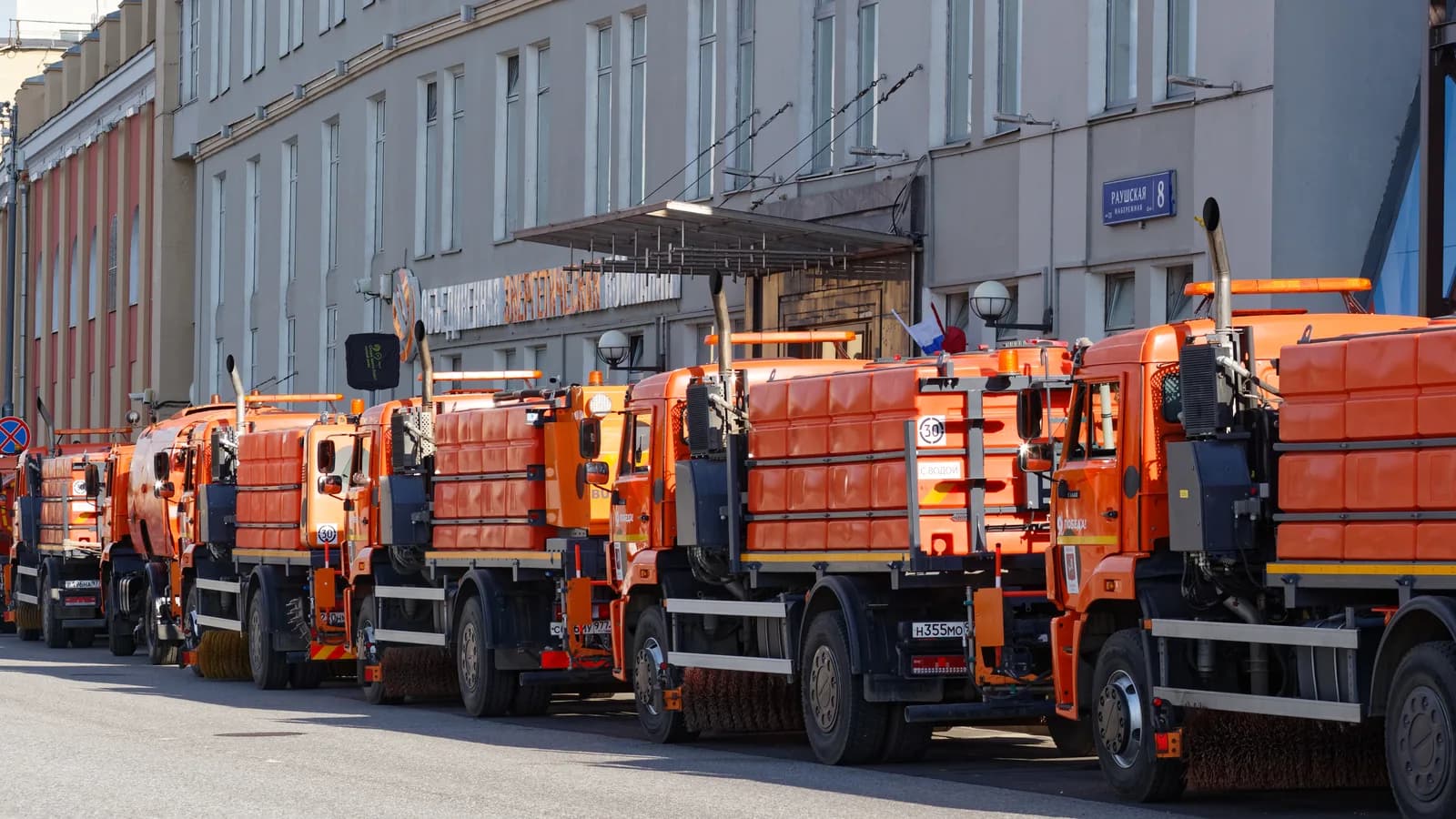
High Point GPS provides GPS fleet tracking for public works and municipal fleets: plows and spreaders, dump trucks, loaders, sweepers, parks pickups and inspection cars. It shows where every unit is, records where the plow was down and the spreader was on, and gives councils, auditors and residents answers backed by data. High Point GPS, a Geotab partner based in Montreal, installs the hardware, sets up each department, answers formal tenders and supports your staff in English and French.
Common challenges
- Residents and council members asking whether a street was plowed, with only an operator's memory to answer
- Salt bought by the thousands of tonnes and spread with no record of where it went
- Plows, loaders, trailers and bins spread across yards and departments, each tracked a different way or not at all
- Tender requirements that a consumer-grade tracker cannot meet
- Aging trucks maintained on mileage that understates how hard they work in winter
- Few internal IT staff to run a fleet software rollout across several departments
How High Point GPS helps
- Plow-down, wing and spreader-on status on the route map, street by street, through the GPS tracking device's auxiliary inputs
- A public plow map that shows residents which streets were serviced, without a login
- Spreader-on time and controller data per route for the salt budget and the salt management plan
- Trucks, loaders, trailers, roll-offs and tools on one map, from the GO10, GO Anywhere Plus, GO Anywhere and Bluetooth tags
- Electronic ronde de sécurité and DVIR in the DVIR app, with defects sent to the municipal shop
- Department groups and permissions, formal tender responses, and installation and support from our Montreal team
What should GPS tracking do for a public works fleet?
A public works fleet needs GPS tracking that proves service, street by street, and stands up when a council, an auditor or a resident asks about it. Location alone answers where a truck is. A municipality also has to show whether a plow blade was down on a given street, how much salt a route used, how many hours a loader worked and which department each vehicle belongs to.
The High Point GPS platform brings those records together for every department: winter operations, roads, parks, water, buildings and by-law. Each department sees its own vehicles, the fleet manager sees all of them, and finance gets the reports. Our Montreal team installs the hardware, configures the groups and trains the people who run the platform day to day.
How do plows and spreaders prove each street was serviced?
An IOX-AUXM module on the GPS tracking device reads the plow, wing and spreader circuits through the truck's own wiring, so every point on the route records whether the blade was down and the spreader was on. The storm map then draws plowed, treated and deadheading segments in separate colours, and the route report lists each street with the time it was serviced and the truck that did it.
That record answers the call the next morning, and it shows the operations manager a missed street before the council meeting. The same records support the defence when a slip-and-fall or collision claim arrives months later, because they show when the road was last plowed and treated. Our Snow Removal and Winter Maintenance page covers storm operations in more detail.
Can residents see a public plow map?
Yes. High Point GPS builds a public plow map on the platform's API: a read-only web page that shows the streets your plows have covered, coloured by the time since the last pass, with no login. The municipality chooses which vehicles and which details appear. Driver names, trip history and other vehicles stay inside the platform.
The page can stand on its own, sit behind a link, or be embedded in the municipality's website. To change which trucks appear, staff edit a group in the platform and the map follows. The same approach works for sweepers in the spring and for any other service residents call about.
Our guide to plow tracker maps shows how cities publish them and what residents see on a storm night.
How does tracking support salt management and the Road Salt Code?
The federal Code of Practice for the Environmental Management of Road Salts, published in 2004 under the Canadian Environmental Protection Act, 1999, is voluntary. It applies to road organizations that use more than 500 tonnes of road salts a year (as a five-year rolling average) and to organizations with vulnerable areas in their territory. It asks them to prepare a salt management plan, report to the Minister of the Environment each year by June 30, and keep the reported information for 7 years.
The yearly report covers, among other items, the total quantity of road salts used, the equipment calibration program and salt application practices. The Code's objective for application is to deliver the right amount of road salts in the right place at the right time. Spreader-on time per route from the auxiliary input, and application rates from spreader controllers that integrate with the platform, give a municipality route-level data for that report. The plan and the report remain the municipality's responsibility; tracking supplies the records.
Which spreader controllers report salt data to the platform?
Geotab documents more than 20 material spreaders whose controllers can send their data through the IOX-WRKS, a harness that connects to the expansion port of a GO device (Geotab lists it for the GO9 and newer models). The controller's data, such as the material type and the application rate, then reaches the Public Works Add-In in MyGeotab, along with road and air temperature where a sensor is connected. The IOX-WRKS also has four inputs for the belly plow, front plow, wing plow and tow plow or beacon, and an IOX-AUXM adds four more.
The table lists the controllers in Geotab's Public Works Controller Integrations document (March 2026). Each one needs a cable for its make and model, and some need a firmware version, a data-logging key or a gateway from the manufacturer, so High Point GPS checks the make, model and firmware of every controller on your list before ordering. Some controllers, especially basic models on smaller trucks, keep no data log; for those, an auxiliary input still records when the spreader is on and off.
The same document lists the road temperature sensors and mobile weather stations that connect the same way: DiCAN Guardian, Lufft MARWIS, Precise ARC WCM-02, RoadWatch and Vaisala MD30.
| Make | Models Geotab lists | Connection |
|---|---|---|
| ACE | Chlorobite, Ecobite II | RS232 serial |
| Aebi Schmidt | Stratos I (AL), Stratos II (CL), Stratos III (ES) | RS232 serial |
| Bosch Rexroth | CS 230, CS 440, CS 52X, CS 53X, CS 550, CS 660 | RS232 serial |
| Certified Cirus | SpreadSmart RX, Dual Spread, XDS; GL400 and ACS through the Cirus ATS Gateway | RS232 serial |
| Dakota Fluid Power | All models, programmed to Geotab's CAN bus specification | CAN bus |
| DICKEY-john | Control Point, Flex 4, Flex 4 Pro | RS232 serial |
| ECON | All models | RS232 serial |
| Epoke | Sirius, X1 and other data-logging models | RS232 serial |
| Force America | 5100 EX, SSC5100, SSC6100 | RS232 serial |
| Genesis | Genesis 1, Genesis 2, Genesis Pro | CAN bus (J1939) |
| Giletta | Ecosat | RS232 serial |
| Muncie | Advantage+, Omni, Omni+ | CAN bus |
| Parker | IQAN models | CAN bus |
| Rasco | EPOS 10 | RS232 serial |
| Scott Industrial | All models, programmed to Geotab's CAN bus specification | CAN bus |
Which tracker fits each municipal vehicle and asset?
A municipal fleet mixes road trucks, heavy equipment, trailers, bins and hand tools, and each one takes a different device. High Point GPS checks your fleet list before any hardware ships. The GO10 does not support the PWM and JPW protocols used on legacy pre-2010 heavy-duty and off-road equipment, so older plow trucks and machines get another device from the range.
Plow trucks, dump trucks, pickups and cars from about 2010 onward take the GO10 GPS tracking device with a harness, plus the IOX-AUXM module for plow and spreader inputs. Loaders, graders, generators and powered trailers take the GO Anywhere Plus, wired with a battery backup (see GPS Tracker for Equipment and GPS Tracker for Trailers). Roll-offs, dumpsters and unpowered trailers take the battery-only next-gen GO Anywhere, machines exposed to water, dust and pressure washing take the GO Rugged, sealed to IP68 and IP69K, and attachments, power tools and ladders carry Bluetooth tags read through IOX-Bluetooth.
Caterpillar, John Deere, Komatsu and Kubota machines with factory telematics can send their AEMP 2.0 (ISO 15143-3) data into the platform with no tracker to install. Everything appears on the same map, and engine hours, from the engine control unit or calculated from ignition and movement, drive maintenance schedules for equipment that works hard without adding much distance.
How do Canadian municipalities buy fleet tracking?
Most municipalities buy fleet tracking through a formal procurement process, because the vehicles and the budget belong to taxpayers. The thresholds and steps come from provincial law and each municipality's own procurement by-law. In Quebec, the public call for tenders threshold for municipal contracts is $139,000 for January 1, 2026 to December 31, 2027, according to Quebec's ministry of municipal affairs (Muni-Express bulletin, December 2025), and Quebec municipalities distribute their call for tenders documents through SEAO, the government's electronic tendering system.
High Point GPS answers municipal and government tenders and RFPs, with written answers on reporting, departmental permissions, installation and bilingual support that an evaluation committee can file. If your municipality buys through a purchasing group or an existing group contract, ask us and we will tell you what applies to your case.
Before the call for tenders goes out, our guide to writing an AVL RFP for snow plows gives a requirement template the procurement office can adapt, and the municipal fleet tracking buyer's guide lists what to compare between bids. For the salt side, our Road Salt Code annual report guide covers who files by June 30 and what the report contains.
Can several departments share one platform with a small team?
Yes. Role-based permissions in the High Point GPS platform let public works, parks, water and by-law each see and report on their own vehicles, while the fleet manager sees everything. No department needs its own administrator to keep that separation in place.
The person who runs the platform often does it as one job among several, so onboarding matters. High Point GPS sets up the groups, rules and reports, trains staff and drivers, and stays on as first-line support from Montreal in French and English. Inspections run in the DVIR app, so a defect found during the ronde de sécurité reaches the municipal shop the same day.
Frequently asked questions
Can GPS tracking show where a plow blade was down?
Yes. An IOX-AUXM module on the GPS tracking device reads the plow, wing and spreader circuits, so every point on the route records the blade and spreader status. The storm map shows plowed, treated and deadheading segments in separate colours, and the report lists each street with the time it was serviced and the truck that serviced it.
Can a municipality publish a public plow map for residents?
Yes. High Point GPS builds a read-only public plow map on the platform's API that shows which streets were serviced and how long ago, with no login. The municipality picks the vehicles and details shown, and driver names and trip history stay hidden. The page can stand alone or be embedded in the municipality's website.
Does the Road Salt Code apply to my municipality?
The federal Code of Practice for the Environmental Management of Road Salts is voluntary. It applies to road organizations that use more than 500 tonnes of road salts a year on a five-year rolling average, and to those with vulnerable areas in their territory. Organizations it covers prepare a salt management plan and report each year by June 30.
What is the public tender threshold for Quebec municipalities?
For January 1, 2026 to December 31, 2027, the public call for tenders threshold for Quebec municipal contracts is $139,000, according to Quebec's ministry of municipal affairs (Muni-Express bulletin, December 2025). Quebec municipalities distribute their call for tenders documents through SEAO. Your own procurement by-law sets the rules for contracts below that amount, so check it before you start.
Can we buy through a purchasing group instead of a full tender?
Ask us. Whether a purchasing group or an existing group contract covers fleet tracking depends on your province, your municipality's procurement by-law and the group itself. Tell us how your municipality buys, and High Point GPS will tell you what applies, or prepare a full written response if your procurement office runs its own tender.
Which tracker goes on loaders and other municipal equipment?
Most powered machines take the GO Anywhere Plus, which wires to 12 V or 24 V DC, keeps a backup battery and reports engine hours. Caterpillar, John Deere, Komatsu and Kubota machines with factory telematics can send their own data with no tracker. Unpowered roll-offs and trailers take the battery-only GO Anywhere, rated for up to 10 years.
Can each department see only its own vehicles?
Yes. Role-based permissions in the High Point GPS platform let each department and administrator see and report on their own vehicles, without access to other departments' data. Public works, parks and by-law can share one platform this way, the fleet manager still sees the whole fleet, and no department needs its own dedicated administrator.
Which spreader controllers work with the platform?
Geotab documents more than 20 material spreaders that report through the IOX-WRKS harness on a GO device, including Force America, DICKEY-john, Certified Cirus, Bosch Rexroth, Epoke, Muncie, Aebi Schmidt and Parker IQAN controllers. Each needs a cable for its make and model, and some need a firmware update or a gateway. Controllers with no data log record spreader on and off through an auxiliary input.
Sources
Related solutions
Related guides
- Road Salt Code Annual Report: Who Files by June 30, What Goes In and How Spreader Data Helps →
- Plow Tracker Maps: How Cities Show Residents Where the Snow Plows Have Been →
- How to Write an AVL RFP for Snow Plows, With a Requirement Template →
- Municipal Fleet Tracking: A Buyer's Guide for Cities, Counties and Public Works →
- Public Sector Fleet Tracking and Dispatch for Government Fleets →
- Public Tracking Portal: A Live Vehicle Map for Customers and Residents, No Login →
- IOX Meaning: What Is an IOX Port and What Does It Do? →
- Fleet Maintenance Schedule: Engine Hours vs Calendar and Mileage →
- How Does a Digital DVIR Work? Inspections, Defects and Repairs →
Get a free quote
- Over 500 fleets
- Since 2013
- 4.9 on Google (19 reviews)
What are you looking for?
Prefer to talk?Call 1-800-613-6323[email protected]