
Industry
GPS Fleet Tracking for Uniform & Linen Services
GPS fleet tracking for uniform and linen service routes: every RSR stop recorded to the minute, routes rebalanced on real data and proof behind invoices.

Updated September 21, 2026
A uniform and linen route is a promise made weekly to hundreds of customers, each expecting the same truck at roughly the same hour with clean goods and a pickup of the soiled ones. The route service representative is the company to that customer, and the branch manager sees the route only through the RSR's handheld until something goes wrong. GPS tracking for uniform and linen services puts every route truck on one live map with its stop list and its progress against the day, so the branch knows before the customer calls that the truck is running late on the west side. Geofences around each customer record the arrival and departure time and how long the stop took, which is the record behind an invoice dispute, a missed-stop credit and the route rebalancing conversation at quarter's end. Driver scoring for a step van that runs residential streets and loading docks all day, idling reports for a fleet that stops sixty times a shift, and electronic inspections and engine-hours maintenance keep the trucks on the road and the RSRs safe. Fuel-card integration and the open API connect the route data to the route accounting system the branch already uses. High Point GPS configures it for a single plant's routes or a regional laundry with a dozen branches.
Common challenges
- Customers calling the branch to ask where the truck is, with the RSR's handheld the only clue
- Missed-stop credits and invoice disputes with no independent record of when the truck was at the customer
- Routes that have grown unevenly for years, with one RSR finishing at two and another at six
- Sixty stops a day with the engine left running at most of them, and a fuel bill nobody can explain
- Step vans on residential streets and tight loading docks with backing incidents and complaints that rest on the RSR's word
- Trucks that miss the pre-trip inspection because the RSR is loading garments at five in the morning
How High Point GPS helps
- Live location of every route truck on one map, with the stop list, the stops completed and the ones still to go
- Geofences on every customer that record arrival, departure and time on site for each weekly stop
- Trip replay that shows the route, the stops and the speed for any truck on any day, for a customer dispute or a route review
- Stops per hour, time on site and kilometres between stops by route and by RSR, for rebalancing routes on real data
- Idling and fuel reports for a fleet that stops sixty times a shift, with fuel-card transactions matched to each truck
- Driver scoring set for step vans on residential streets: speed by zone, hard braking, backing events, seatbelt use
- Electronic DVIR in the driver app, with maintenance reminders on engine hours and fault codes sent to the shop
- Open API and add-on library integrations that connect stop records to route accounting and customer-facing ETAs
Every stop, every week, on the record
A linen customer notices a missed stop the moment the towels run out, and the call to the branch follows. With every truck on the live map and its stop list beside it, the branch manager sees which stops the RSR has made, which are left and where the truck is now. The call is answered with a time rather than a promise to find out. A branch that wants to go further sends an ETA to key accounts as the truck approaches, through the open API and the customer's own portal.
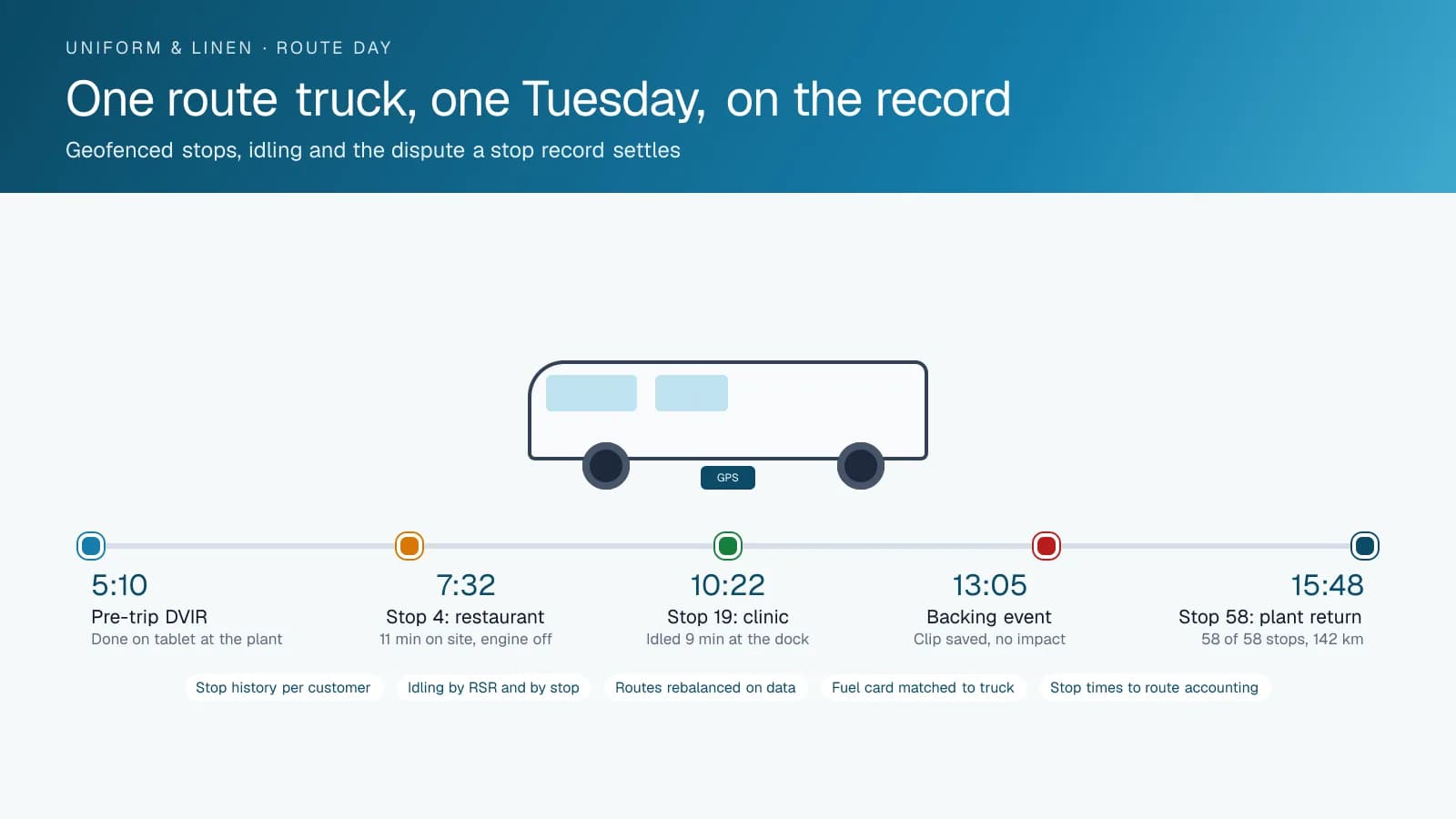
The record behind the map is what settles the invoice. A restaurant disputes a week of charges and says the truck never came; the geofence log shows the truck at the back door for eleven minutes on Tuesday at 10:22. A clinic says the pickup was late and the soiled linen sat over the weekend; the log shows the stop at 3:40 Friday. High Point GPS sets these reports up so an account manager can pull a customer's full stop history for the quarter in one report, which is also the report that backs a rate discussion.
Rebalancing routes on real data
Uniform routes grow one account at a time, and after a few years one RSR is done by two while another is still on the road at six. The platform reports stops per hour, time on site and kilometres between stops by route, by RSR and by day, from the trucks rather than from a handheld the RSR controls. The route manager sees which routes are heavy, which stops take twenty minutes when they should take five, and where two routes cross the same street on different days. That is the basis for a rebalance the RSRs will accept, because it comes from what the trucks did.
The same data shows the branch what a new account costs to serve before the contract is signed. A prospective stop on the far side of the territory adds kilometres and time that the report can show against the routes that pass nearby. A customer who keeps the RSR waiting at a locked dock is visible as time on site, and that is a conversation with the customer rather than a slower route. Routes that were built on guesswork get rebuilt on the record, and the next rebalance is a report rather than a project.
Sixty stops a day and the engine running at most of them
A route truck's fuel bill is not the miles; it is the stops. An RSR who leaves the engine running at each of sixty stops burns hours of fuel a week standing still, and nobody sees it in the odometer. The platform reports idling by truck, by RSR and by stop, and separates the idling at the plant during loading from the idling at the customer's door. A branch that shows the RSRs their idling number each week usually sees it fall without another word being said.
Fuel-card integration matches each purchase to a truck and a driver, and a purchase that does not line up with the truck's position is flagged for the branch manager. Maintenance reminders run on engine hours and mileage, which matters for a step van that runs hard hours on short distances, and engine fault codes reach the shop as the truck logs them. The electronic DVIR in the driver app takes the RSR through the pre-trip on the tablet at the plant, and a defect reaches the shop before the truck is loaded.
Step vans, loading docks and the RSR's safety
A step van on residential streets, in restaurant alleys and at hospital loading docks has the exposures of a delivery fleet without the delivery fleet's supervision. Driver scoring with speed limits by zone, hard braking and backing events gives the branch manager a short weekly list and a specific trip to coach from. AI dash cams add the view from the cab when the company wants it: a road-facing camera records the cyclist in the alley and the car that backed into the truck at the dock, and a driver-facing camera flags phone use, with clips saved by event.
The record protects the RSR as much as the company. A customer who says the driver hit the dock door meets a replay that shows the truck stopped for two minutes with no impact event, and a complaint about a speeding truck on a residential street meets the speed on every segment. When a collision does happen, the trip replay and the event clip are with the insurer before the other party's story is. Companies that share that footage with their insurer often find the renewal conversation changes.
Frequently asked questions
Can the branch see which stops the RSR has completed?
Yes. Every customer location is a geofence, and the platform records the arrival, departure and time on site for each stop as the truck makes it. The live map shows the stop list with completed and remaining stops, and the branch sees a late route before the customer calls.
How does it help with an invoice dispute?
The stop record for the customer shows every visit in the period, with the arrival and departure time to the minute. An account manager pulls the customer's stop history in one report and shows it to the customer, which resolves most disputes about missed or late service.
Can it connect to our route accounting system?
Yes. The open API and add-on library integrations let stop times, mileage and driver data flow to the route accounting or ERP system the branch already uses. High Point GPS scopes the integration during onboarding and builds a custom add-in when a standard connector is not enough.
Will it show us how to rebalance routes?
It gives you the data to do it. Stops per hour, time on site and kilometres between stops are reported by route, by RSR and by day from what the trucks actually did. The route manager sees which routes are heavy and where they overlap, and rebalances on the record.
What does the RSR have to do differently?
Run the pre-trip inspection in the driver app at the plant instead of on paper, and log in so the day's trips are attributed to them. Tracking, stop recording and idling reports work without any input from the RSR, and the handheld the RSR already carries for invoicing stays exactly as it is.
Related solutions
Get a free quote
What are you looking for?