
Industry
GPS Fleet Tracking for Veterinary & Mobile Animal Services
GPS fleet tracking for mobile veterinary and animal services: closest-vet dispatch, time on site for every farm call and vaccine temperature alerts.
Updated September 21, 2026
A mobile veterinary practice runs on a schedule that breaks by 10 am. A calving call comes in, the vet on farm rounds is 40 minutes away, and the office has no idea who is closest. GPS tracking from High Point GPS puts every practice vehicle on one live map, with the client it is at, how long it has been there and where it is due next. The dispatcher sends the closest vet rather than the one who answered the phone. The GPS tracking device records every stop, and geofences around regular clients' farms and clinics produce arrival and departure times that become the time-on-site line on the invoice. A Bluetooth temperature sensor in the vaccine fridge or the sample cooler reports temperature to the High Point GPS platform and alerts the vet when it drifts, which matters when a truck sits in a July farmyard. IOX-AUXM inputs record when the truck's power unit or hydraulic chute is running and when the rear compartment was opened. Driver ID separates the vet's trips from the technician's on a shared truck, and after-hours emergency calls are logged for the on-call billing. Animal control and pet transport fleets use the same records to prove a pickup was made, a transport stayed within temperature and a vehicle was inspected. Engine-hours maintenance keeps a truck that idles at every farm on schedule.
Common challenges
- A dispatcher who cannot tell which vet is closest when an emergency call comes in
- Time on site billed from memory at the end of the day, and disputed by the client a month later
- Vaccines and samples in a truck fridge with no record of temperature between the clinic and the farm
- After-hours and emergency calls that never make it onto the on-call invoice
- Practice trucks shared between vets and technicians with no record of who drove when
- Trucks that idle at every farm and miss an oil change because the schedule runs on mileage
How High Point GPS helps
- Every practice vehicle on one live map, with the client it is at and where it is due next
- Arrival and departure records from geofences around each client's farm, clinic or address, for time-on-site billing
- Bluetooth temperature sensors in the vaccine fridge and sample cooler, with alerts when temperature drifts
- Power unit, hydraulic chute and rear compartment status read from the truck's own circuits through IOX-AUXM inputs
- Driver ID through the IOX-NFCREADERA, separating the vet's trips from the technician's on a shared truck
- After-hours trip records that feed the on-call and emergency-fee billing
- Engine-hours maintenance reminders and fault codes for trucks that idle at every stop
- Dispatch that sends the closest vet or officer to the next call, with the route and ETA sent to the client
Sending the closest vet
The morning schedule is a plan and the afternoon is a series of exceptions. When a client calls about a horse that is down, the dispatcher needs to know which vet is closest, whether they are mid-procedure or driving between calls, and how long the run would take. With every vehicle on a live map and geofences around the client farms, the dispatcher sees each vet's position and how long they have been at their current call, sends the closest one and gives the client a real arrival time. The vet already on the road gets the address on their phone rather than over a hurried call.
Regular routes benefit as much as emergencies. Herd-health rounds, monthly clinic visits and a pet transport loop are planned by the dispatcher with the day's calls in order, and the trip record shows how the actual day compared. A vet who spends 25 minutes driving between two farms that sit next to each other is a routing problem, not a driving one. Over a season, the record shows which areas the practice spends its time in and where a second vehicle or a satellite clinic would pay off, and the decision is made on kilometres rather than on a feeling.
The time-on-site record
Large-animal work is billed by the visit and by the time, and the time is the argument. A geofence around each client's farm records the truck's arrival and departure to the minute, without the vet noting it. The invoice's time-on-site line comes from that record, and the practice manager reviews it against the call notes before billing. When a client questions a two-hour charge for a calving at 2 am, the record shows the truck inside the geofence from 1:52 to 4:05. High Point GPS sets up the client geofences from the practice's address book and adds new clients as they come.
After-hours calls have the same problem in reverse: the vet forgets to bill them. A trip that starts after the practice's closing time and ends at a client's geofence is a call that belongs on the on-call invoice, and the report lists them by week. Mileage between calls is recorded for the practices that bill it, and the fuel-card integration matches purchases to the truck's location. Animal control services under contract to a municipality use the same records to report pickups, responses and response times, and the contract renewal starts from a year of them.
Vaccines, samples and the truck in a hot farmyard
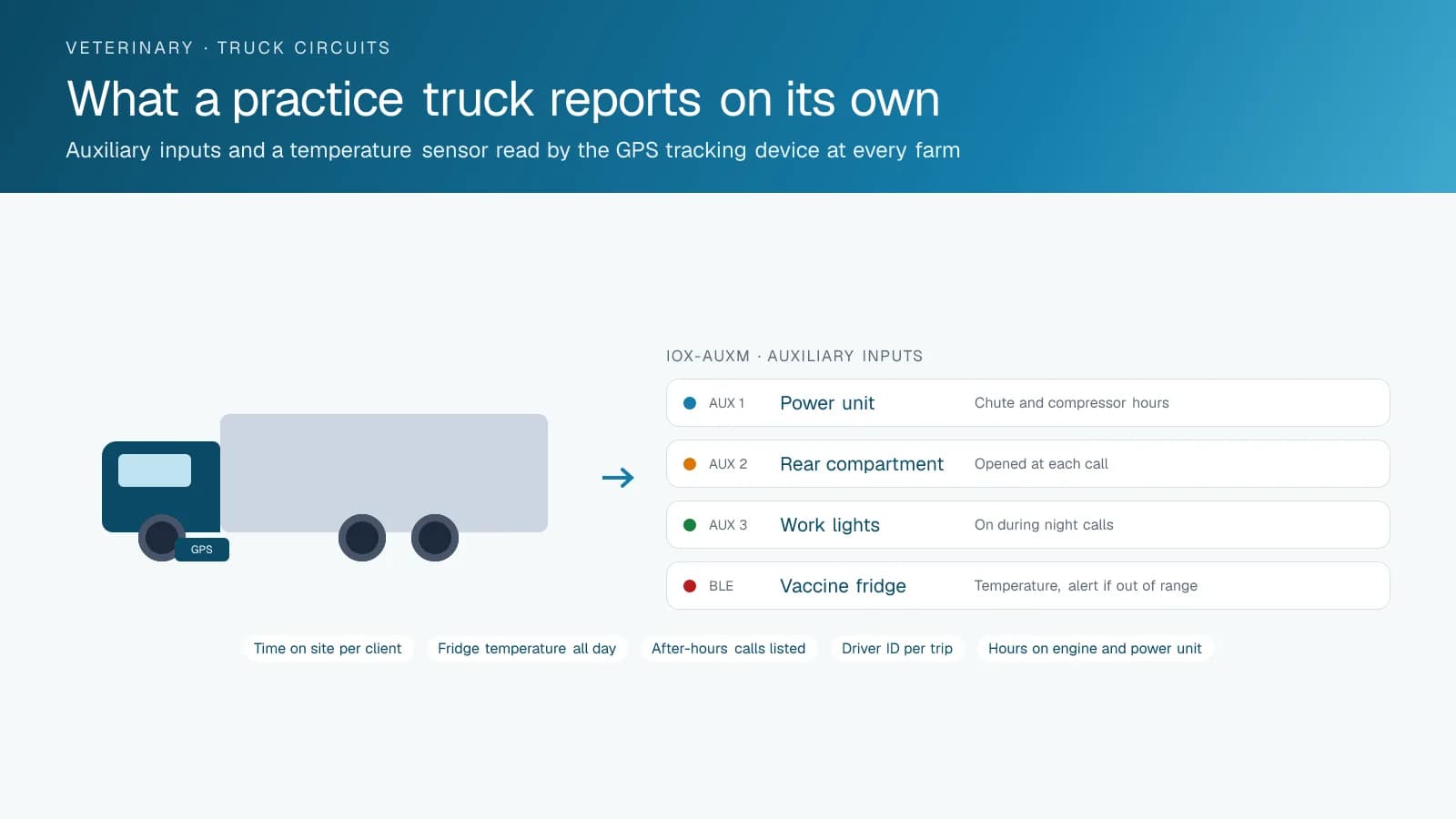
The vaccine fridge in a practice truck spends its day in the sun, and the samples in the cooler spend theirs waiting for the run back to the lab. A Bluetooth temperature sensor in each compartment reports to the GPS tracking device and from there to the High Point GPS platform, and an alert reaches the vet's phone when the temperature moves outside the range set for it. The record shows the temperature for the whole day, and a vaccine that was out of range is discarded on the evidence rather than on suspicion. For a practice that supplies vaccine to producers, the record is proof the product was handled correctly.
The truck's own equipment can be recorded too. An IOX-AUXM module reads the circuits for the power unit that runs the hydraulic chute or the compressor, the rear compartment door and the work lights. Engine hours and power-unit hours are counted separately, and the maintenance schedule runs on both rather than on a mileage figure that understates how hard a truck works when it idles at every farm. Fault codes reach the practice manager or the garage as the truck logs them, which is how a charging-system fault gets fixed before it strands a vet at a farm at night.
Shared trucks, driving and inspections
A practice truck is driven by the vet in the morning, the technician in the afternoon and the on-call vet at night. An IOX-NFCREADERA reader in the cab records who tapped in before each trip, and trips, driving scores and fuel purchases follow the person rather than the truck. Driver scoring flags speeding on rural roads and hard braking on gravel, with thresholds set for a truck carrying drugs, equipment and sometimes an animal. AI dash cams, where the practice chooses them, add the road-facing view when a collision with wildlife or a farm vehicle needs explaining to an insurer.
Electronic inspections in the driver app cover the truck and what it carries: the drug lockbox, the fridge, the chute, the tie-downs and the first-aid kit. A defect is sent to the practice manager with a photo before the truck leaves the clinic. Pet transport and animal control vehicles inspect the kennels, the ventilation and the restraints the same way, and the inspection record sits beside the trip and temperature records when a regulator or a client asks how an animal was transported. Everything a practice needs to answer that question is already in one database.
Frequently asked questions
Can it track the temperature of vaccines in the truck?
Yes. A Bluetooth temperature sensor placed in the vaccine fridge or the sample cooler reports to the GPS tracking device and to the High Point GPS platform. An alert reaches the vet's phone when the temperature moves outside the range you set, and the full day's readings are recorded. Practices use the record to discard product on evidence and to show clients it was handled correctly.
How is time on site recorded?
A geofence around each client's farm, clinic or address records the truck's arrival and departure to the minute. The practice manager reviews the times against the call notes before invoicing, and the record answers a client who disputes the charge. High Point GPS builds the geofences from your client list and adds new ones as they come.
Will it capture after-hours calls we forget to bill?
Yes. A report lists trips that start after closing time and end at a client's geofence, by week, with the time on site. The on-call vet's trips are attributed to them through driver ID, and mileage between calls is recorded as well. Practices commonly find calls on that list that never reached the invoice.
Our trucks are shared between vets and technicians. Does that matter?
It does not, as long as each person taps in. An NFC reader in the cab records who is driving before each trip, and trips, driving scores, fuel purchases and after-hours calls follow the person. A truck that moves without a tap generates an alert to the practice manager, and the record shows who had it when.
Does it work in rural areas with poor coverage?
The GPS tracking device records trips, stops, temperature readings and events on the device when coverage drops and uploads them when it returns. The live map shows the last known position until then, and the full record fills in afterwards. Temperature alerts are delivered as soon as the truck reconnects, with the readings from the gap included.
Related solutions
Related guides
- The Bluetooth Temperature Puck: A Ten-Year Wireless Thermometer for Reefers and Coolers →
- How Geofencing Works for Fleet Tracking →
- What Is an IOX Port and What Does It Do? →
- IOX-NFCREADERA: Driver ID by NFC Tap, So Every Trip Has a Name on It →
- Detention Time: What It Is, What It Costs, and How to Bill It With GPS Evidence →
- Fleet Maintenance: Engine Hours vs. the Calendar →
Get a free quote
What are you looking for?