
GPS Fleet Tracking & Telematics
What Is Fleet Management? A Starter Guide for New Fleet Managers
Fleet management keeps vehicles safe, legal, on schedule and on budget. A beginner's guide: five duties, five numbers for month one, what to set up first.

What Is Fleet Management, and What Is a Fleet Manager Responsible For?
Fleet management is the work of running a fleet's vehicles and drivers, and it comes down to five responsibilities, whatever the fleet: the vehicles are safe and legal to operate, they are where they need to be when they need to be there, they cost what they should, the drivers are safe, and the records will survive an audit or a claim. Each task you take on as a fleet manager, from scheduling an oil change or chasing a DVIR to reviewing a fuel report or buying a truck, belongs to one of those five. Keep them in view and you can decide what to do first when everything seems urgent.
What Does Fleet Management Cover Over a Vehicle's Life?
Fleet management follows each vehicle from the day you acquire it to the day it leaves the fleet. The stages are acquisition (choosing, buying or leasing, and specifying the vehicle), commissioning (upfit, registration, permits and installing the telematics device), the in-service years (fuel, maintenance, driver assignment, compliance and claims) and disposal, when the vehicle is sold, traded or returned at the end of a lease. Leasing hands part of the disposal work to the lessor, but the return conditions written into the lease, such as distance limits and wear standards, are still yours to manage.
Daily work happens in the in-service stage, but the decisions at both ends set what it costs. A vehicle specified for the wrong payload is overloaded or underused for its whole life, and a replacement decision made without the service history and utilization data is a guess. Keep the purchase record, the maintenance history and the telematics data on the same unit number from day one, and the keep-or-replace call becomes a comparison of numbers.
Which Regulations Does a New Fleet Manager Need to Know?
Start with where each vehicle is plated, where it travels and how heavy it is, because those three facts decide which rules apply. In the US, a company that runs a vehicle of 10,001 pounds or more (GVWR, GCWR or actual weight, whichever is greater) in interstate commerce must register with FMCSA and hold a USDOT number, and many states require one for intrastate carriers as well.
In Canada, commercial vehicle rules rest on the National Safety Code, a set of 16 standards that the provinces and territories adopt into their own law, and your NSC number comes from the province or territory where the vehicle is plated. Ontario adds the CVOR for trucks over 4,500 kilograms, and in Quebec, owners and operators of heavy vehicles register with the Commission des transports du Québec (CTQ).
Drivers who must keep logs need an electronic logging device in both countries: in the US since December 18, 2017, and in Canada, for federally regulated carriers, since June 12, 2021. Make a one-page list of the rules that apply to each vehicle group, with the renewal dates, and review it whenever you add a heavier vehicle or a new route across a border.
Which Five Numbers Should You Know in Month One?
If you can quote these for your fleet, you are off to a strong start. Telematics produces all of them.
| Number | Why it matters | Where it comes from |
|---|---|---|
| Cost per mile (or per km) per vehicle | The single figure that shows whether the fleet is healthy | Fuel, maintenance, depreciation, insurance over distance driven |
| Idle hours per vehicle per week | The fastest fuel saving available | Telematics idle report |
| Utilization: hours worked per vehicle per week | Whether the fleet is the right size | Telematics trip history |
| Open defects and overdue services | Safety and legal exposure, today | DVIR and maintenance rules |
| Harsh events per driver per 100 km | Where the next incident is coming from | Telematics driver scorecard |
What to Set Up First
Set things up in this order: inventory, compliance, telematics, maintenance, then the weekly review. Each step depends on the one before. The inventory tells you which compliance rules apply, compliance tells you what the device has to do, and the device produces the data that maintenance and the review run on. Fleets that start with a software purchase and work backwards spend the first quarter discovering what they should have listed on day one.
The third step does the most for you. A plug-in telematics device in every vehicle turns 'I think the vans idle a lot' into a number, 'the truck is probably due for service' into a date, and 'the driver says he was on site by eight' into a record. Once the fleet reports on itself, everything you're measured on as a fleet manager gets easier.
Mistakes That Cost New Fleet Managers the Most
The first is running maintenance on the calendar, so lightly used vehicles get serviced too often and heavily used ones too late. The second is treating compliance as paperwork instead of a system, and finding the gaps at roadside. Buying tracking and never opening the reports is a common failure, and one of the cheapest to fix. Ignoring utilization leaves the fleet carrying two vehicles it doesn't need without anyone noticing. Managing drivers by anecdote (the one who complains, the one who had the accident) misses what the scorecard shows about who needs coaching.
Where to Go From Here
Once the routine is in place, the job gets more interesting: which vehicles to replace and when, whether to add dash cameras, how to cut fuel further, and how to turn compliance data into a better insurance renewal. The guides linked from this one cover each of those. They all start from the same place, a fleet that reports on itself and a manager who reads the reports.
The First 90 Days, Week by Week
A schedule you can follow before you know anything else about the job. Each step produces something the next one needs.
| Weeks | Do | You end up with |
|---|---|---|
| 1 to 2 | List every vehicle with VIN, plate, GVWR, registered weight and driver; list every credential and its expiry | The inventory and the compliance calendar |
| 3 to 4 | Sort vehicles into regulatory classes: ELD, IFTA and IRP, CVOR, HVUT; fix what is expired | Vehicle groups and no surprises at roadside |
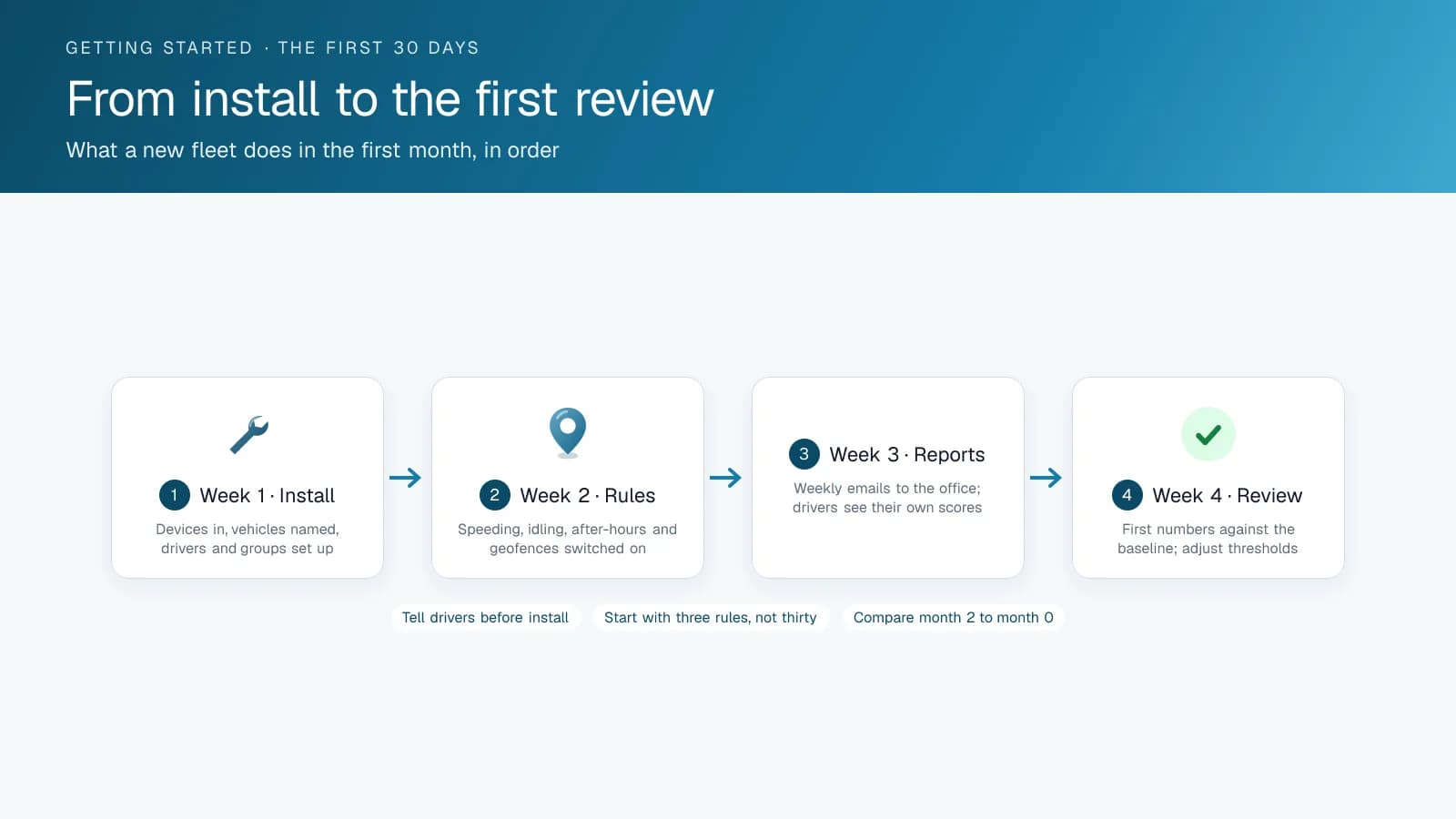
| 5 to 6 | Install telematics; name vehicles and set groups in the platform; turn on three rules | A fleet that reports on itself |
| 7 to 8 | Set maintenance intervals on real odometer and engine hours; open the first work orders | A maintenance schedule that matches use |
| 9 to 10 | Run the five numbers for the first time; share the driver scorecard with drivers | A baseline |
| 11 to 13 | Start the weekly review: exceptions, maintenance due, compliance calendar; fix one thing a week | A routine, and the first improvements against the baseline |
Frequently asked questions
What does a fleet manager do day to day?
A fleet manager keeps the vehicles safe and legal, gets them where they are needed, controls their cost, keeps drivers safe and keeps records that hold up. Day to day, that means maintenance scheduling, compliance, dispatch support, fuel and driver reviews, and purchasing, with most of the information coming from telematics reports.
What is the first thing a new fleet manager should do?
Build a complete inventory of vehicles and drivers, then confirm which compliance obligations apply to each vehicle class. Telematics, maintenance and the weekly review are all built on that list, so a gap in it turns up later as an obligation nobody knew about or a vehicle nobody could account for.
Do small fleets need fleet management software?
Yes, once there are more vehicles than one person can keep in their head; as a rule of thumb, that is often around five to ten. The map is the least of it. The value comes from maintenance on real engine hours, fuel decisions from real idle data, and compliance records that exist without anyone having to remember to make them.
What should a fleet manager review every week?
Review idling, speed and harsh events, fault codes, open DVIR defects and overdue services, and utilization by vehicle. Spend fifteen minutes with the reports open, on the same day each week, and fix one thing each time so the numbers improve against your baseline.
What regulations apply to a small fleet?
It depends on weight, plates and routes. In the US, a vehicle of 10,001 pounds or more in interstate commerce needs a USDOT number. In Canada, the provinces apply the National Safety Code and issue the NSC number; Ontario adds the CVOR above 4,500 kilograms. Drivers who keep logs need an electronic logging device in both countries.
What are the stages of a fleet vehicle's life?
A fleet vehicle goes through four stages: acquisition (choosing, buying or leasing), commissioning (upfit, registration and telematics installation), the in-service years (fuel, maintenance, drivers and compliance) and disposal (sale, trade-in or lease return). Keeping records on one unit number across all four makes the replacement decision a comparison of data.
Sources
Related solutions & products
Related terms
Continue reading
- GPS Fleet Tracking & Management Software overview →
- Fleet Management vs Fleet Tracking: What's the Difference? →
- What Is Fleet Maintenance Software? Preventive Service on Engine Hours and Fault Codes, Not a Calendar →
- Full-Service Fleet Leasing vs In-House Fleet Tracking: Which Fits Your Business? →
- Is There GPS Fleet Tracking With No Monthly Fee? →
- More in GPS Fleet Tracking & Telematics →
Get a free quote
What are you looking for?