
Video Safety & Dash Cams
How Much Does a Fleet Dash Cam Cost? What Drives the Price
Fleet dash cam cost depends on camera count, AI detection and how footage is stored. See what drives fleet camera pricing at each camera setup.
Why Camera Count Drives Fleet Dash Cam Cost
A fleet dash cam costs anything from the price of a single road-facing recorder to several times that per vehicle for a multi-camera system with AI detection, plus a monthly plan. Camera count drives the price more than anything else. A single road-facing camera is the base case. A driver-facing lens for in-cab accountability raises the cost of the device itself. A full 360-degree system, with side, rear and interior cameras on top of the base dash cam, is a much bigger jump, because you are buying more hardware, not a software upgrade.
So start by asking what coverage your fleet needs. A fleet whose liability exposure is limited to the road ahead doesn't need the same setup as a passenger transport or delivery fleet, where incidents can happen at the side or rear of the vehicle.
Do AI Features and Alerts Change the Software Cost?
Yes. AI detection of tailgating, lane departure and distracted driving, with real-time in-cab alerts, adds to the ongoing software cost, since it means processing and coaching infrastructure running all the time on top of video storage. A recording-only dash cam and one with AI event detection and automated coaching workflows are different products with different monthly costs, even when the hardware looks similar.
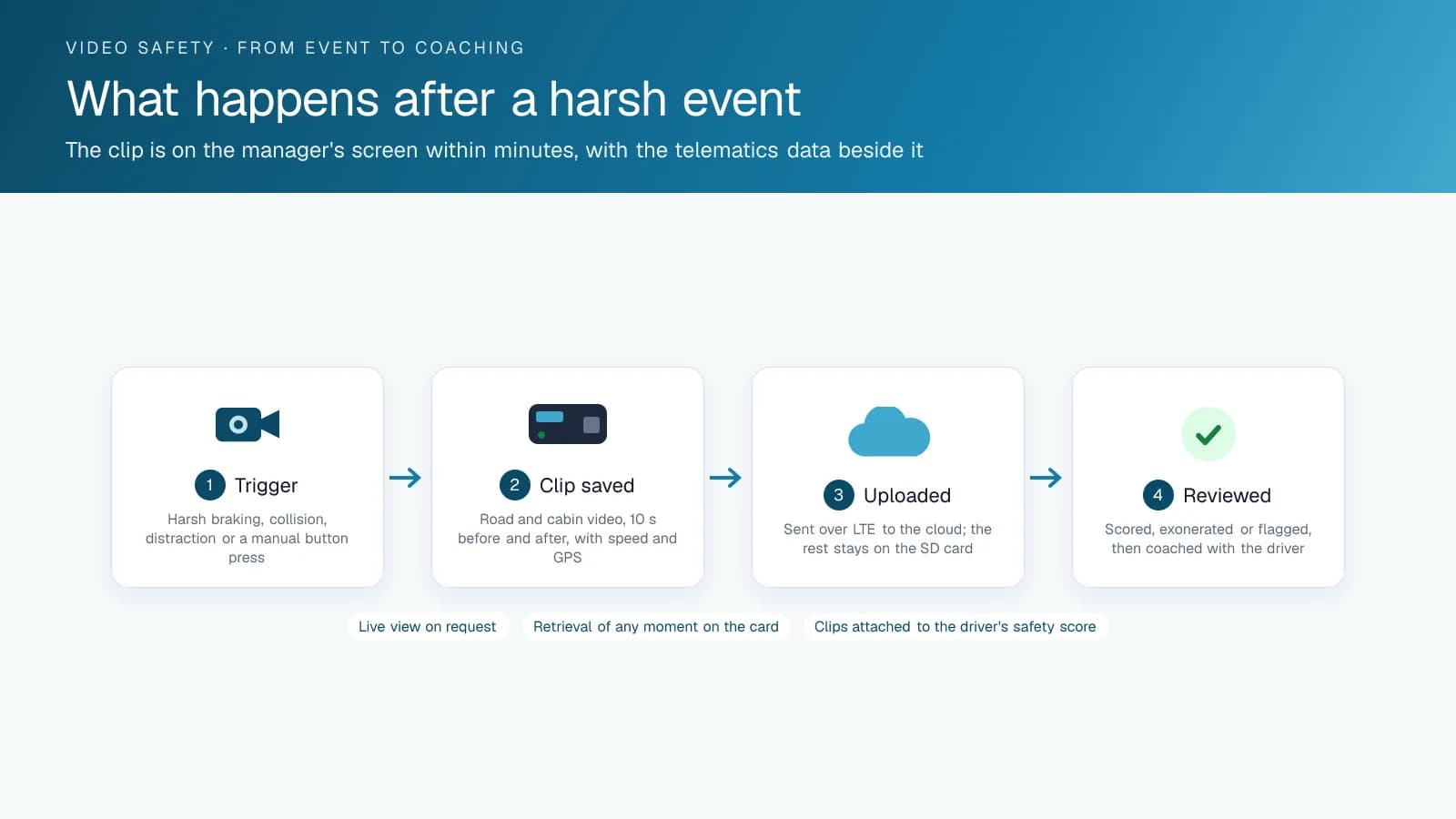
Storage and retrieval affect the price too. How long footage is kept, how fast you can pull up a specific clip, and whether flagged events upload on their own or someone has to fetch an SD card all change both how usable the system is and what it costs.
When Are the Higher Tiers Worth Paying For?
Weigh your fleet's liability exposure before you default to the cheapest single-camera option. AI alerts that catch risky driving in the moment, instead of only recording it for later review, tend to pay for themselves through fewer incidents and faster claims resolution. That offset is real, even if it is hard to put a single number on it.
Scope the system from the specific problem you have. Unresolved insurance disputes point toward footage retrieval and AI event tagging. Liability exposure beyond the road ahead points toward multi-camera coverage. If you buy the fullest system available without that scoping conversation, you usually pay for coverage that never gets used.
What Drives Cost at Each Dash Cam Configuration
Here is what each configuration adds to the hardware and to the monthly plan. Quotes vary with fleet size, contract terms and volume, and installation usually appears as a separate one-time line.
| Configuration | What drives the hardware cost | What the monthly plan covers | Fits |
|---|---|---|---|
| Road-facing only, recording | One camera, the lowest hardware cost | Video storage and clip retrieval | Fleets that want footage for claims |
| Dual-facing with AI detection | A second lens and on-device AI processing | Adds AI event detection and coaching | Most fleets coaching drivers |
| Dual-facing plus one auxiliary camera | An extra camera, cabling and install time | More video to store and review | Delivery, refuse, buses |
| Multi-camera, four or more views | The most hardware and installation time | The most video to store, upload and review | Transit, passenger, high-liability routes |
Frequently asked questions
What's the biggest factor in fleet dash cam pricing?
Camera count and coverage drive the price more than anything else. A single road-facing camera costs less than a dual-camera system with a driver-facing lens, and a full multi-camera 360-degree setup costs more than either. Choose coverage from where your incidents happen, ahead of the vehicle or around it.
Do AI features like tailgating and distraction alerts cost extra?
Yes, generally. AI detection and real-time in-cab alerts need processing and coaching infrastructure running all the time, which adds to the monthly software cost compared with a recording-only camera. Fleets often recover that cost through fewer incidents and faster claims resolution, since the alerts correct risky driving as it happens.
Is a multi-camera system worth the extra cost for every fleet?
Not necessarily. A multi-camera system matters most for fleets with liability exposure beyond the road ahead, such as passenger transport or delivery, where incidents can happen at the side, rear or interior of the vehicle. A fleet whose risk sits in front of the windshield can usually stay with road-facing or dual-facing cameras.
How does footage storage and retrieval affect dash cam cost?
Systems that upload flagged events automatically and keep footage longer generally cost more than basic setups where someone retrieves an SD card by hand. They are also much faster to use when you need a clip for a claim or a dispute, which is where the higher price tends to earn its keep.
Related solutions & products
Continue reading
- Dash Cams & AI Video Safety overview →
- 4G Fleet Dash Cams as Driver Monitoring Cameras: How Behaviour Events Reach the Manager →
- Dash Cam Footage for Insurance Claims: What to Send the Insurer →
- Dash Cam With Live View for Fleets: What the Stream Shows and When to Use It →
- Best Dash Cam for Fleets: Features to Look For Beyond Consumer Models →
- More in Video Safety & Dash Cams →
Get a free quote
- Over 500 fleets
- Since 2013
- 4.9 on Google (19 reviews)
What are you looking for?
Prefer to talk?Call 1-800-613-6323[email protected]