
Industry
GPS Fleet Tracking for Armored Transport & Cash Logistics
GPS tracking for armored carriers and cash-in-transit fleets that gives the control room a live view of every truck, enforces route variation and stop time limits, reads duress and door inputs from the vehicle, and replays any incident second by second.
Updated September 21, 2026
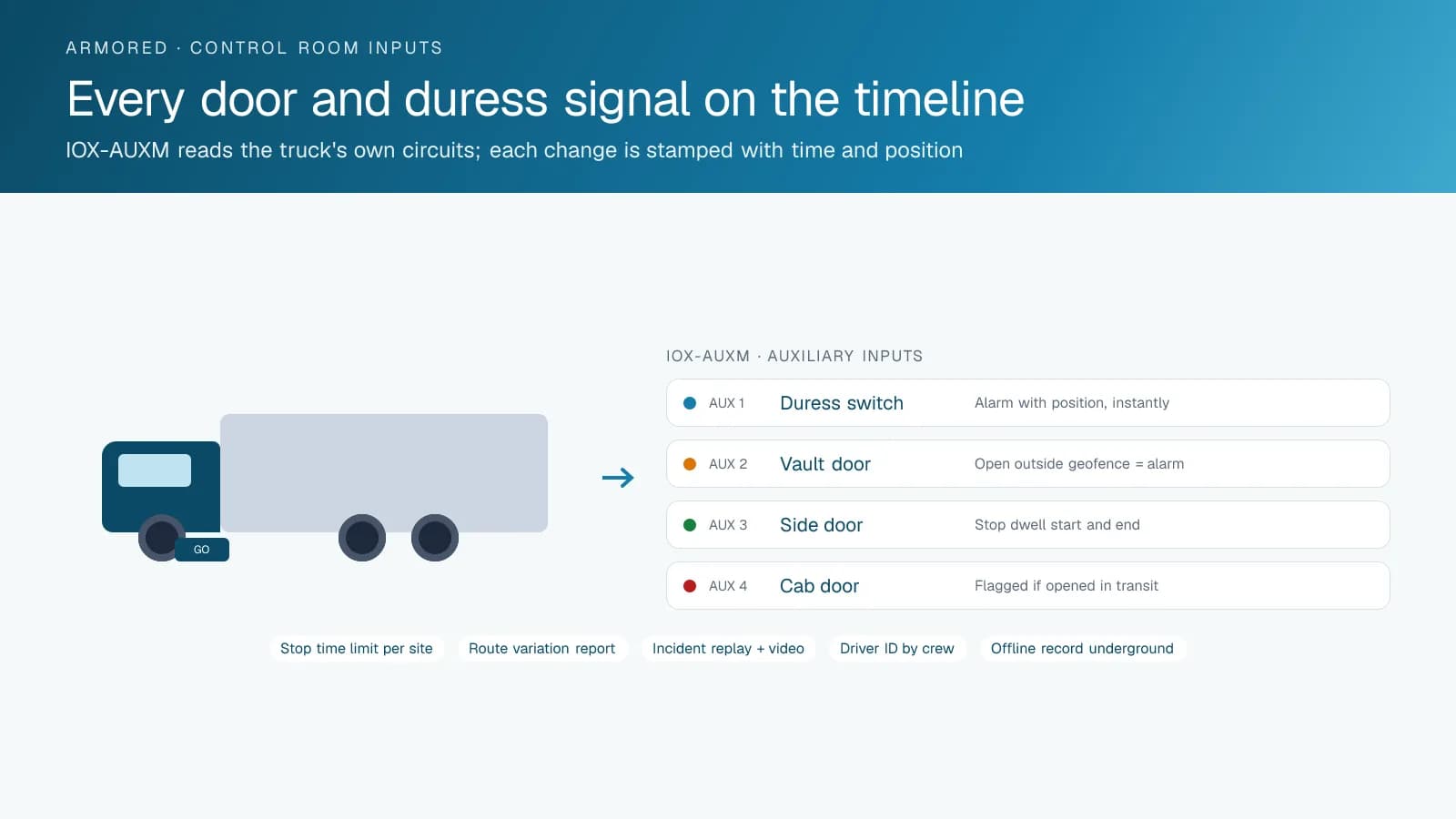
An armored fleet is judged on two things: whether every stop was completed and whether every crew came home. GPS tracking for armored transport and cash logistics gives the control room one live map of every truck, with the planned stops beside the actual position and an alert the moment a truck stops where it should not, stays too long where it should, or leaves the route it was assigned. The Geotab GO device reads the vehicle's own circuits through IOX-AUXM auxiliary inputs, so a duress switch, a vault door, a cab door or a side door each becomes a time-stamped event in the trip record. A door opening outside a geofenced customer location raises an alarm in the control room before the crew has called it in. Route variation, which every carrier's security policy requires, is verified rather than assumed: the trip history for each stop shows the approach taken on each visit, and a supervisor sees when the same approach was used three times in a row. When an incident happens, the replay shows the truck's position, speed, every door event and the dash cam clip from the same timeline, ready for the police, the insurer and the customer. Driver ID ties every trip to the crew, and engine-hours maintenance with fault codes keeps heavy, hard-driven trucks out of the shop on unplanned days. High Point GPS builds this on MyGeotab with access controlled to the people who need it.
Common challenges
- A control room that relies on radio check-ins to know whether a truck is on schedule or in trouble
- Route variation required by policy but impossible to verify without going through crew notes
- Stops that run past the time limit with nobody alerted until the crew reports in
- Door openings and duress signals that exist only inside the truck, not as a record the control room can see
- Incident reviews built from statements and memory when the customer, the insurer and the police all want the same timeline
- Heavy, armored trucks with hard duty cycles that break down between scheduled services
How High Point GPS helps
- Live control-room map of every truck with the planned stop sequence beside the actual position
- Duress switch, vault door, cab door and side door read as time-stamped events through IOX-AUXM inputs
- Alarm to the control room when a door opens outside a geofenced customer location or during transit
- Stop time limits per location, with an alert when a truck exceeds them and a record of every over-limit stop
- Route variation reports that show the approach used on each visit to the same stop over the past weeks
- Incident replay that puts position, speed, door events and dash cam video on one timeline
- Driver ID with the IOX-NFCREADERA so every trip is tied to the crew that ran it
- Engine-hours maintenance and fault codes for armored bodies and drivetrains that carry far more than their base chassis was built for
The Control Room View
A control room needs to see the fleet, not hear about it. Every armored truck sits on one live map with its planned route and stop list, and the platform colours the ones that are on schedule, behind or stopped somewhere unexpected. The operator no longer waits for a radio call to learn a truck has been sitting for twenty minutes in a place with no customer; the map raises it. Geofences around each customer location record the arrival and departure, and a rule on each one fires an alert when the stop runs longer than the limit the security plan allows. The control room sees the alert, the truck and the time over limit in the same view.
The same rules cover transit. A truck that stops between customer locations for longer than a traffic light triggers a check, and a truck that leaves its assigned corridor triggers another. High Point GPS tunes these thresholds with the carrier so the control room gets the alerts that matter and not the ones that are noise. Trips are stored on the GO device if coverage drops in an underground loading dock and uploaded when the truck surfaces, so the record is complete even where the live view briefly was not.
Duress, Doors and the Vault
An armored truck already has the circuits that matter: a duress switch in the cab, sensors on the vault door, the cab doors and the side door. The IOX-AUXM module on the GO device reads each one, and every change becomes an event in the trip record with the time and the position. A vault door that opens inside a customer's geofence is a normal stop. A vault door that opens on the highway, or a cab door that opens during a stop where the plan calls for the crew to stay inside, is an alarm in the control room within seconds. The duress switch does the same, with the truck's exact position attached.
These events are also the audit trail after the fact. A customer asks why the delivery took forty minutes; the record shows the truck arrived at 10:12, the side door opened at 10:14, closed at 10:31, and the truck left at 10:52 after the crew's paperwork. An insurer asks whether the vault was open at the time of a claimed loss; the record answers with a time stamp rather than a statement. High Point GPS sets up the inputs during installation and documents which circuit maps to which input, so the record means the same thing on every truck.
Verifying Route Variation
Every cash-in-transit security plan calls for route variation, and almost none of them can prove it happened. The trip history in MyGeotab keeps each visit to each customer, and a report by stop shows the approach the truck took on each one: the street it arrived from, the time of day, the order in the run. A supervisor who reviews the report sees at a glance when a stop has been approached the same way three Tuesdays running and can change the plan before a pattern becomes a vulnerability. The report is the evidence the carrier shows a customer's security auditor and its own insurer.
The reverse is also true. When a crew is told to vary a route and does not, the record shows it, and the coaching conversation starts from specific trips. When a crew varies it well, the record shows that too. Driver ID through the IOX-NFCREADERA attaches the crew to each trip, which matters on fleets where trucks rotate between teams. The route history stays in the platform for as long as the carrier's retention policy requires, and access to it is restricted to the roles the carrier defines, with every view of it logged.
Incident Replay and Keeping the Trucks Running
When something happens on the road, three parties want the same timeline: the police, the insurer and the customer whose cash was aboard. The trip replay shows where the truck was every few seconds, how fast it was moving, when each door opened and when the duress signal fired, and the AI dash cam clips from the road-facing and cab-facing cameras sit on the same timeline. An investigator scrubs to the moment and sees the whole picture. The carrier hands over an export rather than assembling a report from crew statements written the next day, and the same replay settles a fender-bender with a private motorist or a complaint about a truck blocking a loading zone.
An armored truck carries thousands of kilograms of plate and glass on a chassis that was not designed for it, with a duty cycle of constant stops and heavy braking. Maintenance reminders on engine hours and mileage catch brake and suspension service before it is missed, and fault codes from the engine reach the shop the day they appear. Driver scoring flags hard braking and harsh cornering, which on these trucks is both a safety issue and a maintenance cost. High Point GPS reports these to the fleet manager in the same platform the control room uses, with each role seeing what it needs.
Frequently asked questions
Can the control room see when a door opens on a truck?
Yes. The IOX-AUXM module on the GO device reads the vault door, cab doors and side door from the truck's own circuits, and each opening and closing is recorded with the time and position. A rule fires an alarm in the control room when a door opens outside a customer geofence or during transit.
How does a duress switch work with the tracking?
The duress switch is wired to an auxiliary input on the GO device. When it is pressed, the platform sends an alert to the control room with the truck's exact position and starts a record that includes every subsequent door event and the truck's movement, which is what the police and the insurer ask for afterward.
Can I prove to a customer that we vary our routes?
Yes. The trip history keeps each visit to each customer, and a report by stop shows the approach, time and run order used on every visit over any period. A supervisor uses it to spot repeated patterns before they become a problem, and the carrier shows it to a customer's security auditor as evidence.
Who can see the tracking data?
Access is controlled by role in MyGeotab. High Point GPS sets up groups so the control room sees live positions and alarms, supervisors see route histories, the shop sees maintenance and fault codes, and nobody sees more than their role requires. Retention periods follow the carrier's own security policy, and exports for the police or an insurer are produced on request.
What happens when the truck loses signal in an underground dock?
The GO device keeps recording position, door events and duress inputs offline and uploads everything when the truck returns to coverage. The control room sees the truck reappear with a complete record of what happened below ground, and the stop-time rules still apply once the data arrives, with any over-limit stop flagged for review.
Related solutions
Related guides
- What Is a Geotab IOX and What Does It Do? →
- How Geofencing Works for Fleet Tracking →
- Fleet Dash Cams With Live View: What Live Streaming Shows and When It Is Actually Used →
- Timeline Map: Replaying a Trip Minute by Minute to Settle a Dispute →
- IOX-NFCREADERA: Driver ID by NFC Tap, So Every Trip Has a Name on It →
- Fleet Maintenance: Engine Hours vs. the Calendar →
Get a free quote
What are you looking for?