
Industry
GPS Fleet Tracking for Auto Parts & Dealer Delivery
GPS tracking for auto parts and dealer delivery fleets that confirms every drop at every shop with a time-stamped arrival record, keeps hot-shot runs and multi-stop routes honest, scores drivers in small vehicles the way a parts fleet needs, and separates work from personal use.
Updated September 21, 2026
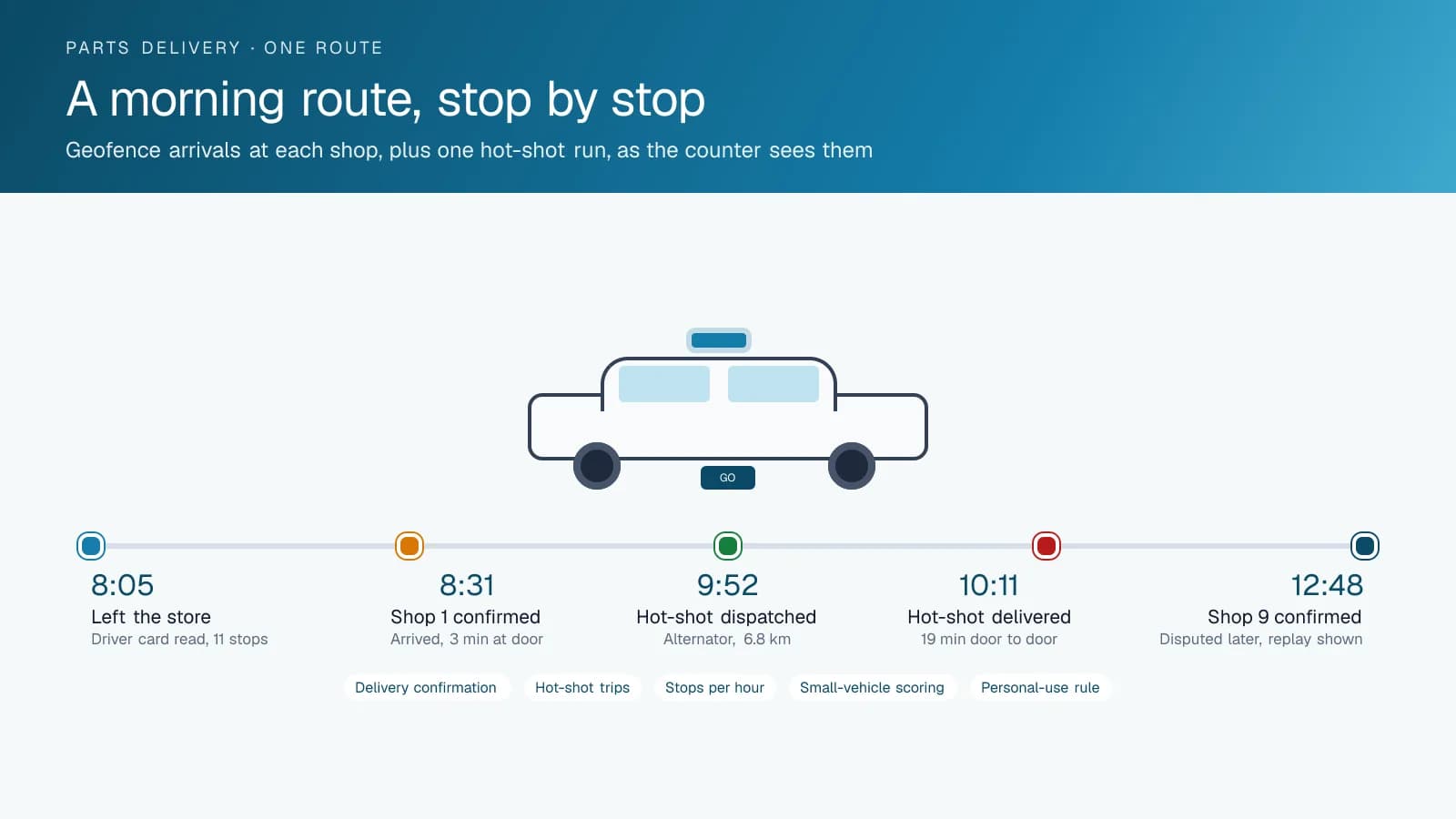
A parts delivery fleet runs on promises made by phone. The shop needs the alternator before the bay is tied up for the afternoon, the counter promises it by one, and the driver has eleven other stops between here and there. GPS tracking for auto parts and dealer delivery fleets puts every van, pickup and car on one live map for the parts manager and the counter staff, with each stop confirmed by a geofence arrival record the moment the driver pulls in. A hot-shot run to a shop across town shows up as its own trip, with the departure, the arrival and the minutes in between. When a shop says the part came late, or never came, the trip replay shows the vehicle at their door at 12:48 for two minutes. Route efficiency comes from the same data: stops per hour by driver, kilometres per stop by route, and the runs where a driver backtracked across the same road three times. Driver scoring is set for small vehicles on city streets, where speeding, hard braking and phone use are what get a delivery car into a claim. A personal-use rule handles the vehicle that goes home at night, and the Geotab GO device records the whole day without the driver doing anything. High Point GPS sets up the zones for every shop and dealer on the route list, the confirmation report and the scoring so the counter can answer the phone with a fact.
Common challenges
- Shops calling to ask where their part is, and the counter with no better answer than a call to the driver's cell
- Deliveries disputed after the fact, with a signature nobody can read and no record of when the driver was there
- Hot-shot runs that take an hour for a twenty-minute trip, with no way to see where the time went
- Drivers who build their own route each morning and cover the same street three times
- Small delivery cars driven hard in traffic, with the fleet's insurance paying for the fender-benders
- Vehicles that go home at night and rack up kilometres the fleet cannot explain
How High Point GPS helps
- Live location of every delivery vehicle for the parts counter, with the stop list and the next shop on the route
- Delivery confirmation per stop from a geofence around every shop and dealer, time-stamped from the vehicle's position
- Hot-shot runs as their own trips, with the departure, the arrival and the drive time reported to the counter
- Route efficiency by driver and by route: stops per hour, kilometres per stop and backtracking flagged on the map
- Driver scoring set for small vehicles in city traffic: speeding, hard braking, cornering and after-hours driving
- AI dash cams with distraction detection for drivers who spend the day in stop-and-go traffic with a phone in the cupholder
- Personal-use rules that separate the commute and evening driving from the delivery day, with distance still logged
- Driver ID with the IOX-NFCREADERA reader for pool vehicles, so the delivery and the driving belong to a named person
Confirming the Drop at Every Shop
The counter gets the same call all day: is my part on the truck, and when will it be here? With every shop and dealer on the route list drawn as a geofence, the platform writes an arrival record when the delivery vehicle pulls in and a departure record when it leaves. The counter sees the vehicle on the map, the stops it has made and the ones still ahead, and answers the call with a time rather than a guess. The stop record is the delivery confirmation, whether or not anyone at the shop signed for it.
The dispute comes later, usually at month end. A shop says the part arrived after the customer left and refuses the invoice. The trip replay shows the van at the shop's door at 12:48 for two minutes, the day's route around it and the next stop at 12:59. A shop that says the part never came has an arrival record and a departure record to answer with. High Point GPS builds the daily confirmation report so the parts manager can send a shop its own delivery history for the month when the question comes up.
Hot-Shot Runs and the Multi-Stop Route
A hot-shot run is a promise with a clock on it. The platform records it as its own trip: the departure from the store, the route, the arrival at the shop and the minutes in between. A twenty-minute run that took an hour shows where the vehicle stopped along the way, and a run that went the long way around shows the route on the map. Over a month, the hot-shot report tells the parts manager how many runs each store sends, how long they really take and whether they are worth what they cost.
The multi-stop route is where the efficiency lives. Stops per hour by driver, kilometres per stop by route and drive time between stops are all in the same report. A driver who builds a route from memory and crosses the same intersection three times shows up on the map, and the platform's routing tools build the order from the stop list instead. Idling at the loading door and the long lunch at the same plaza every day are on the idle report. A parts fleet that runs the same shops every day sees the difference in fuel and in stops per driver within a few weeks.
Scoring Drivers in Small Vehicles
Parts delivery is done in cars, small vans and half-ton pickups, in city traffic, all day, by drivers who are paid to be quick. The claims that follow are the fender-bender in a shop's lot, the rear-end collision at a light and the speeding ticket on the way back from a hot-shot. Driver scoring set for small vehicles weights those: speed over the posted limit on city streets, hard braking in traffic, fast cornering with a load of parts in the back and after-hours driving. The score is per driver, with the trip and the moment behind each event, and the coaching conversation starts from a specific stop on a specific day.
AI dash cams add the rest when the fleet wants it. A road-facing camera records what happened in the shop's lot, and a driver-facing camera with distraction detection flags the phone in the hand between stops. Video is retrieved by event, so a claim from a shop about a scraped bumper is answered with a clip rather than a driver's memory. Dash cam footage of the rear-end collision that was not the driver's fault is what keeps the fleet's insurance rate where it is.
Personal Use, Pool Vehicles and the Vehicle at Night
Delivery vehicles often go home with the driver. It saves a trip to the store in the morning and it costs the fleet the kilometres and the fuel of whatever happens in the evening. The platform handles that with a personal-use rule: outside working hours, the route is hidden but the distance is logged, and the fleet sees the work kilometres and the personal kilometres separately. Fleets that do not allow personal use see the after-hours trips on their own report, with the time, the distance and the vehicle, and settle it with the driver the next morning.
Pool vehicles need the driver named. An IOX-NFCREADERA reader in each vehicle reads the driver's card at the start of the shift, and every stop, every delivery confirmation and every scoring event belongs to that person rather than to the vehicle. Maintenance runs on mileage and engine hours, with fault codes from the vehicle sent to the shop as they appear, which is how a delivery car with a failing alternator gets fixed before it strands a driver with a load of parts. Fuel-card integration matches every fill-up to the vehicle and its odometer.
Frequently asked questions
How does it confirm a delivery at each shop?
Every shop and dealer on the route list is a geofence, and the platform writes an arrival record with the time when the delivery vehicle pulls in and a departure record when it leaves. That record is the delivery confirmation, and the trip replay shows the vehicle at the shop's door when a delivery is disputed.
Can it track hot-shot runs separately?
Yes. A hot-shot run is its own trip with the departure, the route, the arrival and the drive time. The counter sees it live, and the monthly report shows how many runs each store sends, how long they take and where the slow ones lost time.
Is the driver scoring right for small vehicles?
It is set for them. High Point GPS configures the thresholds for cars, small vans and pickups in city traffic: speeding on city streets, hard braking, fast cornering and after-hours driving. The score is per driver, with the trip behind each event, and AI dash cams can add distraction detection.
What about drivers who take the vehicle home?
A personal-use rule hides the route outside working hours while still logging the distance, so work and personal kilometres are reported separately. Fleets that do not allow personal use see the after-hours trips on their own report, with the time, the distance and the vehicle.
Will it help us plan better routes?
Yes. The stop and trip history gives stops per hour, kilometres per stop and drive time between stops by driver and by route, and backtracking shows on the map. Routing tools build the stop order from the day's list, and the idle report shows where time is lost at the door.
Related solutions
Related guides
- How Geofencing Works for Fleet Tracking →
- Route Optimization Software for Last-Mile Delivery: Multi-Stop Planning Explained →
- Driver Safety Scorecards: How Fleet Behavior Scoring Works →
- Geotab Personal Conveyance: How to Set It Up and Stay Compliant →
- IOX-NFCREADERA: Driver ID by NFC Tap, So Every Trip Has a Name on It →
- Do Dash Cams Actually Lower Fleet Insurance Premiums? →
Get a free quote
What are you looking for?