
Industry
GPS Fleet Tracking for Building Materials & Lumber Delivery
GPS tracking for building materials and lumber delivery fleets: live boom truck location, job-site arrival times, boom and PTO hours and proof of delivery.
Updated September 21, 2026
A lumber yard or building supply dealer sells the same thing every competitor sells, and the difference is whether the load is on the site when the crew shows up. Contractors phone the yard all morning asking where the truck is, and the same contractor phones back at noon to say the drywall was dropped in the wrong place or the truck never came. GPS tracking for building materials delivery puts every boom truck, flatbed and Moffett-equipped trailer on one live map with its delivery list and an arrival estimate for each site. Geofences around active job sites record the arrival and departure time. The IOX-AUXM auxiliary inputs on the GPS tracking device read the PTO, the crane or boom and the outriggers, which is the record of how long the truck spent unloading and whether the boom went up at all. When a contractor disputes a delivery, dispatch has the time on site, the boom time and the driver's proof-of-delivery photo in one place. A Bluetooth tag on the Moffett and the forklifts keeps track of where the yard's own equipment is at day's end. Electronic DVIR, engine-hours maintenance for the crane and the chassis, and driver scoring for a heavy truck on narrow site roads complete a platform High Point GPS configures for a single yard or a chain of branches.
Common challenges
- Contractors calling the yard every hour for an ETA that the dispatcher can only get by calling the driver
- Delivery disputes about the wrong drop location, a missed delivery or a truck that showed up after the crew left
- No record of how long a boom truck spent on site, so a long unload or a wait for access is never billed
- Moffett forklifts and other yard equipment left on job sites or lost between branches
- Crane and boom maintenance scheduled on the calendar instead of on the hours they actually ran
- Heavy trucks on narrow site roads and residential streets with tip-overs, strikes and complaints that come down to the driver's word
How High Point GPS helps
- Live location of every boom truck, flatbed and delivery trailer on one map, with the delivery list and an ETA per site
- Geofences on active job sites that record arrival and departure to the minute, for billing and disputes
- PTO, boom, crane and outrigger status read from the truck's own circuits through the GPS tracking device's auxiliary inputs
- Proof-of-delivery photos and signatures tied to the stop, the time and the position on the site
- Bluetooth asset tags on Moffett forklifts, and battery trackers on trailers, so yard equipment is found at day's end
- Trip replay with speed, braking and cornering for any run, for a tip-over review or a damage claim on a customer's driveway
- Maintenance reminders on chassis engine hours, boom and crane hours and mileage, with fault codes sent to the shop
- Electronic DVIR in the driver app with a checklist for the crane, outriggers, straps and load securement
Where is the truck? Answering the contractor before they ask
The yard's phone rings hardest between seven and nine, when crews are on site and the lumber is not. With every truck on the live map and its delivery list beside it, the dispatcher sees which site the truck is heading to and the estimated arrival, and can answer the contractor in one sentence. A branch that wants to go further sends the ETA by text as the truck leaves the yard, or shares a tracking link for the day's delivery, and the contractor watches the truck approach instead of calling.
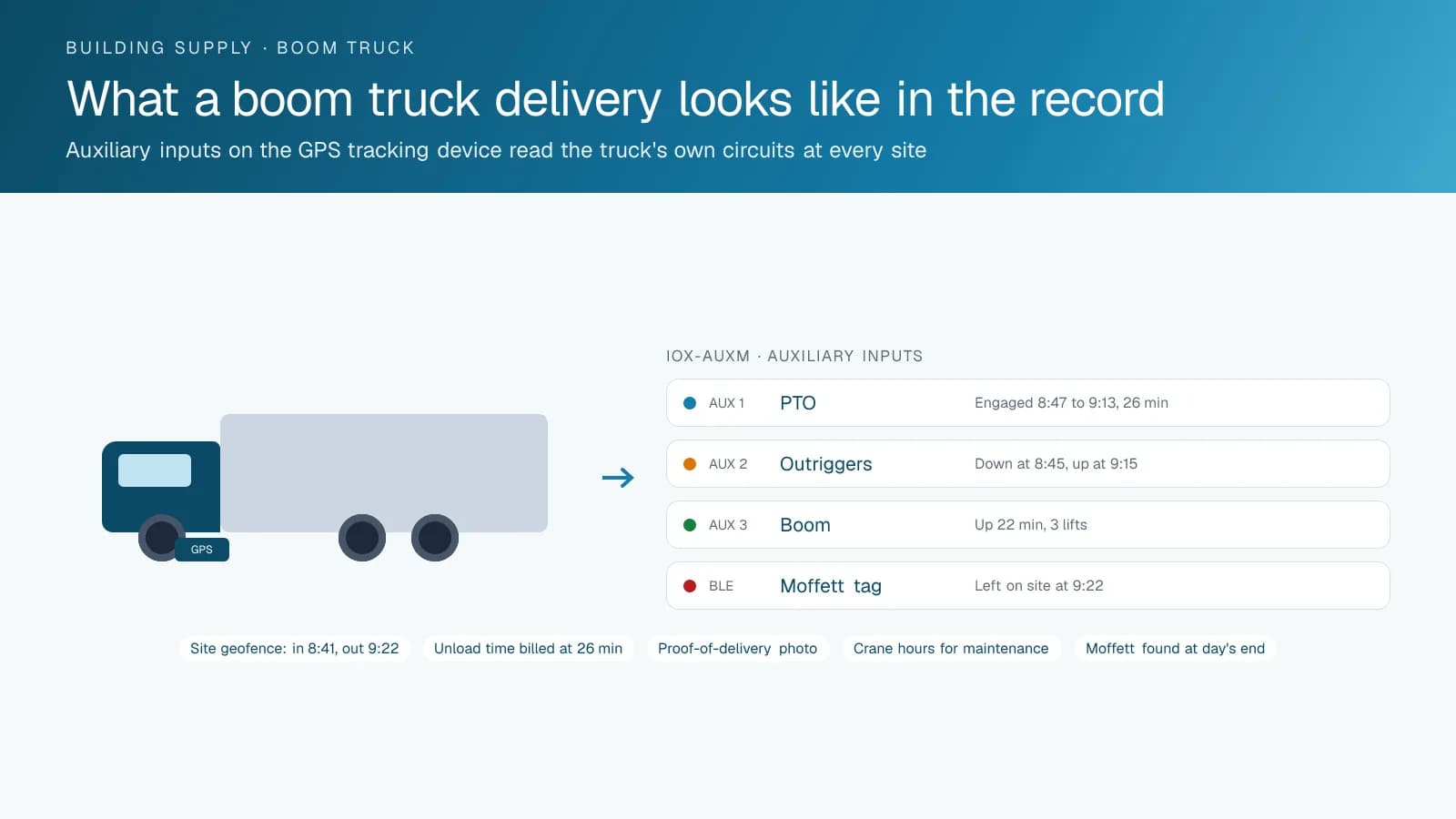
The record is what settles the argument at noon. A contractor says the truck came after the crew left; the geofence log shows the truck on site at 8:41 and leaving at 9:22 with the boom up for twenty-six minutes. A contractor says the trusses were dropped on the wrong lot; the position at the time the boom went up and the driver's photo show where the load landed. High Point GPS sets these reports up so the dispatcher can pull the delivery record while the contractor is still on the line.
The boom, the PTO and the time on site
A boom truck delivery has a shape that a simple stop record misses: the truck arrives, the outriggers go down, the PTO engages, the boom lifts, and the whole thing takes anywhere from ten minutes to two hours depending on the site. An IOX-AUXM module on the GPS tracking device reads the PTO, the boom and the outriggers from the truck's own circuits, so the delivery record shows when each was engaged and for how long. That is the record behind a charge for extended unload time, and it is the record that shows the driver did unload with the crane when the customer says it was dropped at the curb. The boom hours also accumulate for the crane's maintenance schedule.
The same inputs show the yard where its trucks spend their day. A report of boom hours by truck and by driver shows which trucks are doing the heavy deliveries, which sites take longest and where a second truck would pay for itself. Time on site by customer feeds the conversation with a contractor whose crews are never ready when the truck arrives. A Moffett-equipped trailer gets the same treatment through a Bluetooth tag on the forklift, which shows where the Moffett is and whether it came back.
Keeping track of the Moffett, the trailers and the forklifts
A building supply yard owns more wheeled equipment than it has drivers, and much of it leaves the yard every day. Bluetooth asset tags on Moffett forklifts, yard forklifts and other small equipment report their position whenever a tracker-equipped truck is nearby, and battery-powered trackers on trailers and dollies report on their own wherever they sit. At the end of the day the yard manager sees what is on the lot, what is still on a job site and what has been sitting on a site for a week. A tag reported on a site the yard has never delivered to is a call worth making.
The same tags simplify the branch-to-branch shuffle in a multi-yard company. Equipment moved to another branch for a busy week shows up on that branch's map, and the annual count of trailers and forklifts takes an afternoon with a report rather than a week with a clipboard. High Point GPS sets up the asset groups and the reports during onboarding, and adds a tag to a new piece of equipment in the time it takes to stick it on. A tag that has not reported in a week is its own alert, and the last known position is the place to start looking.
Heavy trucks on site roads: driving, inspection and maintenance
A loaded boom truck on a muddy site road or a tight residential cul-de-sac is the most dangerous thing the yard does. Driver scoring with tighter thresholds for speed and cornering on a heavy truck, speed limits set by geofence around schools and residential zones, and AI dash cams that record the road ahead and the driver's attention give the safety manager a specific trip to coach from. When a truck tips on a soft shoulder or catches a low wire with the boom, the trip replay and the event clip show what happened before the insurer asks.
The electronic DVIR in the driver app carries a checklist for the chassis and the crane: outriggers, boom pins, hydraulic lines, straps and load securement, and a defect reaches the shop before the truck leaves the yard. Maintenance reminders run on chassis engine hours, boom hours read from the auxiliary input and mileage, which means the crane inspection is scheduled on the hours the crane actually ran rather than on a calendar date. Engine fault codes reach the shop as the truck logs them, with the truck's location beside the code.
Frequently asked questions
Can it tell how long the boom or crane was in use on a site?
Yes. An IOX-AUXM module on the GPS tracking device reads the PTO, the boom and the outriggers from the truck's own circuits, and the delivery record shows when each was engaged and for how long. That backs a charge for extended unload time and settles a dispute about how the load was delivered.
Can contractors see when the truck will arrive?
Yes, if the yard chooses. Dispatch can send an ETA by text as the truck leaves or share a tracking link for the delivery, and the contractor watches the truck approach. The yard controls what is shared, and dispatch always has the full live map.
How do I keep track of Moffett forklifts and trailers?
A Bluetooth asset tag on each Moffett or forklift reports its position whenever a tracker-equipped truck is nearby, and a battery-powered tracker on a trailer reports on its own. The yard sees at the end of the day what is on the lot and what is still on a job site.
What happens when a contractor disputes a delivery?
Dispatch pulls the delivery record: the geofence arrival and departure times, the boom and PTO time, the position when the load was set down and the driver's proof-of-delivery photo. Most disputes end with that record shown to the contractor, and the ones that go further have a dated, time-stamped file behind the invoice.
Does it schedule crane maintenance on actual hours?
Yes. The auxiliary input that reads the boom or PTO also counts its running hours, and maintenance reminders can be set on those hours as well as on chassis engine hours and mileage. The crane inspection is scheduled on the hours it ran, not on the calendar.
Related solutions
Related guides
- What Is an IOX Port and What Does It Do? →
- PTO On/Off Reader: Proving the Winch Ran, for Tow Billing and Hydraulic Maintenance →
- How Geofencing Works for Fleet Tracking →
- IOX-BT and Bluetooth Asset Tags: How They Work and What to Tag →
- GPS Asset Tags vs. Powered Trackers: Which to Use →
- Fleet Maintenance: Engine Hours vs. the Calendar →
Get a free quote
What are you looking for?