
Industry
GPS Fleet Tracking for Cleaning & Janitorial Services
GPS tracking for cleaning and janitorial fleets: live crew locations for night supervisors, time on site per building, and proof of service for clients.
Updated September 21, 2026
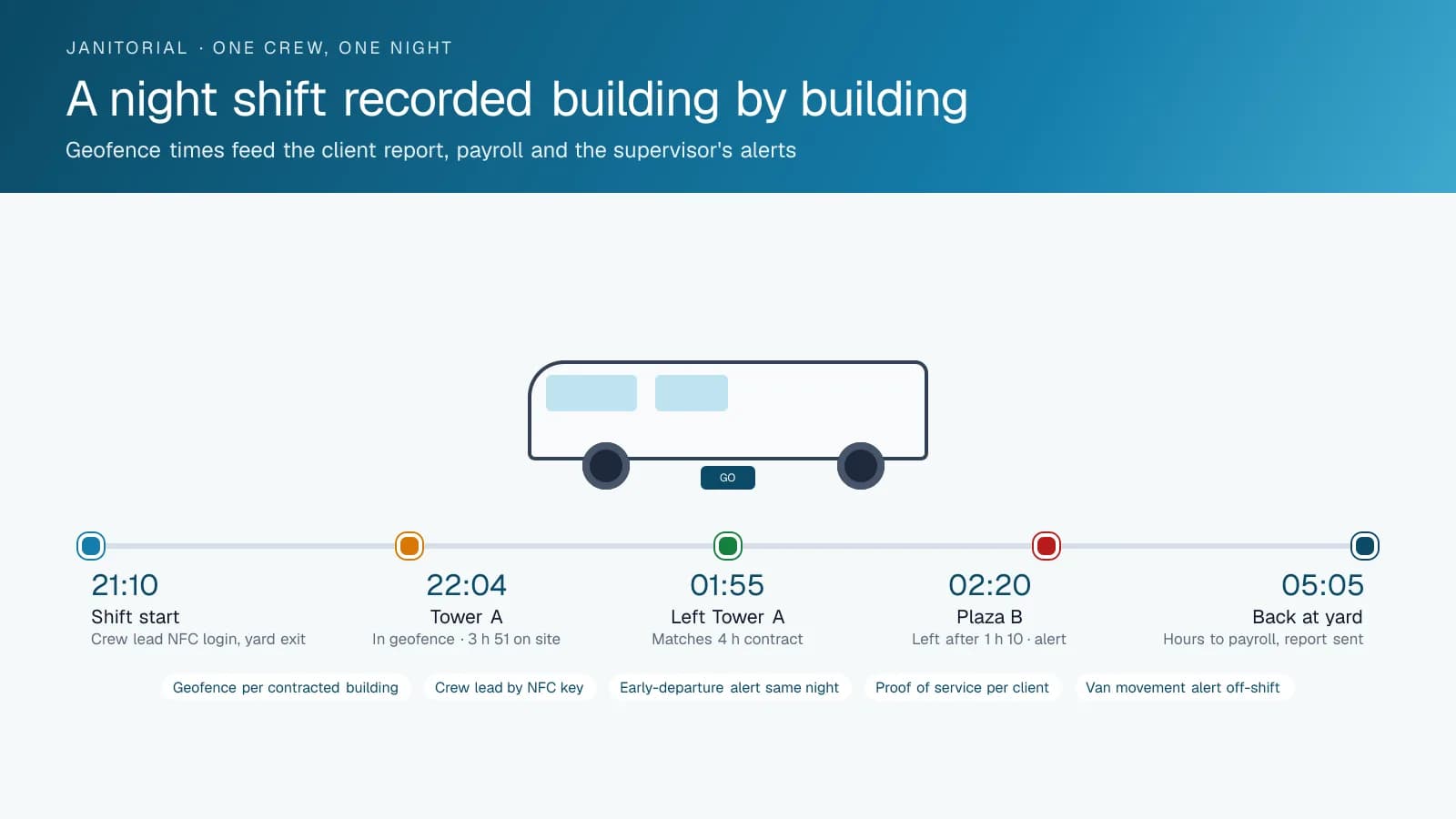
High Point GPS provides GPS tracking for commercial cleaning and janitorial companies, building service contractors and facility-services firms with crews across a city or a region. Night supervisors see every crew van on one map, each building visit becomes a timed record, and that record feeds payroll, billing and the client's proof of service. Most of the work happens while clients are asleep. Crews leave the yard at 9 p.m. in vans loaded with floor machines, supplies and the keys to a dozen buildings, and the supervisor responsible for all of them can be in only one place. The next morning the client calls to say the third floor was not done, the crew lead says it was, the contract says four hours a night, and payroll pays whatever the timesheet says. A geofence around every building on the contract list turns each stop into a record: arrived at 22:04, stayed 3 hours 51 minutes, left. The client gets it in a monthly report, payroll pays from it and the contract is billed against it. A crew that finishes a four-hour building in ninety minutes shows up for the supervisor that night, long before the client cancels at the end of the month. After-hours movement alerts and Bluetooth tags on the floor machines protect the keys and equipment in the vans. Driver scoring keeps tired crews driving safely at 3 a.m., and dash cams settle the parking-lot collisions that night work produces. High Point GPS installs, configures and supports the whole setup.
Common challenges
- Clients who say a building was not cleaned, or not for the contracted hours, and only the crew's word to answer them
- Timesheets showing four hours at every building every night, whatever happened
- One night supervisor for a dozen crews across the city, driving between buildings to check on them
- Building keys, access cards and floor equipment in vans parked on the street overnight
- Skipped buildings and early exits on nights nobody is watching, and a lost contract when the client notices
- Monthly client reports pieced together by hand from timesheets and inspection checklists
How High Point GPS helps
- Live location of every crew van for the night supervisor, with the building it is at and how long it has been there
- A geofence around every contracted building that records arrival, departure and time on site for each crew each night
- Proof-of-service reports per client and per building, emailed on a schedule or shared through a client portal
- Time on site exported to payroll, with the crew lead identified by NFC key or the driver app
- Same-night alerts for early departures and skipped buildings, so the supervisor acts before the client notices
- After-hours movement alerts on parked vans, and Bluetooth asset tags on floor machines and equipment
- Driver behaviour scoring for late-night driving, with optional AI dash cams for collisions and parking-lot disputes
- Maintenance reminders on engine hours and mileage for vans that run every night and rarely see the shop
How does GPS tracking prove a building was cleaned?
GPS tracking proves a cleaning visit with a geofence around each building that records when the crew arrived, how long it stayed and when it left. A cleaning contract is a promise about time and presence, and until now the client had no way to check either. The record reads like this: the van arrived at 22:04, stayed 3 hours 51 minutes and left at 01:55. It carries the crew lead's identity from the NFC key or the driver app, and the report for each building lists every night of the month with the same three numbers. When the client says the building was skipped on the 14th, the report shows the visit or it does not, and the conversation is short either way.
Clients who get that report every month without asking for it tend to renew. High Point GPS sets up the report per client, in the format the client's facilities manager wants, and schedules it. Clients who want more can have a portal that shows their own buildings and visits and nobody else's. The same records help you bid for new work, since you can show your service history at comparable buildings. The report also shows the driving between buildings, which explains to a client how the night was sequenced and why their building gets cleaned at 1 a.m. instead of 10 p.m.
Time on Site to Payroll, Not the Timesheet
A timesheet that says four hours at every building every night is a timesheet nobody has read. With time on site coming from the geofence record, payroll pays the hours the crew was actually at the building, plus the driving between them, and the number is the same one the client is billed against. The crew lead logs in with an NFC key or the driver app at the start of the shift, so the hours are attributed to the right person even when crews are reshuffled at the yard.
The night the numbers diverge is the night the supervisor needs to know. A crew that leaves a four-hour building after ninety minutes triggers an alert while the supervisor can still send them back. A building with no visit at all by midnight triggers another. Trip replay in the morning shows the route each van took, the stops it made and the ones it did not, and the supervisor's conversation with the crew starts from a specific building on a specific night instead of a general complaint. Crews that consistently finish early at a building may be the sign that the building is scoped for more hours than it needs, which opens a pricing conversation with the client.
Keys, Machines and the Van on the Street
A cleaning van is a target: it holds a ride-on scrubber worth more than the van, a box of building keys and access cards, and it is parked on the street in the middle of the night. An alert when a parked van moves outside its shift tells the supervisor before the loss is found in the morning, and the live position supports recovery. Bluetooth asset tags on the floor machines report through the GPS tracking device whenever a van is nearby, which shows whether the scrubber was left at the last building or is still in the van.
The keys are the client's problem as much as the cleaning company's. Some companies keep them in a lockbox in the van that opens only on site, tied to the geofence; others use the tracking record to show a client which van had the keys and where it was when access was questioned. Either way, the record of where the van was every minute of the night is the answer to a client who asks how someone got into the building at 4 a.m. A client who receives that answer within the hour keeps the contract; one who waits a week for it starts looking at other bids.
Supervisors, Drivers and the Vans Themselves
A night supervisor with twelve crews used to spend the shift driving between buildings, seeing each crew once. With every van on the map, the supervisor sees all twelve at once, knows which are on schedule and which are running behind, and spends the shift at the buildings that need a visit. When a crew calls for supplies or an extra pair of hands, the supervisor sees who is closest and sends them. Live ETAs let the office tell a client when a crew will arrive for a special request.
Crews drive at hours when fatigue and empty roads combine badly. Driver scoring flags the speeding and hard braking that come with 3 a.m. driving, and AI dash cams with event clips settle the parking-lot scrape a client's security guard reports the next morning. Maintenance reminders on engine hours and mileage keep vans that run every night from failing mid-shift, and fault codes reach the fleet coordinator as they appear. High Point GPS sets up the alerts, the reports and the driver rules for the way a cleaning fleet works.
Frequently asked questions
How does it prove a building was cleaned?
A geofence around each contracted building records when the crew van arrived, how long it stayed and when it left, with the crew lead identified. The report for each building lists every night's visit and goes to the client on a schedule or through a portal. It proves presence and duration; supervisors and inspections still cover cleaning quality.
Can time on site go straight to payroll?
Yes. The geofence record gives the hours at each building, and the crew lead's login with an NFC key or the driver app assigns them to the right person. The report totals hours per crew per pay period, including the driving between buildings, and exports to your payroll system.
Will the supervisor know the same night if a crew leaves early?
Yes. Rules in the High Point GPS platform alert the supervisor when a van leaves a building before the contracted time, or when a building has no visit by a set hour. The supervisor can send the crew back or cover the building before the client finds out the next morning.
How does it protect equipment and keys in the vans?
An alert fires when a parked van moves outside its shift, and the live position helps with recovery. Bluetooth asset tags on floor machines show whether a machine is in the van or was left at a building. The tracking record shows where each van, and the keys inside it, were at any minute of the night.
Do crews have to do anything with the system?
Very little. The crew lead logs in at the start of the shift with an NFC key or the driver app, so the hours go to the right person. The GPS tracking device in the van records everything else on its own, including arrivals, departures and time on site at each building.
Related solutions
Related guides
- What Is Geofencing? How It Works in Fleet Tracking →
- IOX-NFCREADERA: Driver ID by NFC Tap, So Every Trip Has a Name on It →
- Bluetooth Asset Tracking Tags and the IOX-BT: How They Work and What to Tag →
- Heavy Equipment Theft Recovery: How GPS Gets Stolen Machines and Trailers Back →
- Public Tracking Portal: A Live Vehicle Map for Customers and Residents, No Login →
- GPS Fleet Tracking for Small Business: What a 3 to 20 Vehicle Fleet Needs →
Get a free quote
- Over 500 fleets
- Since 2013
- 4.9 on Google (19 reviews)
What are you looking for?
Prefer to talk?Call 1-800-613-6323[email protected]