
Industry
GPS Fleet Tracking for Dairy Farms & Milk Hauling
GPS tracking for milk hauling and dairy farms: arrival and pump time at every farm, tank temperature to the plant dock, and hours of service.
Updated September 21, 2026
High Point GPS tracks milk tankers for haulers and dairy farms, recording when the truck reached each farm, how long it pumped and what temperature the milk held on the way to the plant. Those are the questions the farms, the processor and the inspectors all put to the hauler. A milk route visits the same farms in the same order every day or every other day, and it runs whether or not the road is plowed, because a bulk tank that is not emptied means dumped milk. Every tanker shows on one live map in the High Point GPS platform with its farm list beside it. A geofence at each farm logs arrival and departure, and an IOX-AUXM module on the PTO and pump circuit logs how long the pump ran at each stop. That is the pickup record the processor and the farm both rely on. A temperature sensor on the tank reports the milk from the first farm to the plant dock and sends an alert if the reading climbs. Rural routes lose cell coverage for long stretches, so the GPS tracking device stores everything and uploads it once the truck is back in range. Drivers who need an ELD run hours of service and the electronic pre-trip inspection in the driver app. For trucks that cross a provincial or state line, IFTA distance by jurisdiction comes from the same trip data, and driver scoring holds a loaded tanker on a gravel road to a standard the hauler can defend to its insurer.
Common challenges
- Farms and processors arguing over when the truck arrived and how long the pickup took, with only the driver's ticket as evidence
- Milk temperature checked at the farm and again at the plant, with the two or three hours between them unrecorded
- Routes that lose cell coverage for an hour at a time and leave dispatch blind on a winter morning
- Hours of service on long rural routes, hard to track on paper and easy to get wrong at a roadside inspection
- IFTA distance by jurisdiction rebuilt from odometer readings for trucks that cross a provincial or state line
- Loaded tankers on gravel roads with no record of speed or driving when a rollover claim comes in
How High Point GPS helps
- Every tanker live on one map, with the farm list, the pickup order and an ETA for the next farm
- A geofence at each farm that logs arrival, departure and time on site for every pickup
- PTO and pump run time read from the truck's own circuits through IOX-AUXM inputs, giving pump hours per farm
- Tank temperature sensors reporting from the first farm to the plant dock, with an alert when the reading climbs
- Trips, pump times and temperatures stored on the GPS tracking device out of coverage and uploaded when the truck is back in range
- Hours of service and electronic DVIR in the driver app for drivers who fall under the ELD rules
- IFTA distance by jurisdiction from the trip record for trucks that cross a provincial or state line
- Driver scoring set for loaded tankers: speed on gravel and in curves, hard braking and cornering with a liquid load
How does GPS tracking record a milk pickup?
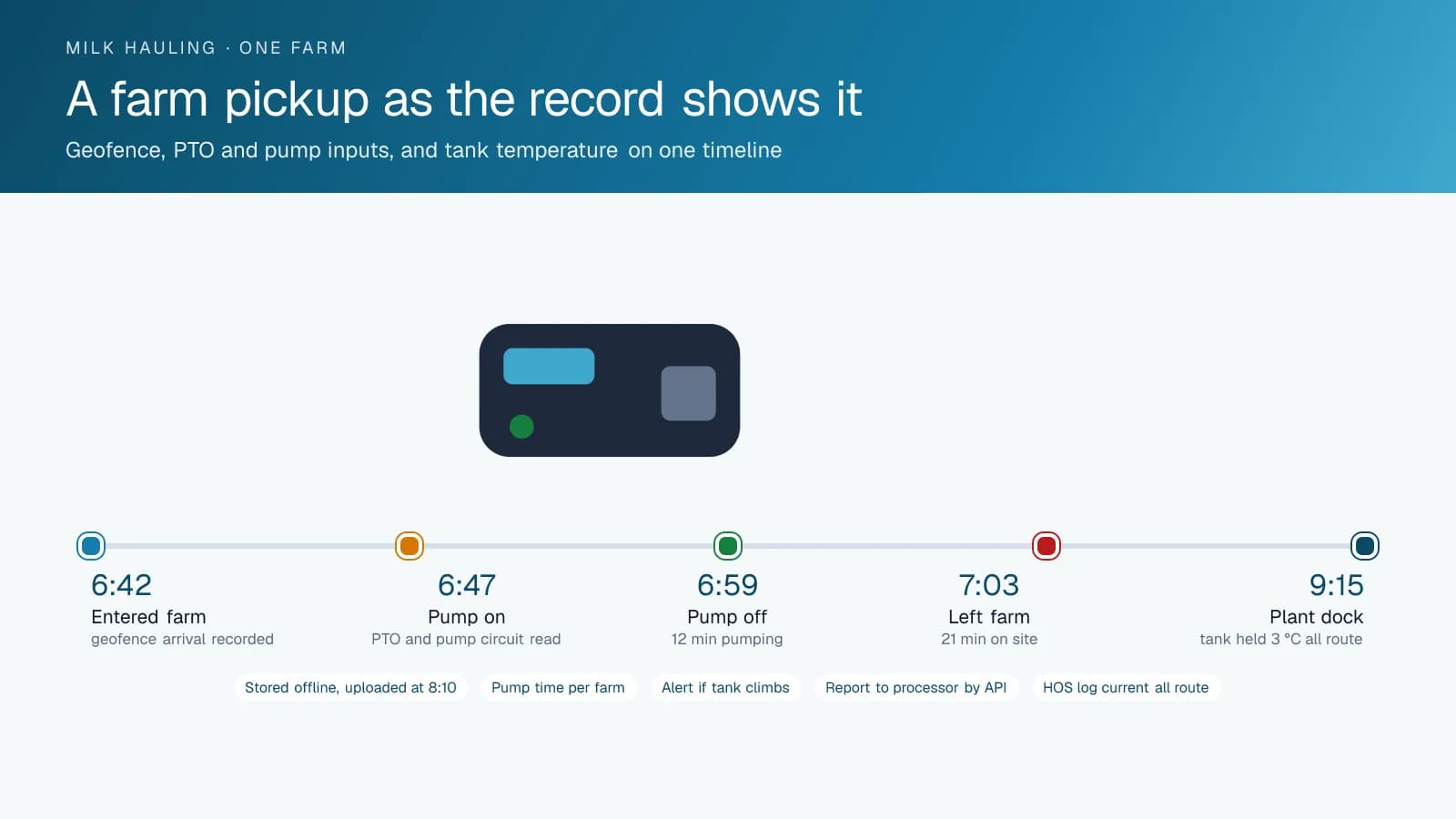
GPS tracking records each milk pickup from the truck itself: when it reached the farm, when the pump ran and when it left. That matters because any pickup can turn into a dispute. The farm says the truck came late and the milk sat; the plant says the pickup ran long and the route ran over. High Point GPS draws a geofence around every farm on the route, and the GPS tracking device logs the truck entering at 6:42 and leaving at 7:03. An IOX-AUXM module on the PTO and pump circuit adds that the pump ran from 6:47 to 6:59. For that farm on that day, the record reads twenty-one minutes on site and twelve minutes pumping, and it comes from the truck instead of the driver's memory.
The day's route report lists every farm in the order visited, with the time on site and the pump time at each. It goes to the processor as a file through the API or as a High Point GPS platform report. If a farm's bulk tank alarm goes off overnight and the farmer calls to ask why the truck did not come, the dispatcher has the truck's position and arrival time before the call ends. If a driver runs the farms out of order, the exception report shows it in the morning.
Temperature from the first farm to the dock
Milk is checked at the farm and again at the plant, and what happens in the tank between is a question the paper record cannot answer. A temperature sensor on the tank reports through the GPS tracking device on the same timeline as the route. The hauler sets the ceiling, and if the reading climbs past it the dispatcher and the driver both get an alert while the truck is still on the road. The temperature history for the load prints as one report from the first farm to the dock.
When the plant rejects a load, that report is the first thing the hauler pulls. It shows whether the milk went into the tank warm at a particular farm, whether it climbed on a long summer run, or whether it arrived at the dock at the same temperature it left. The farm, the hauler and the processor argue less when all three read the same record. High Point GPS installs and calibrates the sensor and adds the alert to the dispatcher's rules.
Routes that run out of coverage
A milk route spends a good part of its morning in places with no cell signal. The GPS tracking device keeps recording anyway: position, farm geofence times, pump run time, temperature readings and driver ID all stay on the device until the truck reaches coverage, then upload as a block. The morning's pickups appear in the High Point GPS platform a few minutes after the truck comes back into range, complete and in order. Dispatch sees a gap on the live map for an hour, and the record does not have one.
The same holds for hours of service. The driver app on the driver's tablet keeps the log current whether or not the truck is connected, and the log is ready for a roadside inspection at any point on the route. The pre-trip inspection runs in the same app with a checklist written for a tanker: the pump, the hoses, the sample case, the tank lids. A defect reaches the shop before the truck leaves the yard.
Hours, IFTA and a loaded tanker on a gravel road
Drivers on a two-day rotation can drift toward the edge of their hours without meaning to, and a milk hauler cannot afford an out-of-service order on a morning when the farms are waiting. The driver app tracks the driver's hours against the ruleset that applies, warns before a limit is reached, and gives the dispatcher a view of who has hours left for a route that ran long. For trucks that cross a provincial or state line, the distance by jurisdiction for the IFTA return comes out of the same trip data, and High Point GPS sets up the report so it matches the return.
A loaded tanker is a liquid load on a gravel road, and a rollover in a curve is the claim that ends a small hauler. Driver scoring set for tankers weights speed in curves and hard cornering more heavily than it would for a dry van, with speed limits per zone set through geofences on the roads the route uses. AI dash cams record the road ahead and the cab, and a claim from a farm about a damaged driveway or a lane blocked at milking time is answered with the clip for that stop.
Frequently asked questions
Can it record pump time at each farm?
Yes. An IOX-AUXM module on the GPS tracking device reads the PTO and the pump circuit, so the trip record shows pump-on and pump-off times inside each farm's geofence. The pickup report lists arrival, departure and pump time for every farm, and the hauler can send it to the processor as a report or through the API.
Does it monitor the milk temperature on the road?
Yes. A temperature sensor on the tank reports through the GPS tracking device on the same timeline as the route. The hauler sets a ceiling, the dispatcher and the driver get an alert if the reading climbs past it, and the temperature history for any load prints as one report from the first farm to the plant dock.
What happens when the route has no cell coverage?
The GPS tracking device keeps recording. Position, geofence times, pump run time, temperature readings and driver ID stay on the device and upload when the truck returns to coverage, so the morning's pickups appear in the High Point GPS platform complete and in order. The driver app also keeps the hours-of-service log current while offline.
Does it handle hours of service and IFTA?
Yes. Drivers who fall under the ELD mandate in Canada or the US run hours of service in the driver app, with the electronic DVIR before the shift. For trucks that cross a provincial or state line, the distance by jurisdiction for the IFTA return comes out of the same trip data instead of odometer readings.
Can the processor see the pickup data?
Only if the hauler chooses to share it. High Point GPS can set up a report that goes to the processor on a schedule, or an API feed that sends each pickup's arrival time, pump time and temperature into the processor's receiving system. The hauler decides what is shared and with whom.
Related solutions
Related guides
- PTO Tracker: The PTO On/Off Reader for Tow Billing and Hydraulic Maintenance →
- What Is Geofencing? How It Works in Fleet Tracking →
- Wired Reefer Temperature Monitoring for Multi-Compartment Refrigerated Trucks →
- FMCSA Hours of Service Rules (US): 11-Hour and 14-Hour Limits →
- IFTA Reporting Software: How High Point GPS Automates Fuel Tax Reports →
- What Is an ELD? Electronic Logging Devices Explained →
Get a free quote
- Over 500 fleets
- Since 2013
- 4.9 on Google (19 reviews)
What are you looking for?
Prefer to talk?Call 1-800-613-6323[email protected]