
Industry
GPS Fleet Tracking for Fencing & Decking Contractors
GPS fleet tracking for fencing and decking contractors: crew trucks and trailers on one map, hours on site per job, and augers and compressors tracked.
Updated September 21, 2026
A fencing and decking contractor's fleet is trucks and trailers. A pickup pulls a trailer of posts, panels and concrete to one property in the morning and a trailer of composite boards and a compressor to another after lunch, and the auger or the post driver stays wherever the crew left it. The office schedules by the linear foot or the square foot and hears how the day went at the end of it. High Point GPS puts each truck on one live map, with a geofence around the yard, the lumber supplier and every property under contract. The GPS tracking device stamps the departure from the yard, the arrival at the property and the time the crew leaves. The High Point GPS platform totals hours on site per job and per crew for the estimator and the bookkeeper. Bluetooth asset tags on trailers, augers, compressors and post drivers keep the equipment on the same map as the trucks, with an alert when a trailer moves after hours. Driver ID through the IOX-NFCREADERA attributes each trip to the crew leader when trucks change hands. When a homeowner says the crew left early or a property manager says the fence line was not started on the promised day, the trip replay answers with times. Mileage and engine-hours reminders keep the trucks in service through a season that runs from the first thaw to the first snow. Contractors across Canada and the United States run it from one High Point GPS platform database, with reports built by High Point GPS around how they estimate and bill.
Common challenges
- Trucks and trailers leaving the yard each morning with the office relying on a text message to know when a crew reached the property
- Homeowners and property managers disputing the hours billed or the day a job was started, with only the crew's word to answer
- Estimates by the linear foot with no way to check the hours a crew actually spent against the bid
- Augers, post drivers, compressors and trailers left on a property between jobs and not where the next crew expects them
- A trailer of composite decking stolen from a job site overnight with no record of when it left
- Pickups that tow loaded trailers all season and miss brake and tire service because nobody tracks the mileage
How High Point GPS helps
- Every crew truck on one live map with a geofence around the yard, the lumber supplier and each property under contract
- Arrival, departure and hours on site recorded for every job without the crew logging anything
- Bluetooth asset tags on trailers, augers, compressors and post drivers, with alerts when a trailer moves after hours
- Driver ID from an NFC key fob that attributes each trip to the crew leader, whichever truck the crew took
- Hours-on-site reports per job that the estimator compares to the linear-foot bid and the bookkeeper attaches to the invoice
- Trip replay that shows when the crew arrived, how long it stayed and any supplier run in between
- Maintenance reminders on mileage and engine hours for trucks that tow all season, with fault codes sent to the shop
- Driver scoring on speeding, harsh braking and idling for crews towing loaded trailers through residential streets
Every truck and trailer on one map, by property
A fencing contractor in June might have fifteen properties under way, each one a day or two of work, and the crews move between them faster than the schedule board can keep up. High Point GPS draws a geofence around each property and names it after the job number, with the yard and the lumber supplier drawn the same way. The live map shows which truck is at which property, which is at the supplier and which is on the road, with the time spent at each. A scheduler who needs to send a second crew to finish a long fence line sees which crew is wrapping up without a phone call.
The record behind the map is the one the office keeps. Every entry and exit is stamped by the GPS tracking device with the truck, the crew leader from the NFC fob and the time, and the High Point GPS platform totals the hours on site per job. When a rural property or a new subdivision has no coverage, the GPS tracking device stores the trip and uploads it when the truck reaches a signal, and the log is complete either way. The trip replay shows the route between properties and the twenty-minute stop at the supplier that explains a late start.
Equipment left behind and trailers that leave at night
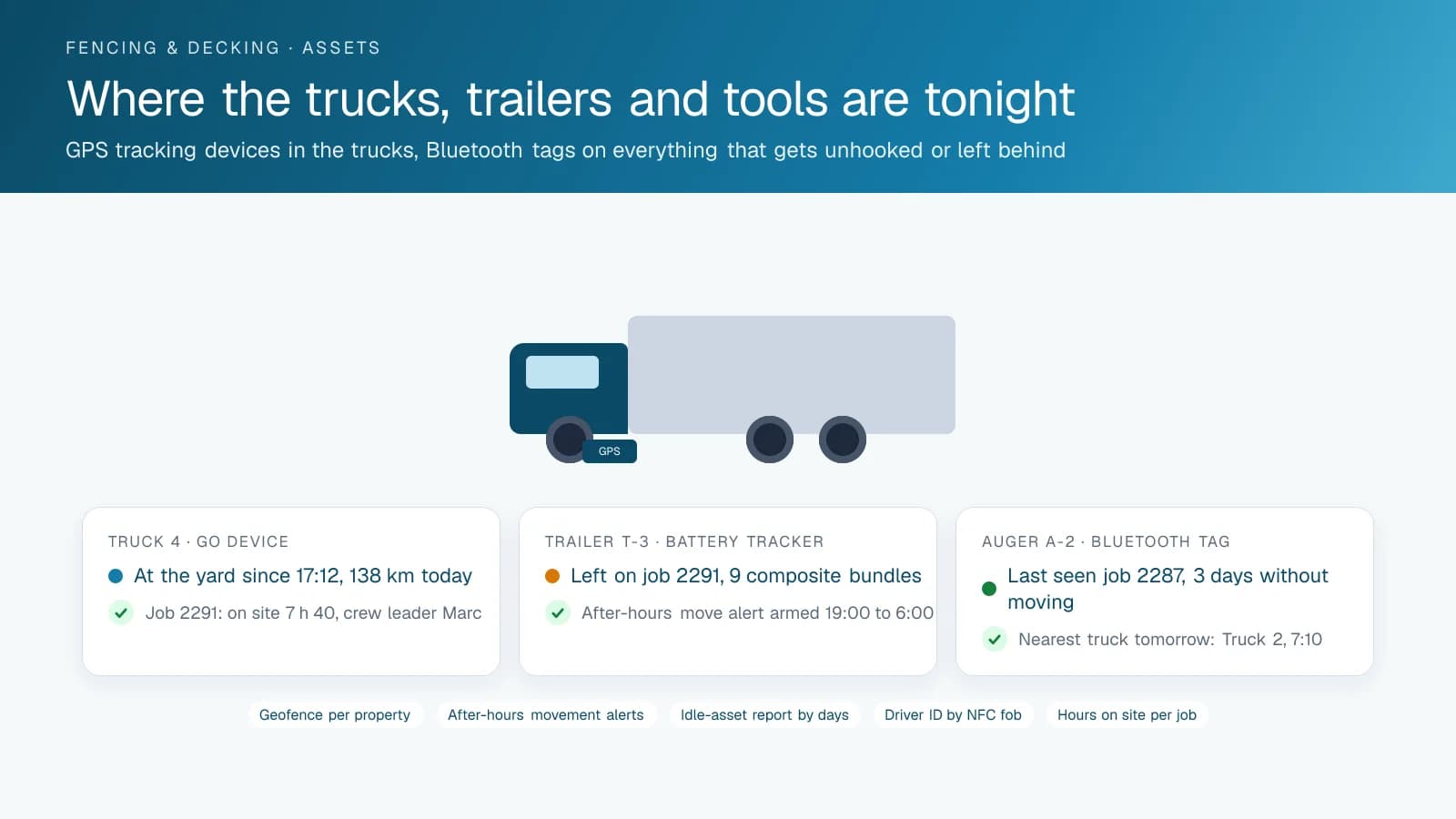
The auger stays on the property where the posts are going in. The compressor stays where the deck boards are going down. The trailer stays wherever it was unhooked. Bluetooth asset tags on each piece report through any truck with a GPS tracking device that passes nearby, and a battery-powered tracker covers a trailer that sits on a property for a week. The map shows a crew leader which property the second auger is sitting on before the truck leaves the yard, and a report lists every tagged asset that has not moved in a set number of days.
Theft is the other reason. A trailer loaded with composite decking is worth stealing, and it disappears from a job site at two in the morning. An alert fires the moment it moves outside the hours the contractor sets, and the tracker reports its position until it is recovered. The same record settles a smaller question: whether the crew brought the compressor back to the yard on Friday or left it on the property over the weekend. High Point GPS sets the alert rules for after-hours movement, off-site departures and low battery once, and the office hears about a problem before the crew does.
Hours on site behind the estimate and the invoice
Fencing is bid by the linear foot and decking by the square foot, and both come down to a guess about labour. The hours-on-site report turns the guess into a number. An estimator who sees that a 200-foot cedar fence took a crew two and a half days rather than the two in the bid adjusts the next one. Over a season the report shows which crews are quick on chain link and which are better on composite decks, and which kinds of jobs are being underbid. The report is per job and per crew, and it runs on a schedule once High Point GPS builds it with the contractor's job numbering.
For billing, the report goes on the invoice. A homeowner who says the crew left at two on a day billed as a full day gets the truck's arrival at 7 h 20 and departure at 16 h 05. A property manager who says the fence line was not started on the promised Monday gets the arrival stamp for that Monday. Callbacks for a leaning post or a loose board appear as additional visits to the same geofence, and the office decides whether they are warranty or billable. The reports export through the open API to the accounting software the contractor already uses.
Trucks that tow all season, and the drivers behind the wheel
A pickup that tows a loaded trailer from April to November wears its brakes, tires and transmission faster than the same truck driven empty, and the service schedule slides when the truck is never in the yard. The High Point GPS platform tracks mileage and engine hours per truck and raises a reminder when an oil change, a brake service or a transmission service comes due, on a schedule set per vehicle. Engine fault codes reach the shop the day they appear, which is how a transmission temperature fault gets looked at before it strands a truck and a trailer on a highway shoulder. For trailers that cross a scale or a border, electronic DVIR in the driver app records the pre-trip walk-around.
The driver matters as much as the truck. A crew leader towing a trailer of posts and concrete through a residential street at speed is the contractor's largest liability exposure, and the insurer knows it. Speeding, harsh braking and idling are scored per driver through the NFC fob rather than per truck, and the coaching conversation starts from a specific trip. An AI dash cam on the trucks that tow adds the road view when a claim is disputed, with footage pulled by event rather than by scrolling. A supervisor sees the clip, and the insurer sees a fleet with a program.
Frequently asked questions
Can it track the trailers and the augers, not just the trucks?
Yes. Bluetooth asset tags on trailers, augers, compressors and post drivers report through any truck with a GPS tracking device that passes nearby, and a battery tracker covers a trailer left on a property for a week. Each piece appears on the same map as the trucks, and an alert fires when a trailer moves after hours.
How does it record hours on site without the crew doing anything?
High Point GPS draws a geofence around each property under contract. The GPS tracking device stamps every entry and exit with the truck, the time and the crew leader from the NFC fob. The High Point GPS platform totals the hours per job and per crew, and the office reads or exports the report without a time sheet.
What if a homeowner says the crew left early?
The trip replay shows the truck's arrival at the property, the time it stayed and when it left, with the crew leader identified. The office replies with those times, and the invoice can carry them for each day. The record comes from the GPS tracking device rather than a recollection.
Does it work on rural properties with no signal?
Yes. The GPS tracking device stores each trip and each geofence event when there is no coverage and uploads them as soon as the truck moves back into signal. The hours-on-site record is complete either way, and only the live map lags while the truck is out of range.
Can we use the hours on site to check our linear-foot estimates?
That is one of the main reasons contractors ask for it. The hours-on-site report per job sits beside the labour hours in the bid, and the estimator sees where the bid was short. Over a season the pattern by fence type, deck material and crew feeds the next set of bids.
Related solutions
Related guides
- GPS Fleet Tracking for Small Business: What a 3 to 20 Vehicle Fleet Needs →
- Trailer GPS Tracking: How to Track Trailers With and Without a Truck Attached →
- GPS Asset Tags vs. Powered Trackers: Which to Use →
- Equipment Theft Recovery: How GPS Gets Stolen Machines and Trailers Back →
- How Geofencing Works for Fleet Tracking →
- Fleet Maintenance: Engine Hours vs. the Calendar →
Get a free quote
What are you looking for?