
Industry
GPS Fleet Tracking for Freight & LTL Trucking
GPS fleet tracking and ELD compliance for freight and LTL carriers: tractors and trailers on one map, dock detention records and IFTA mileage.
Updated September 21, 2026
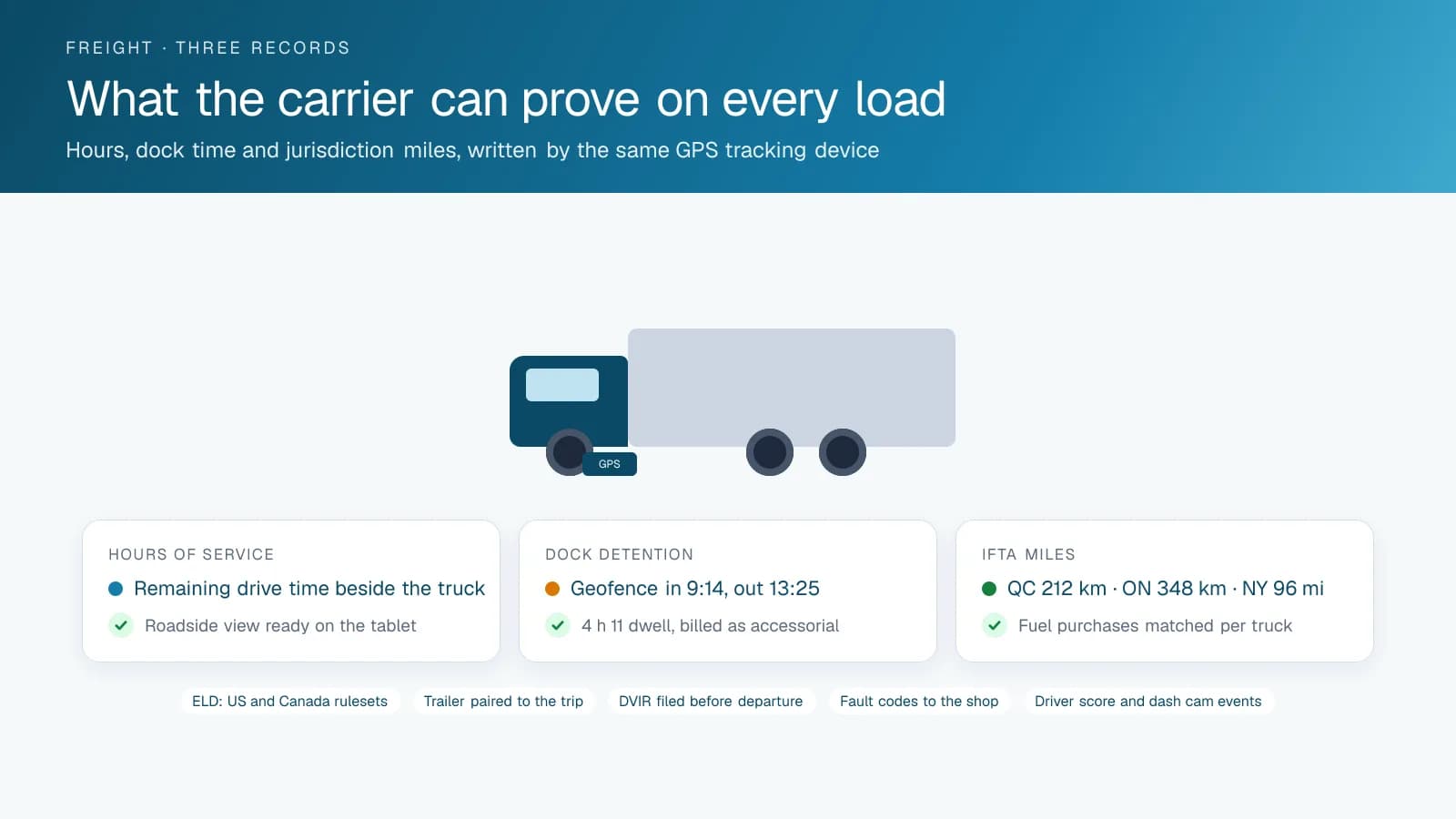
A freight or LTL carrier lives on margins measured in cents per mile and on the trust of shippers who want to know where their load is. High Point GPS builds the carrier's operation on the High Point GPS platform. A GPS tracking device in every tractor supplies location, engine data and hours of service through the driver app, and asset trackers on every trailer make the yard and the drop lot as visible as the road. Dispatch sees each driver's remaining hours beside the truck's position and plans the next pickup around them rather than finding out at the shipper's gate that the driver is out of time. Geofences around customer docks and terminals write the arrival and departure times behind every detention claim, and the record is the carrier's, not the shipper's. IFTA mileage by jurisdiction comes out of the trip history without a driver keeping a state-line log, and fuel-card integration matches each purchase to the truck and the driver. Electronic DVIR keeps roadside inspections uneventful, driver scoring and AI dash cams keep the safety record that insurers and the CSA system reward, and engine fault codes reach the shop before a tractor is down on the shoulder. Every one of those records is built for the moment it is questioned: the auditor, the adjuster, the shipper disputing an accessorial or the officer at the scale.
Common challenges
- Detention time at shipper and receiver docks that goes unbilled because the carrier cannot prove the arrival and departure times
- Dispatch planning loads without seeing the driver's remaining hours until the driver calls to say they are out
- Trailers lost at drop lots and customer yards, with a tractor sent to find one that is not there
- IFTA mileage by jurisdiction reconstructed each quarter from paper logs and fuel receipts
- Roadside inspections and audits where log gaps, unassigned driving and missing DVIRs become violations
- Shippers calling for a load status and a dispatcher who has to call the driver to find out
How High Point GPS helps
- Every tractor and trailer on one live map, with the driver's remaining hours of service beside each truck
- ELD hours of service in the driver app, with US and Canadian rulesets and roadside inspection mode
- Dock arrival and departure times from geofences, producing a detention record the carrier controls
- Trailer asset trackers for the yard, the drop lot and the customer's fence line, with dwell reports per trailer
- IFTA mileage by jurisdiction from the trip history, matched to fuel-card purchases by truck and driver
- Electronic DVIR with defects routed to the shop before the tractor leaves the terminal
- Driver scoring and AI dash cams that build the safety record behind insurance renewals and CSA scores
- Engine fault codes and engine-hours maintenance reminders to keep tractors out of the breakdown lane
Dispatching around hours of service instead of against them
The dispatcher's hardest job is matching loads to drivers who still have the hours to run them. In the High Point GPS platform, the driver's remaining drive time, on-duty time and next required break appear beside the truck on the map, updated from the driver app as the driver's day unfolds. A planner sees that the driver at the Laval terminal has four hours left and the driver coming off a reset in Buffalo has a full clock, and assigns the load that fits. High Point GPS configures the US and Canadian rulesets, the cross-border switch and the exemptions the carrier actually uses.
The same system keeps the audit clean. Unassigned driving time is flagged for the driver to claim or for a manager to assign to yard moves, and edits leave an audit trail. A violations report shows which drivers are running close to the limit before an officer does. When a truck is pulled in at a scale, the driver hands over the roadside inspection view on the tablet, and the log the officer sees is the log the carrier has been watching all week. Driver summaries by week show who needs a conversation about log habits.
Detention, dock times and the records behind an accessorial
Detention is the accessorial carriers earn most and collect least. A geofence around each customer dock writes the arrival and departure of every truck, and the platform reports dwell time per stop with the driver and the trailer attached. When the shipper's dock held a truck for four hours and eleven minutes, the invoice line carries that figure and the record shows the truck sitting inside the fence for the whole period. A shipper who wants to dispute it is looking at a timestamped record from the carrier's own equipment rather than a driver's handwritten note.
The dock records serve the rest of the operation too. Average dwell by customer tells a sales manager which accounts are costing the fleet hours, and it is the number behind the next rate conversation. LTL terminals see each pickup and delivery stop in sequence with the time at each, which is how a dispatcher answers a shipper's status call without a phone call to the cab. Shippers who want to see their own load can be given a portal view of that truck and nothing else. Terminal managers use the same view to see which doors are backed up.
Trailers that are where the system says they are
A trailer pool is a carrier's second fleet, and it is usually the one nobody can see. High Point GPS installs powered or solar asset trackers on every trailer, and the High Point GPS platform shows each one at the terminal, at a customer's dock, on a drop lot or on the road behind a tractor. The tractor's GPS tracking device pairs with the trailer it is pulling, and the trip record shows which trailer moved which load. When a dispatcher needs an empty in the Montreal yard, the map shows the three that are there rather than the five the spreadsheet claimed.
Dwell reports by trailer show which units have sat at a customer for a week and should be billed or retrieved, and which have been at a drop lot long enough to be a theft risk. A geofence rule raises an alert when a trailer leaves a lot outside working hours or without a fleet tractor attached. Reefer trailers add temperature and reefer status to the same view, and a carrier that mixes dry van and reefer runs both from one database. High Point GPS installs the trailer units and sets the pairing rules.
IFTA, fuel, inspections and the safety record
IFTA reporting from paper logs takes days each quarter and is wrong more often than anyone admits. The GPS tracking device records every mile in every jurisdiction, and the platform's IFTA report lists distance by state and province per truck for the period. Fuel-card integration matches each purchase to the truck, the driver and the location, and the fuel-tax report is assembled from the two rather than reconstructed from a shoebox. High Point GPS sets up the report and the fuel-card feed, and the same trip history supports IRP mileage and the weight-distance taxes some states levy.
Electronic DVIR in the driver app records the pre-trip and post-trip walk-around, routes a defect to the shop and keeps the inspection on file for the period the regulation requires. Engine fault codes reach maintenance as the tractor logs them, and reminders keyed to engine hours and mileage schedule service between loads. Driver scoring reports speeding, hard braking and following distance by driver, and AI dash cams capture the event with road and cab video. A carrier that shows an insurer a year of scored driving and event footage is negotiating from a stronger position than one that shows a loss run.
Frequently asked questions
Does the ELD cover both US and Canadian rules?
Yes. The driver app runs FMCSA and Canadian hours-of-service rulesets, and drivers switch when they cross the border. High Point GPS configures the rulesets, exemptions and the roadside inspection view, and the platform is certified for both mandates. Drivers log in once and the app applies the right rules.
How does detention billing work?
A geofence around each customer dock records the arrival and departure of every truck. The platform reports dwell time per stop with the driver and trailer attached, and the invoice line for detention carries a timestamped record from the carrier's own equipment that a shipper can review. Reports are pulled by customer or by period.
Can it track trailers when they are not attached to a tractor?
Yes. Powered or solar asset trackers on each trailer report position on their own, and the High Point GPS platform shows every trailer at the terminal, a customer dock or a drop lot. Dwell reports and geofence alerts cover trailers sitting too long or leaving a lot after hours. Reefer trailers add temperature to the same view.
Will it produce our IFTA report?
Yes. Distance by jurisdiction comes from the GPS tracking device's trip history for each truck, and fuel-card integration matches purchases to the truck and driver. The IFTA report is generated for the quarter from those two sources, with the trip detail available if a jurisdiction audits it. The report is exported for filing each quarter.
Can shippers see where their load is?
Yes, if the carrier chooses. A shipper can be given a portal view limited to the truck carrying their load, or the carrier's dispatch can answer from the live map. Load status can also be pushed to a TMS through the open API and a custom integration. The carrier decides what each shipper sees.
Related solutions
Related guides
- What Is an ELD? A Plain-English Guide for Fleets →
- Hours of Service Rules Explained: The 11 and 14 Hour Limits →
- Detention Time: What It Is, What It Costs, and How to Bill It With GPS Evidence →
- Trailer GPS Tracking: How to Track Trailers With and Without a Truck Attached →
- High Point GPS IFTA Reporting: How Automated Fuel Tax Reports Save Fleets Hours →
- How to Pass a DOT Roadside Inspection →
Get a free quote
What are you looking for?