
Industry
GPS Fleet Tracking for Home Healthcare & Nursing Fleets
GPS tracking for home healthcare and nursing fleets that verifies each patient visit for billing, calculates mileage reimbursement from real trips, protects caregivers working alone, plans routes across a day of patients and enforces a personal-use policy on company cars.
Updated September 21, 2026
A home care agency bills for visits it cannot see. A nurse or personal support worker drives to eight patients in a day, spends thirty minutes at each, submits a mileage claim at the end of the week and a visit log the agency sends to the funder. When the funder audits, the agency has to show that the visit happened, at that address, for that long. When a caregiver claims 140 kilometres for a day that should have taken 90, the coordinator has to decide whether to ask. GPS tracking from High Point GPS turns both into records instead of conversations. A Geotab GO device in each agency car logs every trip and every stop, and a geofence at each patient address produces an arrival and departure time that matches, or does not match, the visit note. Mileage for reimbursement comes from the odometer, per trip, split between patient visits and personal use by the driver's own selection in the Geotab Drive app. A caregiver who has not moved from a patient's address long past the scheduled visit, or who has stopped somewhere unexpected after dark, is visible to the coordinator who can call or send help. Route planning across a caseload cuts the driving between visits, and the driver scoring and dash cam options that other fleets use apply here too. High Point GPS installs, configures and supports it for agencies, community nursing programs and private-duty providers, with the privacy settings each requires.
Common challenges
- Funder audits that ask for proof a visit happened at the patient's address for the documented time, and a visit log that rests on the caregiver's word
- Mileage claims that grow every quarter with no way to check them against the actual trips
- Caregivers working alone in patients' homes, after dark, with nobody knowing where they are if a visit goes wrong
- Caseloads assigned by patient, not by geography, and caregivers crossing the city twice a day as a result
- Company cars taken home under a personal-use policy that nobody can enforce or report on
- Coordinators fielding calls about late caregivers with no better answer than a text message that goes unanswered
How High Point GPS helps
- Visit verification from a geofence at each patient address: arrival time, departure time and time on site, matched to the scheduled visit
- Mileage reimbursement calculated from the odometer per trip, with business and personal trips separated in the Geotab Drive app
- Lone-worker visibility for the coordinator: a caregiver who overstays a visit or stops somewhere unexpected is flagged in minutes
- Route planning across a day's patients that orders visits by geography and time window and cuts the driving between them
- Personal-use reporting on agency cars: after-hours and weekend trips, distance and location, under the policy the agency sets
- Live location of every caregiver for the coordinator, with the current visit and the next one beside it
- Driver behaviour scoring and optional AI dash cams for agencies whose insurance or fleet size calls for them
- Maintenance reminders on mileage and engine hours across a fleet of small cars that are rarely at the office
Visit Verification an Auditor Accepts
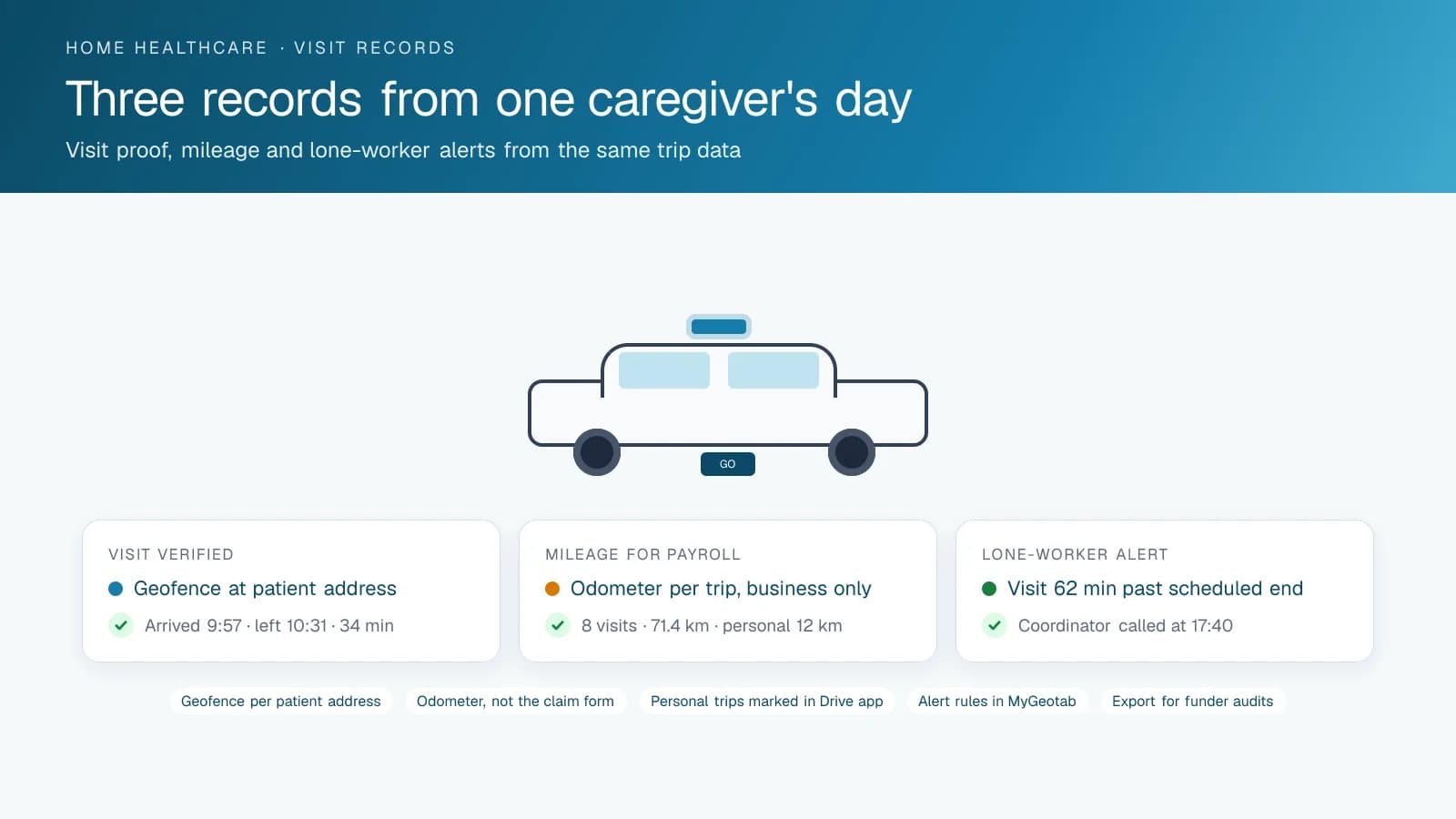
Home care funding depends on documented visits, and a documented visit is one that can be shown to have happened. A geofence around each patient's address, set up from the agency's client list, records when the caregiver's vehicle arrived and when it left. The visit note says 30 minutes of care at 10:00; the geofence record says the car was there from 9:57 to 10:31. When an auditor samples a month of visits, the agency exports the record for each one and the sample closes without a single phone call to a caregiver.
The same record protects the caregiver. A family member says the nurse never came on Thursday; the record shows the car at the address for 28 minutes. A patient's complaint that the visit was rushed is checked against the time on site. High Point GPS sets the geofences up in bulk from the agency's patient addresses, keeps them current as the caseload changes and builds the visit report in the form the funder asks for. Patient identities can be masked in the report where the privacy policy requires it, with geofences named by a client code rather than an address.
Mileage From the Odometer, Not the Claim Form
Mileage reimbursement is the largest variable cost in most home care agencies, and it is paid on forms filled in from memory at the end of the week. With a GO device in the car, every trip is recorded with its distance from the odometer. Caregivers using their own vehicles can carry a small device too, or use the Drive app, depending on the agency's policy. The claim becomes a report: trips between patient addresses on the days worked, totalled per pay period, exported to payroll. The coordinator approves in minutes and the numbers are the same for everyone.
For agency-owned cars taken home, the driver marks a trip as personal in the Geotab Drive app, and the report separates business distance from personal distance under the agency's policy. Trips that start after hours or on a weekend show as what they are. Most agencies find the claim total drops the first month, not because caregivers were dishonest, but because guessing tends to round up. High Point GPS builds the report and the payroll export, and sets the rate table so the reimbursement is calculated at the agency's rate for the distance recorded.
Caregivers Who Work Alone Are Not Alone
A caregiver walks into a stranger's home several times a day, often after dark, and the office does not know what is behind the door. Tracking gives the coordinator a way to notice trouble before a phone call comes. A visit that runs an hour past its scheduled end with no message from the caregiver, a stop at an address that is not a patient's, a car that has not moved since a visit ended: each is a rule in MyGeotab that alerts the coordinator, who can call and, if there is no answer, send someone or contact the police with a location.
For agencies that want more, the Drive app on the caregiver's phone provides a check-in at the start and end of each visit, and an alert if the check-out is missed. Where the agency operates in rural areas, trips are stored on the device when there is no coverage and uploaded when the car is back in range, so the coordinator still sees where the caregiver went. Caregivers who know the office can see them tend to feel safer, and agencies that can say so hire more easily. The policy on what the office sees, and when, is written down and shared with staff before the first device is installed.
Routing the Caseload and Running the Cars
Assigning patients by continuity of care is right; assigning them without looking at the map is expensive. Route planning in the platform takes a day's visits with their time windows and orders them to cut the driving between them, and shows the coordinator which caregivers are crossing the city twice when a swap would save both an hour. Live ETAs let the coordinator tell a patient's family when the nurse will arrive without calling the nurse. When a caregiver calls in sick at 7 a.m., the coordinator sees which colleagues are already near each of that day's patients and reassigns the visits in minutes rather than by working down a phone list.
The cars themselves are a fleet that is rarely at the office. Maintenance reminders on mileage and engine hours reach the coordinator when each car is due, and engine fault codes come in as they happen, which keeps a caregiver from being stranded between patients. Driver scoring and AI dash cams are optional for most agencies and standard for larger ones, where insurance premiums and collision claims follow the same pattern as any other fleet. High Point GPS scopes what the agency needs and leaves out what it does not.
Frequently asked questions
How does the system verify a patient visit?
A geofence at each patient address records when the caregiver's vehicle arrived and when it left, which gives the time on site. The record is matched to the scheduled visit and exported for audits or billing. High Point GPS creates the geofences from your client list and keeps them current.
Can it calculate mileage reimbursement?
Yes. Each trip's distance comes from the odometer through the GO device, and the report totals business trips per caregiver per pay period, with personal trips separated by the driver's selection in the Geotab Drive app. The result exports to payroll and replaces the claim form.
What about caregivers using their own cars?
Options include a small plug-in device the caregiver installs in their own vehicle, or the Geotab Drive app on their phone for check-in and trip logging. The choice depends on your policy and the caregiver's agreement, and High Point GPS helps you set the privacy rules for each option.
How does it help keep lone caregivers safe?
Rules in MyGeotab alert the coordinator when a visit runs far past its scheduled end, when a car stops at an unexpected address, or when a check-out is missed. The coordinator can call, send someone or give a location to the police. Trips in rural areas without coverage are stored and uploaded later.
Can we enforce a personal-use policy on agency cars?
Yes. The report shows trips outside working hours, on weekends and beyond the service area, with distance and location, and the driver marks personal trips in the Drive app. The agency sets the policy and the thresholds, and the report shows compliance without a coordinator reviewing every trip.
Related solutions
Related guides
- How Geofencing Works for Fleet Tracking →
- Can My Employer Track My Work Vehicle? GPS and the Law →
- Geotab Personal Conveyance: How to Set It Up and Stay Compliant →
- Route Optimization Software Explained →
- GPS Fleet Tracking for Small Business: What a 3 to 20 Vehicle Fleet Needs →
- Fleet Maintenance: Engine Hours vs. the Calendar →
Get a free quote
What are you looking for?