
Industry
GPS Fleet Tracking for Hotel & Airport Shuttles
GPS tracking for hotel and airport shuttle fleets that shows the front desk and guests where each shuttle is on its loop, records on-time arrivals at the terminal, counts passengers, tracks driver hours and cuts the idling at the curb that airports and budgets both notice.
Updated September 21, 2026
A shuttle loop looks simple until the phone rings. A guest at Door 4 has been waiting twenty-five minutes, the front desk cannot reach the driver, and nobody knows whether the shuttle is stuck in the departures loop or already on its way back. High Point GPS puts every shuttle on one live map with its loop, its scheduled terminal times and its position now, and gives the front desk and the guest an ETA they can trust. Geofences at each terminal door, the hotel entrance and the cell-phone lot record every arrival and departure, so the on-time report for a week is a list of facts rather than a driver's recollection. A passenger counter or a simple driver tally in the Geotab Drive app records loads per run, which is what a hotel needs when it decides whether to add a second shuttle at 5 a.m. or drop the 11 p.m. run. Idling at the curb is reported by zone, because ten minutes with the engine running at a terminal is a fuel bill, an airport citation and a complaint from the next driver in line. Driver hours, driver ID and pre-trip inspections keep a small fleet compliant, and AI dash cams protect the hotel when a passenger falls in the aisle or a taxi clips the shuttle in the loop. A hotel, a parking operator or a contracted shuttle company runs it from one MyGeotab database.
Common challenges
- Guests waiting at the terminal with no answer from the front desk about when the shuttle will arrive
- Late and missed pickups recorded nowhere, so a review complaint is answered from memory
- No passenger counts per run, so the decision to add or cut a departure is made on a hunch
- Shuttles idling at the curb for ten or fifteen minutes, drawing fuel cost and attention from airport operations
- Driver hours and pre-trip inspections tracked on paper, or not tracked, across part-time and overnight drivers
- Passenger injuries and loop collisions with no video and no record of speed or braking
How High Point GPS helps
- Every shuttle on one live map with its loop, its scheduled stops and its current position, visible to the front desk
- Guest-facing ETA through a public tracking link or a text reply, taken from the shuttle's real position
- Geofence arrival and departure records at each terminal door, the hotel entrance and the holding lot
- On-time reports per run, per driver and per week, built from terminal arrival records
- Passenger counts per run from a counter input or a driver tally in the Geotab Drive app
- Idling reported by zone, with the curb at each terminal treated separately from the holding lot
- Driver ID with an NFC reader, hours tracked in the Geotab Drive app and electronic pre-trip inspections
- Road- and driver-facing AI dash cams for passenger incidents, loop collisions and distracted driving
Telling the Guest When the Shuttle Will Arrive
A shuttle loop has one question worth answering: when does the next one reach my door? The front desk sees each shuttle on the live map with its position on the loop, the last terminal it left and the arrival estimate for the next stop, and can tell the caller a time rather than a shrug. Hotels that want to go further give guests the same view. A public tracking link on the confirmation email or a sign at the terminal shows the shuttle moving on the loop and the ETA for that door. Guests stop calling, and the front desk stops relaying radio checks.
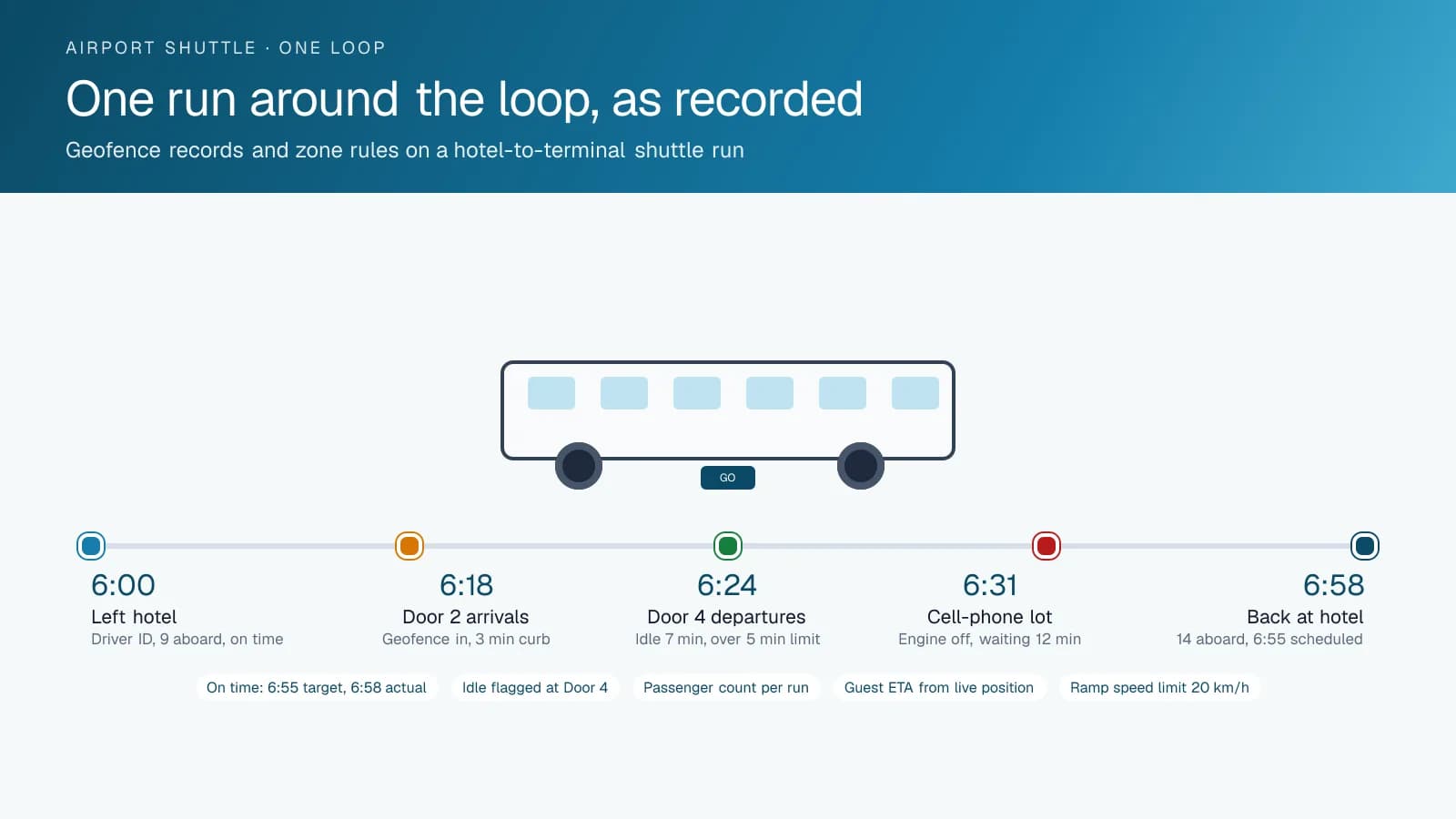
The loop itself is drawn as a set of geofences: each terminal door, the arrivals curb, the cell-phone lot, the hotel entrance. The GO device records the entry and exit for every one on every run. The on-time report compares those records to the schedule the hotel publishes, run by run. When a guest review says the 6:30 shuttle never came, the record shows whether it arrived at Door 2 at 6:34 and left at 6:37, or whether it did not run at all. The same report goes to the airport when the operator's permit requires it.
Passenger Counts and the Shape of the Schedule
Shuttle schedules are set once and rarely revisited, because nobody counts who rides. A passenger counter at the door, wired to an auxiliary input, or a two-tap count by the driver in the Geotab Drive app records the load for each run. Over a month, the platform shows that the 5:15 a.m. departure carries eleven passengers and the 10:45 p.m. run carries one. That is the basis for adding a second early shuttle in the summer, dropping the late run in the winter or replacing a 24-seat bus with a van on Sundays.
The same records support the airport's requirements. Many airports charge shuttle operators per trip or per passenger and ask for counts to back it up. Terminal geofence records give the trip count, the passenger tally gives the loads, and both come from the platform rather than a driver's clipboard. High Point GPS builds the report the airport wants to see, and it comes out the same way every month. The counts also show which runs the wheelchair-accessible shuttle is actually needed on, which matters when a hotel has only one.
Idling at the Curb
Idling is where a shuttle fleet loses money quietly. A driver waiting at the arrivals curb with the engine running for the heat or the air conditioning burns fuel for nothing, and most airports enforce an idling limit at the terminal with fines to match. The GO device records idling by location, and High Point GPS sets a rule for the curb zones that flags any idle beyond the airport's limit. The report shows which drivers idle at the terminal, which idle in the holding lot and which shut down and wait, and the coaching conversation starts from a specific run.
Speed on the loop is treated the same way. The airport roadway, the parking garage ramp and the hotel driveway each get their own limit in a geofence, and a driver taking the ramp at twice the posted speed shows up in their score. The score itself weighs speeding, hard braking and cornering with passengers standing or seated, which is what matters when a guest claims an injury from a sudden stop. Trip replay shows the stop, the speed before it and the braking, and the dash cam, where fitted, shows the cabin.
Hours, Inspections and Video for a Small Fleet
A shuttle fleet is often three or four vehicles and a dozen drivers, many of them part-time or overnight. Driver ID with an IOX-NFCREADERA reader ties each run to the person driving, and the Geotab Drive app tracks hours where the vehicle class or the operator's policy requires it. The pre-trip inspection runs on the same app, with the shuttle's own checklist: wheelchair lift, doors, interior lights, luggage racks. A defect reaches the maintenance contact before the shuttle leaves the hotel. Maintenance reminders run on engine hours, which matter more than mileage on a vehicle that spends half its day at idle or in the loop.
Dash cams answer the incidents that a hotel's insurer cares about. A road-facing camera shows the taxi that pulled out in the loop; a driver-facing camera with distraction detection shows whether the driver was looking at the road. An interior view, where the hotel chooses to add one, shows the passenger who stood up before the shuttle stopped. Video is retrieved by trip and by event, and the hotel sets retention and access with High Point GPS at setup. Live view on the camera lets the front desk check on a shuttle that is not answering the radio.
Frequently asked questions
Can guests see where the shuttle is?
Yes. A public tracking link, shared on the confirmation email or a sign at the terminal, shows the shuttle on its loop and the ETA for the guest's door. The hotel decides what is shown. The front desk always has the full live map with every shuttle. Guests need no app or login to use the link.
How does it measure on-time performance?
Each terminal door, the hotel entrance and the holding lot is a geofence, and the GO device records every arrival and departure. The platform compares those records to the published schedule and produces on-time reports per run, per driver and per week, with the exceptions listed. The same report goes to the airport when the permit requires it.
Does it count passengers?
Yes, two ways. A passenger counter at the door can be wired to an auxiliary input on the GO device, or the driver records the count for each run in the Geotab Drive app. Either way the load per run is stored with the trip and reported by time of day. The counts feed schedule decisions and the airport's per-passenger reporting.
Can it enforce the airport's idling limit?
Yes. Each curb zone is a geofence with its own idling rule, set to the airport's limit. Any idle beyond it is flagged with the driver, the shuttle and the time, and the weekly report shows idling at the terminal separately from idling in the holding lot. Rules can differ between the terminal curb and the hotel loop.
Do we need ELD hours of service for shuttles?
It depends on the vehicle class, the operator and whether the shuttle crosses jurisdictions, and High Point GPS reviews that with you. Where hours apply, the Geotab Drive app records them. Where they do not, the same app still handles driver login and pre-trip inspections. Driver ID by NFC card works in either case.
Related solutions
Related guides
- How Geofencing Works for Fleet Tracking →
- Public Tracking Portal: Giving Customers and Residents a Live Map Without a MyGeotab Login →
- IOX-NFCREADERA: Driver ID by NFC Tap, So Every Trip Has a Name on It →
- How to Reduce Fleet Fuel Costs →
- Geotab DVIR: How Digital Vehicle Inspection Reports Work →
- Fleet Dash Cams With Live View: What Live Streaming Shows and When It Is Actually Used →
Get a free quote
What are you looking for?