
Industry
GPS Fleet Tracking for Medical Equipment (DME) Delivery
GPS fleet tracking for medical equipment (DME) suppliers: time at each patient's door, rental equipment by serial number and delivery proof for payers.
Updated September 21, 2026
A DME supplier's day is a list of patient addresses with clinical deadlines behind them: a hospital discharge that cannot happen until the bed is set up, an oxygen concentrator a patient is waiting on, a CPAP resupply that has to be documented to bill. High Point GPS puts every delivery van on one live map in the High Point GPS platform with its stop list beside it, and a geofence at each patient address records the arrival time, the departure time and the minutes at the door. When a payer questions a claim, the record shows the van at the address on the date of service, and the technician's proof-of-delivery photo and signature carry the same timestamp. Bluetooth asset tags on rental equipment, and battery trackers on higher-value items like power wheelchairs and hospital beds, show which unit is in which van, which patient's home it went to and when it came back. Driver ID assigns each route to the technician who ran it, dash cams document the parking lot and the road, and driver scoring keeps a fleet that visits residential streets all day to a standard the supplier can defend. Maintenance runs on engine hours and mileage, fault codes reach the fleet coordinator as they appear, and the API feeds delivery times back into the billing system without a second data entry.
Common challenges
- Payers denying claims for lack of proof the equipment reached the patient on the date of service
- Discharge coordinators calling to ask when the bed will arrive, and dispatch calling the driver to find out
- Rental equipment that leaves the warehouse and is never matched to the van, the patient or the return date
- Technicians on residential routes all day, with no record of speed or driving when a complaint comes in
- Oxygen deliveries that have to be documented to the cylinder, on paper, at the door
- Delivery times keyed into the billing system by hand from the driver's notes at the end of the day
How High Point GPS helps
- Live location of every delivery van on one map, with the day's stop list and an ETA for the next patient
- A geofence at each patient address that records arrival, departure and time at the door for the date of service
- Proof-of-delivery photos and signatures timestamped against the same trip record the payer will see
- Bluetooth asset tags on rental equipment and battery trackers on beds and power chairs, matched to the van and the address
- Driver ID with an IOX-NFCREADERA reader, so each route and each event goes to the technician who drove
- AI dash cams, road- and driver-facing, for parking-lot claims and residential-street complaints
- Delivery times, stop durations and mileage sent to the billing and inventory systems through the open API
- Maintenance on engine hours and mileage, with fault codes sent to the coordinator before a van misses a discharge
Proof that the equipment reached the patient
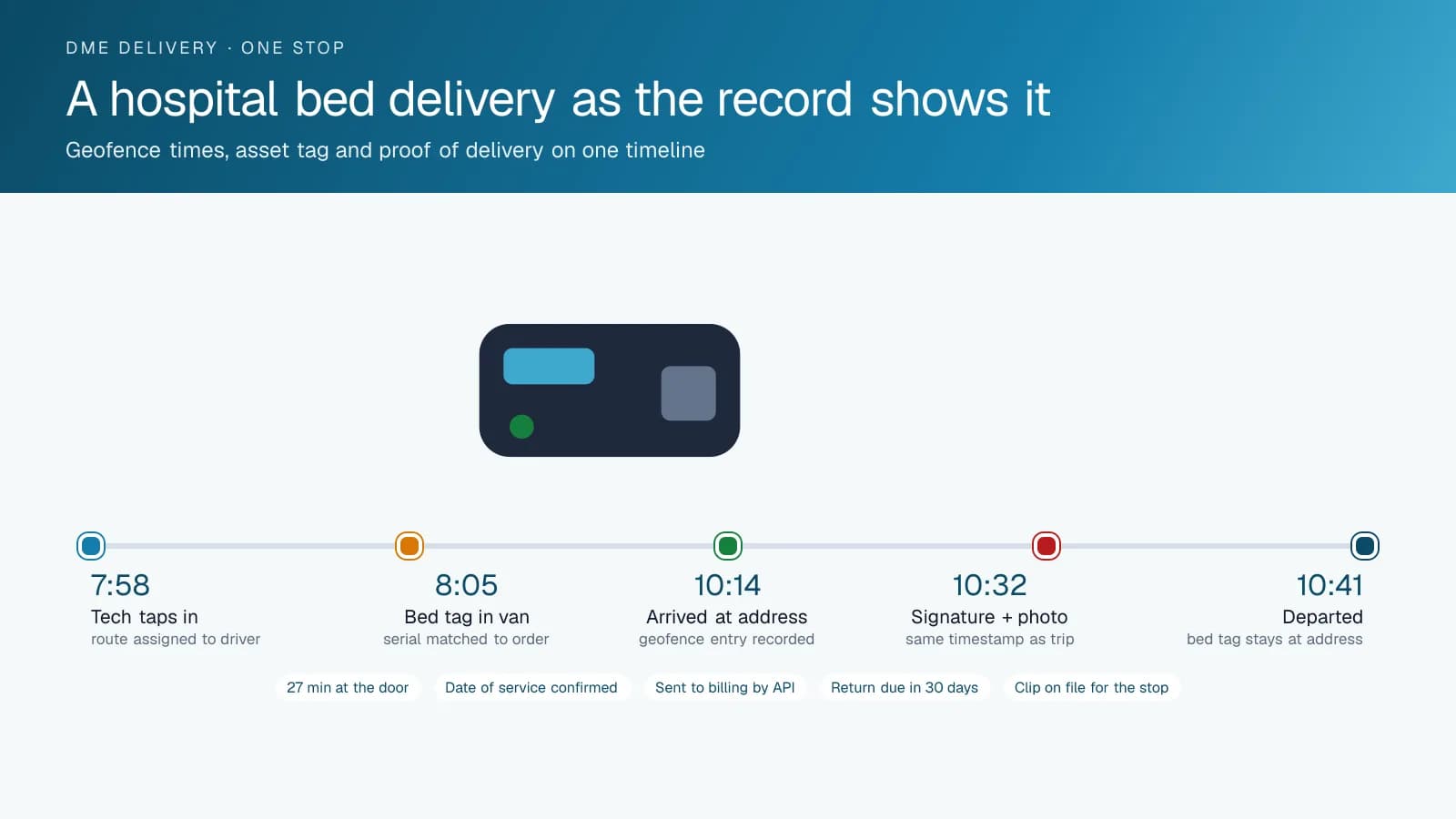
A DME claim rests on a delivery that happened at an address on a date. When a payer audits, they want to see it, and a driver's handwritten time is a weak witness. High Point GPS draws a geofence at each patient address as the order is created, and the GPS tracking device records the van's arrival at 10:14, its departure at 10:41 and the twenty-seven minutes between. The technician's proof-of-delivery photo and the patient's signature carry the same time from the same device. The audit file for that claim is a single report, printed from the High Point GPS platform or pulled through the API into the billing system.
The same record settles the everyday questions. A patient's family says the driver never came; the replay shows the van at the curb for six minutes and the doorbell moment in the dash cam clip. A discharge planner wants to know if the bed will be there by 14:00; dispatch sees the van two stops away and gives a time instead of a promise. High Point GPS sets up the address geofences to build themselves from the order feed, so nobody draws them by hand.
Knowing which unit is in which van
Rental equipment is inventory that lives in patients' homes and in vans, and it drifts. A hospital bed goes out on a Tuesday, the return is scheduled for a month later, and in between nobody is sure which of three vans it is in or whether it came back at all. Bluetooth asset tags on beds, lifts, wheelchairs and concentrators report to the GPS tracking device in whichever van they ride in. The High Point GPS platform shows the tag arriving at the patient's address, staying there while the van leaves, and coming back into a van on the pickup date. A battery tracker on a power wheelchair or a high-value bed reports on its own, anywhere it goes, and answers the question of where a unit went when the patient moved.
The inventory view that results is by serial number, and it lines up with the order system through the API. A unit that has been at an address past its scheduled return shows on a report every morning. A unit in a van that was supposed to be in the warehouse shows too. Oxygen cylinders can be tagged the same way when the supplier wants a chain of custody to the cylinder.
Technicians on residential streets all day
A DME van spends its day in driveways, cul-de-sacs and apartment lots. Most of the claims against the fleet come from those places: a scraped car in a parking lot, a neighbour's complaint about speed on a quiet street. AI dash cams, road-facing and driver-facing, record the moments a supervisor needs and flag the events worth reviewing. When a parking-lot claim arrives a week later, the clip for that stop is pulled by address and by time. High Point GPS sets driver scoring for this kind of driving, with residential speed limits enforced through geofences and weighted more heavily than the highway segment between towns.
Driver ID makes the scoring fair. An IOX-NFCREADERA reader assigns each trip to the technician who tapped in, and the coaching conversation starts from a specific stop on a specific day rather than a van's monthly average. The pre-trip inspection runs in the driver app with a checklist that includes the lift gate and the oxygen securing, and a defect goes to the coordinator before the van leaves the yard.
Feeding delivery data into billing and accreditation
The delivery record is only useful if it lands in the systems the supplier already runs. Through the open API, High Point GPS sends the arrival time, the departure time and the mileage for each stop into the billing platform, so the date-of-service field is populated from the GPS tracking device rather than from a driver's notes. Returns and pickups update the inventory system the same way. A supplier that runs an ERP alongside a specialized DME billing package gets both fed from the same records.
Accreditation surveys ask for evidence of delivery timeliness, vehicle maintenance and driver qualification. Each is the High Point GPS platform report: on-time delivery against the scheduled window, preventive maintenance completed on engine hours and mileage, and driver ID with the scoring history behind it. The supplier hands the surveyor a set of reports pulled from one database, and the fleet section of the survey takes an hour instead of a week.
Frequently asked questions
Can it prove a delivery for a payer audit?
Yes. A geofence at the patient address records the van's arrival, departure and time at the door on the date of service, and the technician's proof-of-delivery photo and signature carry the same timestamp. The report for that stop prints from the High Point GPS platform or flows into the billing system through the API.
How does it track rental equipment?
Bluetooth asset tags on beds, lifts, wheelchairs and concentrators report to the GPS tracking device in whichever van carries them, and the High Point GPS platform records where each unit was dropped off and when it came back. Battery trackers report on their own for power chairs and high-value beds that may move after delivery.
Will delivery times go into our billing system?
Yes. The open API sends arrival and departure times, stop duration and mileage for each address into the billing or inventory platform. High Point GPS builds the integration so the date-of-service field is filled from the trip record rather than keyed in by hand at the end of the day.
Do the dash cams record at patient homes?
The road-facing camera records the approach, the driveway and the parking lot, which is where most claims arise. The driver-facing camera records the cab. Video is retrieved by event and by stop, and the supplier sets the retention and access policy so patient privacy is respected.
What does the technician have to do differently?
Tap in with their driver card at the start of the shift, run the pre-trip inspection in the driver app and take the proof-of-delivery photo as they do now. Location, stop times, asset tags and driver scoring all record without any input from the technician.
Related solutions
Related guides
- How Geofencing Works for Fleet Tracking →
- GPS Asset Tags vs. Powered Trackers: Which to Use →
- IOX-BT and Bluetooth Asset Tags: How They Work and What to Tag →
- Dash Cam Footage and Insurance Claims →
- The High Point GPS API: What You Can Actually Build →
- IOX-NFCREADERA: Driver ID by NFC Tap, So Every Trip Has a Name on It →
Get a free quote
What are you looking for?