
Industry
GPS Fleet Tracking for Restoration & Damage Recovery
GPS fleet tracking for water and fire restoration companies: nearest crew to the loss, arrival times for the insurer and every dehumidifier accounted for.
Updated September 21, 2026
Restoration is a business of emergencies. A pipe bursts at 2 a.m., the adjuster wants to know when the crew arrived, and forty dehumidifiers and air movers are spread across a dozen properties with nobody quite sure which ones. High Point GPS gives a restoration company one live map of every truck and van in the High Point GPS platform, with the crew closest to the new loss visible at a glance and its trip recorded from the moment it rolls. Geofences around each active job site write the arrival and departure times the insurer's file needs, and the site-visit history shows every monitoring visit during the drying period. Bluetooth asset tags on dehumidifiers, air movers, air scrubbers and extraction units tell the office which truck dropped each unit at which property and when it came back. That is how a company stops buying replacements for equipment that is sitting in a customer's basement. Driver ID readers attribute after-hours trips to the technician on call, and driver scoring keeps emergency response from turning into reckless driving. Engine-hours maintenance and fault codes keep trucks that idle for hours running pumps and generators in service. When a homeowner or an adjuster questions the response time, the equipment days billed or the number of visits, the answer is a report, not a recollection.
Common challenges
- Dispatching an emergency call by phoning around to find out which crew is closest and free
- Adjusters asking for the exact arrival time on a loss, with nothing better than the technician's word
- Dehumidifiers and air movers left at customer properties and forgotten, replaced at full price weeks later
- Equipment-day billing that the insurer disputes because nobody can show when the units were placed and picked up
- On-call technicians driving company vans at night with no record of who took which vehicle
- Trucks that idle for hours running pumps and generators, with maintenance still scheduled by the calendar
How High Point GPS helps
- Live map of every truck and van, with the nearest available crew to a new loss visible in seconds
- Arrival and departure times per job site from geofences, matching what the insurer's file requires
- Monitoring-visit history over the full drying period, showing each check on each property
- Bluetooth asset tags on dehumidifiers, air movers, scrubbers and extractors, tied to the truck that carried them
- Alerts when a tagged unit has not been seen by any company vehicle for a set number of days
- Named technician on every after-hours trip through the IOX-NFCREADERA driver ID reader
- Driver scoring and speed rules that hold emergency response to a safe standard on the road
- Engine-hours maintenance reminders for trucks that idle to power pumps, plus fault codes to the shop
Getting the closest crew to the loss, and proving when it arrived
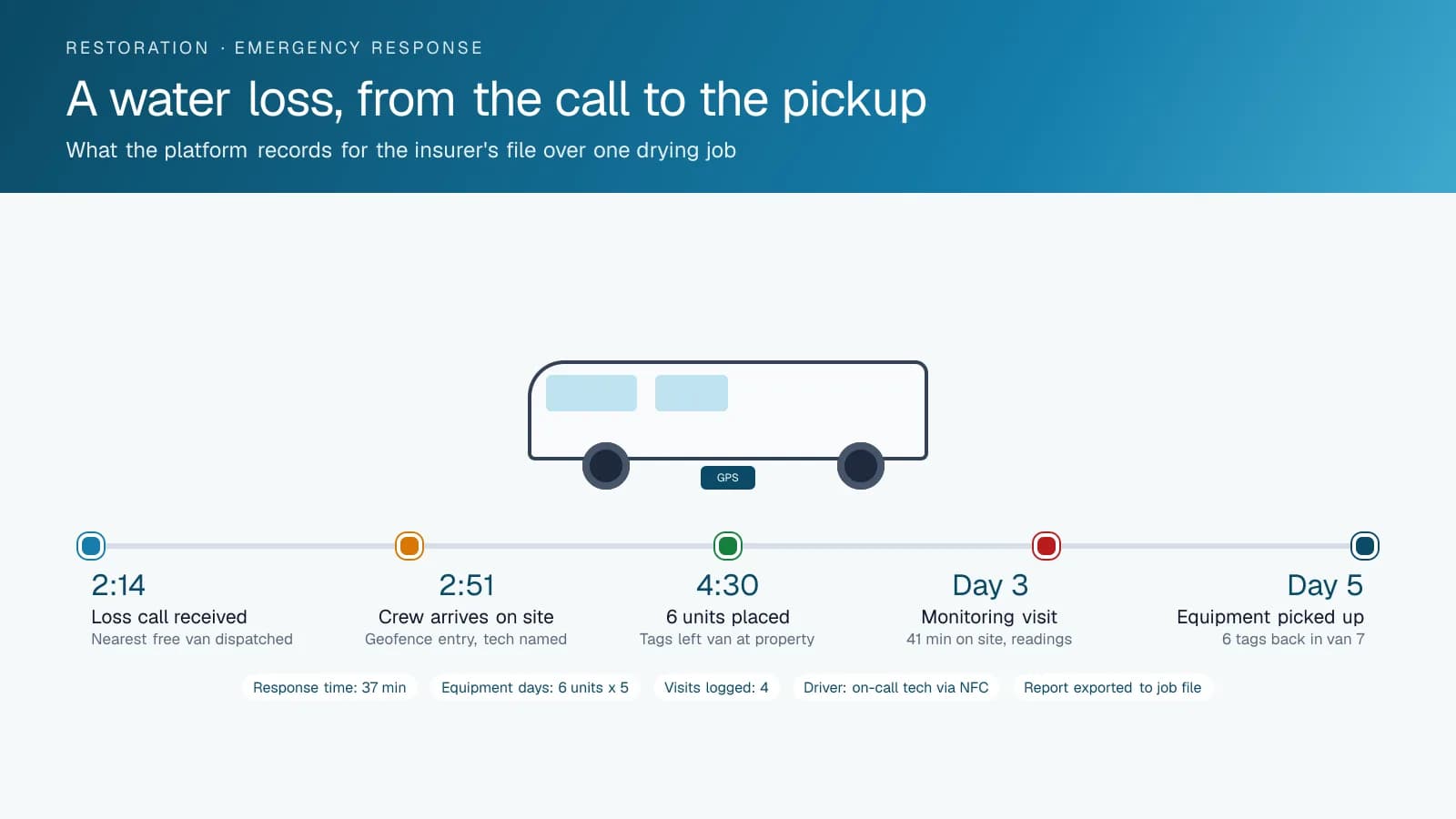
The first hour after a water loss decides how much of the property is saved. When the call comes in, the dispatcher sees every truck on the map, which ones are stopped at a job and which are moving. The nearest free crew gets a job that appears on the technician's phone. The trip starts recording as the van leaves the yard or the technician's driveway. High Point GPS sets up a geofence around the loss address as soon as the job is created, and the arrival time is written the moment the van enters it.
That arrival time becomes the first line of the insurance file. Adjusters and program managers ask for it on every claim, and a restoration company that answers with a timestamped record rather than a technician's estimate builds a reputation with the carriers that feed it work. The same records show the response time across all losses in a month, by crew and by time of day. That is the number a company uses when it negotiates its place on a carrier's preferred-vendor list. A crew dispatched twice to the same loss shows both trips.
Knowing where every dehumidifier is tonight
Drying equipment is the restoration company's inventory, and it lives in other people's homes. A dehumidifier placed on a Tuesday and forgotten on the pickup two weeks later is a unit that is bought twice. A Bluetooth asset tag on each dehumidifier, air mover, air scrubber and extraction unit reports to the GPS tracking device in whichever truck it rides in. The High Point GPS platform shows which units left the warehouse in which truck, which property they were dropped at and when they came back. The equipment list per job site stays current without a technician writing serial numbers on a clipboard.
The equipment record also settles the billing. Equipment days are invoiced per unit per day, and insurers push back when the count looks high. The tag history shows the six air movers arriving at the property on the 4th and leaving on the 9th, in the company's own truck, and the invoice matches. When a tagged unit has not been seen by any company vehicle for a set number of days, the platform raises an alert, and the office goes looking before the unit is written off. Serial numbers stay tied to the tag, so the inventory count at the warehouse matches what the platform reports.
On-call nights, shared vans and safe driving under pressure
Restoration vans go home with whoever is on call, and a company needs to know who drove what when a claim, a ticket or a complaint arrives. The IOX-NFCREADERA reader attributes each trip to the technician who tapped in, and after-hours trips are reported separately from the working day. Personal-use rules let the on-call technician keep a Saturday errand off the job report while the company still has the vehicle's location if it is needed. The company also has a record of which van carried which equipment on the night call, which closes the loop with the asset tags on the units.
Emergency work pulls drivers toward speed. Driver scoring in the High Point GPS platform reports speeding, hard braking and cornering by named driver, and geofence speed rules can be set around residential areas where the company's vans spend their time. A supervisor sees who is driving safely at night and who is not, and coaching starts from a specific trip. Dash cams add the view from the road when a company wants it; a fender-bender on the way to a flooded basement is settled with the footage rather than with the other driver's version. Footage is retrieved by trip and by event, and the company sets who can view it.
Monitoring visits, maintenance and the records behind the invoice
Drying does not end when the equipment is placed. A technician visits every day or two to take readings and adjust the setup, and the insurer expects those visits to have happened. The site-visit history for each job's geofence lists every visit with its time and duration, by technician, over the full drying period. If a homeowner says nobody came for a week, the record settles it, and if the company's own report shows a property with no visit in three days, the manager knows before the adjuster does.
The trucks work as hard as the crews. Extraction pumps and generators run off the engine for hours at a loss, and a calendar-based service schedule misses it. Maintenance reminders keyed to engine hours schedule the oil change when the engine has actually done the work, and fault codes reach the shop as they appear. High Point GPS builds the reports a restoration company needs: response times by claim, equipment days by job, visits by property and mileage by vehicle. They export to the job-management system through the open API where the company wants it.
Frequently asked questions
Can it give the insurer an exact arrival time on a loss?
Yes. A geofence around the loss address records the moment the crew's vehicle enters it, with the time, the vehicle and the technician. The arrival time and every later monitoring visit appear in a site-visit report that matches what adjusters and carrier programs ask for. The report exports as a PDF or a spreadsheet.
How does it track dehumidifiers and air movers left at a property?
Bluetooth asset tags on each unit report to the GPS tracking device in the truck that carries them. The High Point GPS platform shows which units were dropped at which property and when they came back, supports equipment-day billing and alerts when a tagged unit has not been seen by any company vehicle for a set number of days.
Does it work for on-call technicians who take vans home?
Yes. A driver ID reader attributes each trip to the technician who tapped in, after-hours trips are reported separately from the working day, and personal-use rules keep private errands off the job report while the company still has the vehicle's location if needed. Trips are reported by technician and by vehicle.
Can the data go into our job-management software?
Yes. Arrival times, visits, equipment movements and mileage are available through the open High Point GPS API, and High Point GPS builds the integration or a custom add-in when a company wants the records inside its job-management or invoicing system rather than in a separate report. Reports can also be exported on a schedule.
What about trucks that idle for hours running pumps?
Maintenance reminders run on engine hours rather than the calendar, which captures the wear from idling at a loss. Engine fault codes are sent to the shop as the truck logs them, and idling is reported separately so a manager can tell pump time from a driver leaving the engine running.
Related solutions
Related guides
- How Geofencing Works for Fleet Tracking →
- GPS Asset Tags vs. Powered Trackers: Which to Use →
- IOX-BT and Bluetooth Asset Tags: How They Work and What to Tag →
- Equipment Theft Recovery: How GPS Gets Stolen Machines and Trailers Back →
- IOX-NFCREADERA: Driver ID by NFC Tap, So Every Trip Has a Name on It →
- Fleet Maintenance: Engine Hours vs. the Calendar →
Get a free quote
What are you looking for?