
Industry
GPS Fleet Tracking for Roofing & Siding Contractors
GPS tracking for roofing and siding contractors that puts every crew truck, dump trailer and material delivery on one map, records time on site for each job, protects trailers and equipment from theft, and settles disputes with customers and crews from the trip record.
Updated September 21, 2026
A roofing or siding contractor runs a fleet that is never in one place. Crew trucks leave the yard at dawn, dump trailers sit at three job sites at once, and a supplier's flatbed is due somewhere with forty squares of shingles that the crew cannot start without. GPS tracking from High Point GPS gives the office a live map of all of it: which crew is on which roof, which trailer is at which address, and when the truck left the supplier's yard. The Geotab GO device in each truck records every trip, every stop and how long it lasted, and that record becomes the time on site the estimator needs to know whether the job made money. Bluetooth asset tags and battery trackers on trailers, compressors and lifts mean the equipment that walks off a site at night is found the next morning. On a weather day, the office sees who went to the site, who turned around and who sat in the truck for two hours, and the crew's pay reflects what happened. A loaded dump trailer behind a three-quarter-ton pickup changes how the truck should be driven, and driver scoring with dash cams shows who respects that and who does not. Every record is timestamped and stored, ready for a customer who says the crew never showed, an insurer asking about a trailer, or a crew lead disputing hours on a Friday.
Common challenges
- Crew trucks and dump trailers spread across five job sites with no live view of which is where
- Time on site guessed from crew timesheets, which makes job costing on a re-roof a rough estimate at best
- Dump trailers, compressors and ladders stolen from job sites overnight, with no way to find them
- Material deliveries that arrive late or at the wrong address while the crew waits on the roof
- Weather days where nobody knows who drove to the site, who got sent home and what to pay
- Hard braking and speeding with a loaded dump trailer that ends in a rear-end claim or a jackknife
How High Point GPS helps
- Live map of every crew truck and trailer, with the job site each is parked at and how long it has been there
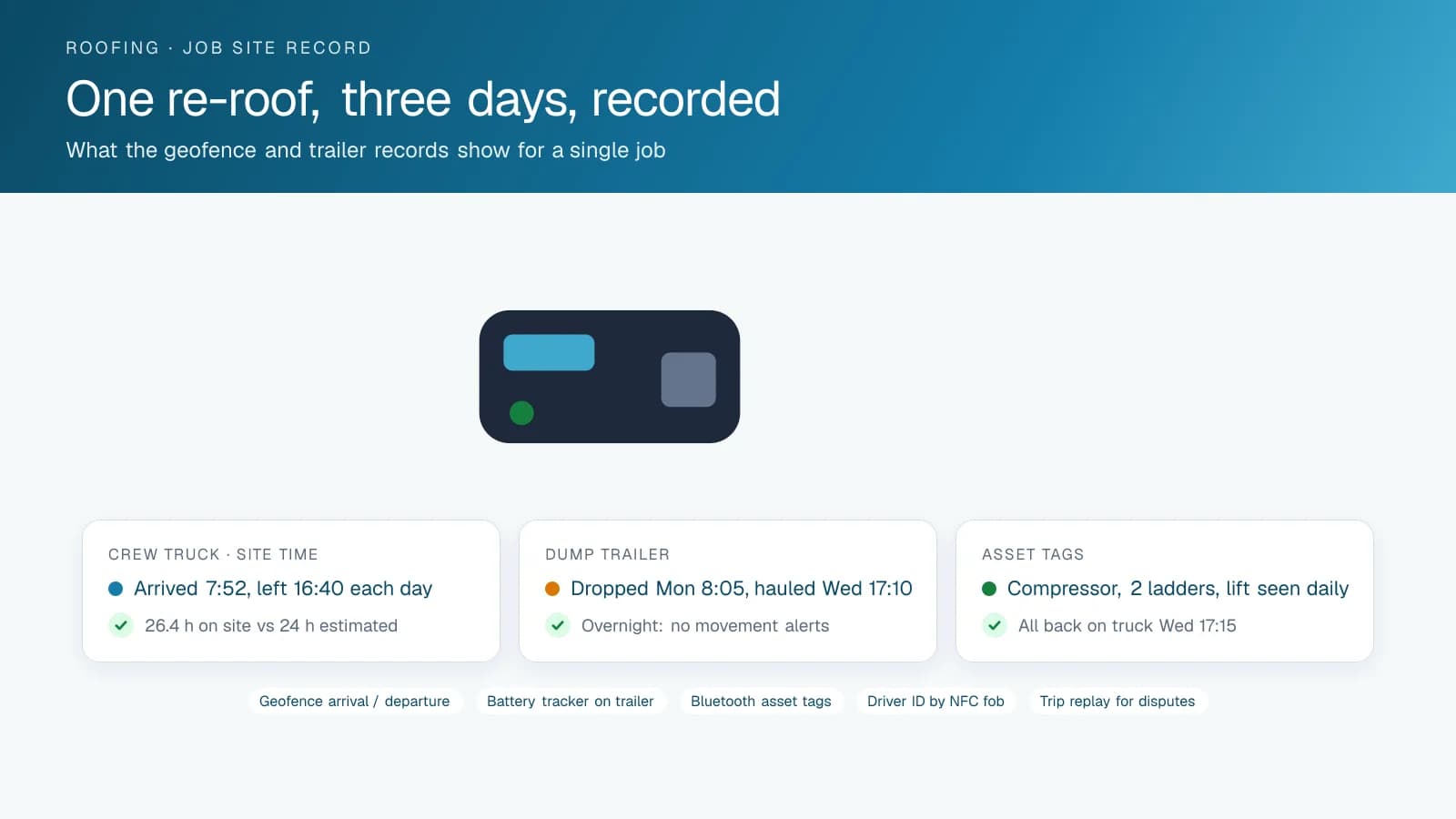
- Time on site per job from geofence arrival and departure records, ready to compare against the estimate
- Bluetooth asset tags on ladders, compressors and lifts, battery trackers on dump trailers, all visible in MyGeotab
- Theft alerts when a trailer moves outside working hours or leaves a job site geofence without a crew truck
- Delivery tracking for the contractor's own supply runs, with arrival records at the job site
- Driver scoring tuned for trucks pulling loaded trailers: following distance, hard braking, speed on grades
- AI dash cams that capture the road ahead and flag the events that matter when a trailer is behind the truck
- Engine-hours and mileage maintenance reminders for trucks that tow every day, with fault codes sent to the shop
Knowing Where Every Crew and Trailer Is at 7 a.m.
The office of a roofing contractor starts the day with the same question a customer will ask an hour later: where is the crew? With every truck on a live map in MyGeotab, the answer is on screen. Each job site is drawn as a geofence, and the platform records when a truck arrived, when it left and how long the stop lasted. The dispatcher sees a crew that has not left the yard yet, a truck stopped at a coffee shop for forty minutes, and a dump trailer still sitting at a job that finished yesterday. Trailers carry their own tracker; a trailer left behind is a trailer the office knows about, not one discovered when the next crew needs it.
The same map serves the customer. A homeowner who was told the crew would be there at 8:00 calls at 8:20. The office sees the truck three blocks away and says so, rather than promising to call back. When a customer later claims the crew arrived late every day of a week-long job, the arrival records for each day are in the trip history, with times to the minute. High Point GPS sets up the job-site geofences from the contractor's schedule, and a new address can be added in the time it takes to type it.
Time on Site as the Basis for Job Costing
A roofing estimate assumes a number of crew hours per square. The only way to know whether that number held is to know how long the crew was actually on the roof. Timesheets give a version of that; the geofence record gives the one that cannot be rounded. For each job, MyGeotab reports the trucks that visited, the hours between arrival and departure each day, and the total across the job. The estimator compares that against the bid and learns which roof types, which pitches and which crews are running over. Over a season, the estimates get better because they are built on recorded hours instead of remembered ones.
Weather days are the hardest hours to cost. The crew drove forty minutes to the site, the rain started, and they sat in the truck until the foreman called it. The trip record shows the drive out, the two hours parked at the site and the drive back. That is the record payroll uses, and it is the record that ends the Friday argument between a crew lead who says they waited three hours and a foreman who says one. Driver ID through an NFC key fob ties each trip to the person driving, which matters when trucks change hands between crews mid-week.
Trailers and Equipment That Stay Where You Left Them
A dump trailer full of tear-off, a compressor, a nail gun set and a set of ladders left on a job site overnight are the easiest things in a contractor's business to steal. A battery tracker on each trailer reports its position several times a day and wakes up the moment it moves. High Point GPS configures an alert for any trailer that moves outside working hours or leaves a job-site geofence while no crew truck is nearby. The office gets a text with the trailer's position and direction, and the police get a live location instead of a description. Trailers that are recovered the same night are trailers that do not get replaced through insurance.
Smaller equipment goes on Bluetooth asset tags. The tags are read by the GO device in any of the contractor's trucks, and the platform knows which compressor was last seen with which truck at which site. When a crew lead reports a missing lift, the last-seen record shows it was at the Tuesday job and never left with the truck. The inventory of what went to a site and what came back is kept without anyone counting, and an insurance claim for stolen equipment comes with a location history the insurer accepts.
Driving with a Loaded Trailer Behind the Truck
A pickup pulling a dump trailer with three tons of tear-off stops differently, corners differently and needs more room than the same truck empty. Driver scoring in MyGeotab records hard braking, fast cornering and speeding on each trip, and High Point GPS sets the thresholds for a fleet that tows. An IOX-AUXM input can read the trailer-brake controller or the trailer-lights circuit, so the platform knows when a trailer is attached and applies the tighter rules only then. The foreman's weekly review starts from specific events on specific trips rather than a general talk about driving carefully.
AI dash cams give that review a picture. A road-facing camera records the following distance and the traffic ahead; a driver-facing camera flags phone use and fatigue on long drives to out-of-town jobs. When a loaded trailer is rear-ended at a light, or a truck is blamed for a collision on a highway ramp, the footage and the speed record arrive together, and the insurer's question is answered in an afternoon. Maintenance reminders on engine hours and mileage keep brakes and tires on trucks that tow daily from being the reason a job runs late.
Frequently asked questions
Can I see how long a crew was actually on a job site?
Yes. Each job site is drawn as a geofence, and MyGeotab records when each truck arrived, when it left and the total time inside, day by day and across the whole job. That record is what the estimator compares against the bid and what payroll uses for weather days and disputed hours.
How do I track dump trailers that have no power of their own?
A battery-powered tracker mounted on the trailer reports its position on a schedule and wakes when it moves. High Point GPS sets an alert for movement outside working hours or away from a job site without a crew truck nearby. A stolen trailer is followed live on the map rather than reported the next morning, and the police get a position instead of a description.
What about ladders, compressors and lifts?
Bluetooth asset tags on smaller equipment are read by the GO device in any of your trucks. The platform records which tag was last seen with which truck at which site. A missing compressor has a last-known location, the crew lead knows which truck to check first, and an insurance claim comes with a location history instead of a guess.
Will it tell me when a truck is towing a trailer?
It can. An IOX-AUXM input reads the trailer-lights or brake-controller circuit, and the platform records when a trailer is attached. Driver scoring then applies the towing thresholds only on those trips, and the trip history shows which truck moved which trailer.
How does this help on a weather day?
The trip record shows who drove to the site, how long they stayed and when they left. The office sees in real time who is waiting out the rain and who was sent home, and payroll has a recorded basis for the hours instead of a crew lead's estimate on Friday.
Related solutions
Related guides
- Trailer GPS Tracking: How to Track Trailers With and Without a Truck Attached →
- Equipment Theft Recovery: How GPS Gets Stolen Machines and Trailers Back →
- GPS Asset Tags vs. Powered Trackers: Which to Use →
- How Geofencing Works for Fleet Tracking →
- Do Dash Cams Actually Lower Fleet Insurance Premiums? →
- GPS Fleet Tracking for Small Business: What a 3 to 20 Vehicle Fleet Needs →
Get a free quote
What are you looking for?