
Industry
GPS Fleet Tracking for Security Patrol & Guard Services
GPS tracking for security patrol and guard fleets that proves every site visit with a time-stamped record, keeps mobile patrol routes unpredictable, measures alarm response time, attributes each check-in to a guard and produces the client reports a contract renewal depends on.
Updated September 21, 2026
A security company sells presence, and presence is hard to prove. The contract says three patrols a night at each site; the client asks whether they happened; the patrol supervisor has a logbook filled in at the end of the shift. GPS tracking for security patrol fleets replaces that logbook with a record the vehicle creates on its own. A geofence around every client site logs the patrol vehicle's arrival, the minutes it stayed and its departure, and the report by site and by night shows every visit against the contract's requirement. Driver ID through the IOX-NFCREADERA reader attributes each visit to the guard on duty. Alarm response is measured from the dispatch time to the arrival at the site geofence, which is the number a monitoring client wants in the monthly report. Mobile patrol routes are reviewed on the trip replay so that a supervisor can confirm the order of visits changes from night to night rather than following a pattern anyone watching could learn. After-hours and off-territory use of patrol vehicles shows up on an exceptions report, and driving is scored with night-shift fatigue detection from a driver-facing AI dash cam if the company chooses cameras. High Point GPS builds the MyGeotab database around the company's site list, produces the client-facing reports and connects the records to the company's guard-management or dispatch software through the open API.
Common challenges
- Client contracts that require a set number of patrols per night with only a guard's logbook to show they happened
- Alarm response times reported from memory or from the monitoring centre's call log, with no record of when the vehicle actually arrived
- Patrol routes that settle into the same order every night, which anyone watching a site can learn
- Guard check-ins at a site that cannot be tied to a specific guard or a specific vehicle after the fact
- Monthly client reports assembled by hand from logbooks and dispatch notes, a day of work per large account
- Patrol vehicles used off the clock or outside the territory, discovered only when a fuel bill or a complaint arrives
How High Point GPS helps
- A geofence around every client site that records arrival, time on site and departure for each patrol visit without any input from the guard
- Proof-of-patrol reports by site, by night and by contract that show every visit against the required count
- Alarm response time measured from dispatch to arrival at the site geofence, with the trip replay behind each number
- Guard attribution through the IOX-NFCREADERA driver ID reader, tying each visit and each trip to the person on duty
- Trip replay for route review, so a supervisor can confirm patrol order varies from night to night
- Exceptions reports for after-hours, off-territory and personal use of patrol vehicles, with the driver attached
- Driver-facing AI dash cam with fatigue and distraction detection for night shifts, and road-facing video by event
- Client reports and check-in records passed to guard-management or dispatch software through the open API
Proof of Patrol: Every Site, Every Visit, Every Night
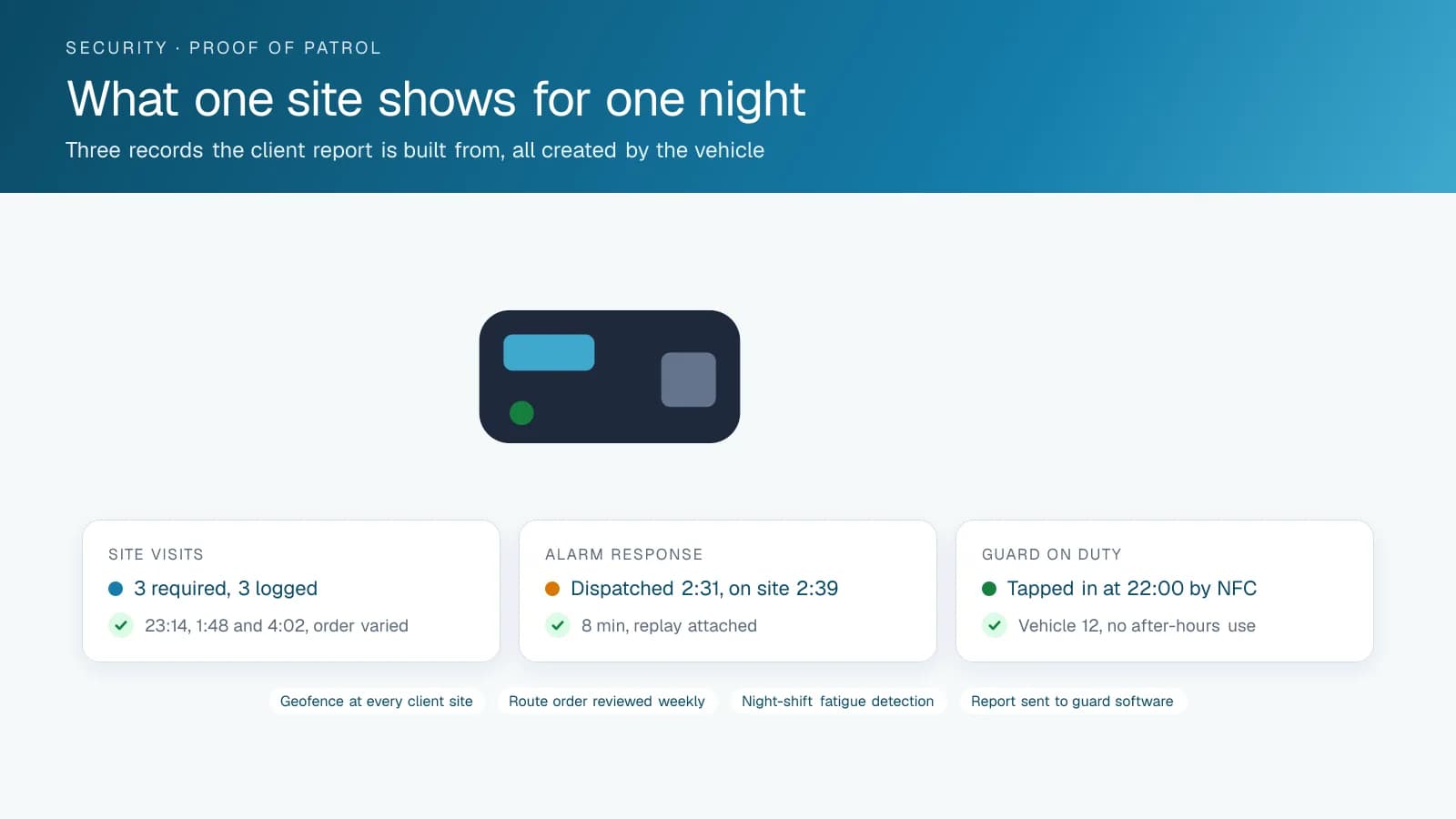
A mobile patrol contract is a promise of visits, and the client's question at renewal is whether the visits happened. High Point GPS sets a geofence around every site in the contract list, and the GO device in each patrol vehicle records the arrival, the time on site and the departure. The record is created by the vehicle rather than by the guard, and it exists whether or not the guard remembered to scan a checkpoint. The proof-of-patrol report lists each site with its visits for the night, the time of each and the guard on duty, against the count the contract requires.
When a client calls to say the lot was empty at 2 a.m. and there was no patrol, the supervisor sees the vehicle at the site from 1:48 to 1:56 and says so. When the visit was missed, the supervisor sees that too and deals with it before the client does. For a client with thirty sites, the monthly report is one document produced in minutes instead of a day spent transcribing logbooks. The report is also the supervisor's own tool: a night with two visits logged against three required stands out at the top of the list before the client's call.
Routes That Do Not Repeat and Responses That Are Timed
A patrol route that follows the same order every night is a schedule anyone watching a site can learn. The trip replay shows a supervisor the order of visits for each vehicle each night, and a weekly review confirms that the sequence and the timing vary. Where the company assigns routes from a dispatch system, the open API passes the night's plan into the vehicle and the completed visits back out, so a supervisor compares planned to actual on one screen. A site that was visited at the same minute three nights running is flagged before the client notices.
Alarm response is timed from the vehicle. The dispatch time comes from the monitoring centre or the dispatch system; the arrival comes from the site geofence. The gap is the response time, and the report shows it by site, by hour and by guard for the month. A monitoring client that pays for a response guarantee receives the numbers with the trips behind them, and a dispute about a slow response is settled by the replay rather than by two accounts of it. Over a month, the report shows which sites and hours run long, which is where the company adds a vehicle or moves a post.
Who Was on Duty and Where the Vehicle Went After
Guards share vehicles across shifts, and a record that shows a vehicle at a site is not enough when the client asks who was there. The IOX-NFCREADERA driver ID reader ties each trip and each site visit to the guard who tapped in at the start of the shift. Check-ins at the site, whether by NFC checkpoint or in the company's guard app, line up with the vehicle's arrival record, and a check-in that happened while the vehicle was elsewhere stands out. Guards also see their own attributed visits, and a guard accused of skipping a site can point to the record rather than to memory.
A patrol vehicle marked with the company's name does not belong at a guard's house on a night off. Time-of-day and zone rules put after-hours, off-territory and personal trips on an exceptions report with the driver and the trip replay attached. Most weeks the report is empty, and when it is not, the supervisor has the trip rather than a suspicion. The same rules cover the vehicle's speed on patrol, with limits set per zone so that a residential client site is patrolled at a residential speed. Trips are stored on the device in an underground garage and uploaded when the vehicle surfaces.
Night Shifts, Cameras and the Client Report
Night patrol is where fatigue does its damage. A driver-facing AI dash cam detects drowsiness and distraction and flags the events for the supervisor, with the video pulled by trip and by event rather than by watching a shift's footage. A road-facing camera records what the patrol vehicle saw at a site, which has settled more than one dispute about a gate left open or a vehicle in a lot. The company sets retention and access, and the guard sees the same events on their own score. Cameras are optional, and many companies start with tracking alone and add them for the accounts that ask.
Everything above ends up in the client report. High Point GPS builds it from the site visits, the response times and the exceptions, in the format the client contract calls for, and connects the records to the company's guard-management or dispatch software through the open API. Maintenance reminders run on mileage and engine hours, and electronic DVIR inspections in the Geotab Drive app give the start-of-shift walkaround a time stamp and a path to the shop. Maintenance and inspection records also serve the client audit, because a contract that requires a marked vehicle on site requires one that runs.
Frequently asked questions
How does it prove a patrol visit happened?
A geofence around each client site records the patrol vehicle's arrival, time on site and departure from the GO device, without any input from the guard. The proof-of-patrol report lists every visit by site and night against the count the contract requires, with the guard on duty attached through driver ID.
Can it measure alarm response time?
Yes. The dispatch time comes from the monitoring centre or dispatch system and the arrival time from the site geofence. The report shows response time by site, hour and guard for the month, and each number has the trip replay behind it if a client questions one.
How do we know which guard was in the vehicle?
The IOX-NFCREADERA driver ID reader ties each trip and site visit to the guard who tapped in at the start of the shift. Vehicles shared across shifts are attributed correctly, and a site check-in that does not line up with the vehicle's arrival record is visible to the supervisor.
Can it help keep patrol routes unpredictable?
The trip replay shows the order and timing of site visits for each vehicle each night, and a weekly review confirms they vary. Where routes come from a dispatch system, the open API passes the plan in and the completed visits out, so planned and actual are compared on one screen.
Does it produce the monthly client report?
Yes. High Point GPS builds the client report from site visits, response times and exceptions in the format the contract calls for, and can pass the same records to the company's guard-management software through the open API so the report is produced from one system.
Related solutions
Related guides
- Dispatch Software for Security Patrol and Guard Companies →
- How Geofencing Works for Fleet Tracking →
- IOX-NFCREADERA: Driver ID by NFC Tap, So Every Trip Has a Name on It →
- Timeline Map: Replaying a Trip Minute by Minute to Settle a Dispute →
- Fleet Dash Cams With Live View: What Live Streaming Shows and When It Is Actually Used →
- GPS Fleet Tracking for Small Business: What a 3 to 20 Vehicle Fleet Needs →
Get a free quote
What are you looking for?