
Industry
GPS Fleet Tracking for Senior Living & Community Transport
GPS tracking for senior living and community transport vans: live van position, every pickup and drop-off recorded and wheelchair lift use logged.
Updated September 21, 2026
A residence van carries the people who can least afford a missed pickup: a resident with a dialysis appointment, a group going to the pharmacy, a couple who need the wheelchair lift and a driver who knows how to use it. GPS tracking from High Point GPS puts every van on one live map for the activities coordinator or transport office, with the stop it is heading to and the time it will arrive. A family member's call is answered in seconds. The GPS tracking device records every trip and every stop, and an auxiliary input on the door records how long it was open at each one. An IOX-AUXM module on the wheelchair lift circuit records when the lift was deployed, which shows a resident was boarded properly and supports the funding reports many community transport agencies file. Driver ID through an NFC tag ties each trip to the staff member who drove, including the recreation aide who takes the van on Tuesdays. Driver scoring with thresholds set for frail passengers flags the hard braking and fast cornering that a resident in a wheelchair feels most. Electronic inspections in the driver app confirm the lift, the tie-downs and the ramp were checked before the first pickup. When a family asks why their mother was 45 minutes late for her appointment, or an incident report has to be filed after a fall on the lift, the trip record answers it.
Common challenges
- Families and clinics calling to ask where the van is, with the coordinator unable to say
- Missed or late medical appointments with no record of when the van actually arrived
- No proof that a resident in a wheelchair was boarded with the lift and secured before the van moved
- Rough driving that a frail passenger feels and reports, with nothing to check the report against
- Vans shared among recreation, nursing and maintenance staff with no record of who drove when
- Funder and regulator reports on trips, riders and lift use compiled by hand from paper logs
How High Point GPS helps
- Every van on one live map with its next stop and arrival estimate, for the coordinator answering a family's call
- Stop records with door-open time at each pickup and drop-off, for the appointment that was missed or made
- Wheelchair lift and ramp use read from the van's own circuit through the GPS tracking device's auxiliary inputs
- Driver ID through an NFC tag, so each trip is attributed to the staff member behind the wheel
- Driver scoring with thresholds set for frail and seated passengers, flagging hard braking and fast cornering
- Electronic pre-trip inspections in the driver app covering the lift, tie-downs, ramp and first-aid kit
- Trip and rider counts by day, route and program, exported for funder and regulator reporting
- Engine-hours maintenance and fault codes sent to the shop, keeping a small van fleet available every day
The call from the family
The coordinator's hardest call is from a daughter who has been waiting at the clinic with her father for half an hour. With the van on a live map, the coordinator sees where it is, the stop it is heading to and its arrival estimate, and can say so. Geofences around the residence, the hospital, the dialysis centre and the pharmacies on the regular runs log arrival and departure without the driver writing anything down. When a resident has a standing appointment, the coordinator sets an alert for the van's arrival at the clinic and stops watching the clock.
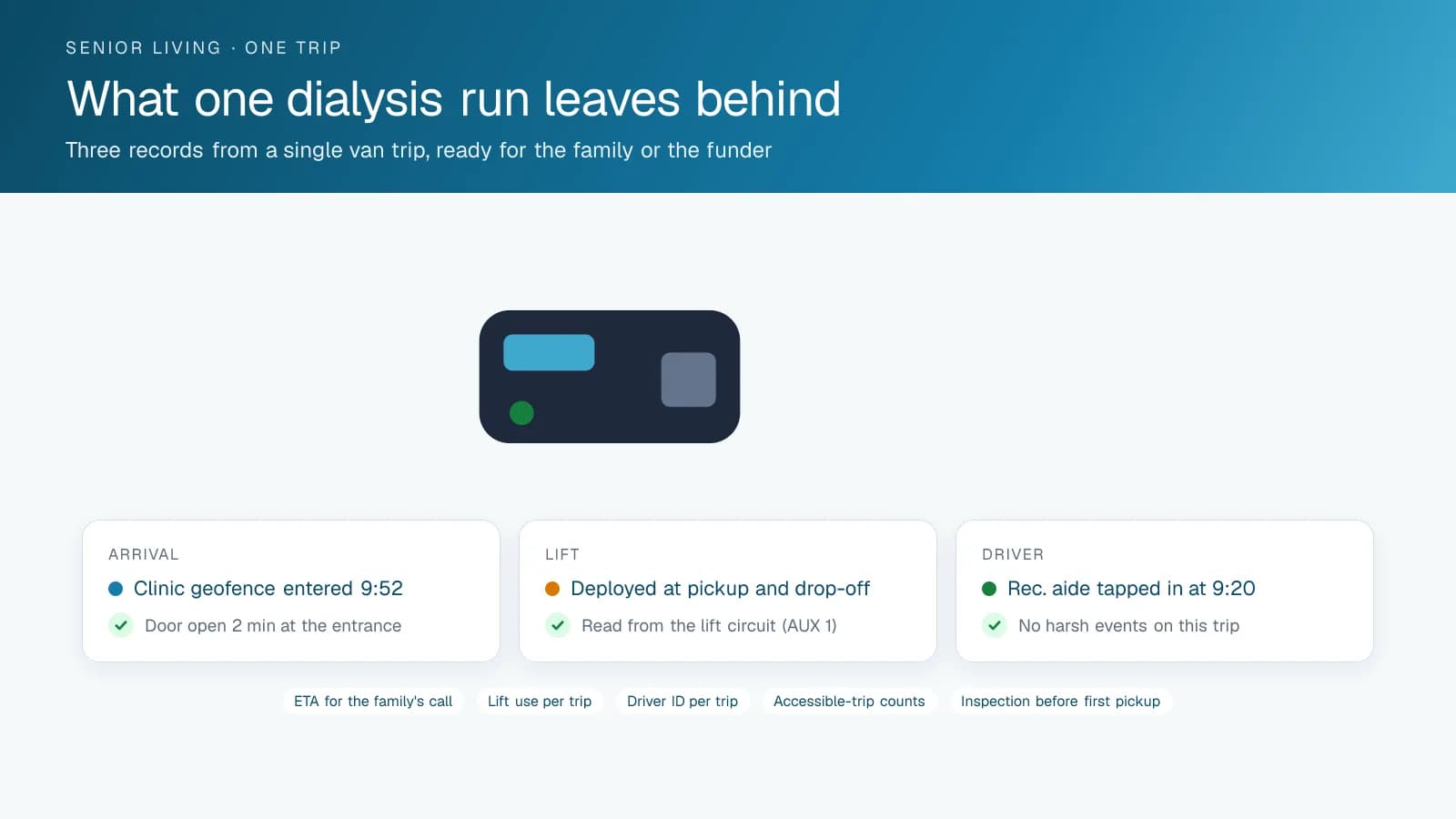
The record settles what the call could not. The family says the van was late; the trip replay shows it at the clinic door at 9:52, three minutes before the appointment. The clinic says the resident never arrived; the record shows the door open for two minutes at the entrance. A resident says the driver skipped their stop; the replay shows the route. High Point GPS sets these reports up for a coordinator who has other work to do, and a question that used to take an afternoon of phone calls takes a minute.
The lift, the door and the driver
A wheelchair lift is the most important piece of equipment on a residence van and the one least often recorded. An IOX-AUXM module on the GPS tracking device reads the lift circuit, and every deployment is logged with the time and the location. Paired with the door-open record from the stop, the trip shows that a resident using a wheelchair was boarded by the lift at the pickup and unloaded by it at the drop-off. For a community transport agency whose funding depends on counting accessible trips, that record replaces a tally sheet the driver fills in at the end of the day.
Residence vans are shared. The recreation aide drives on Tuesday, a nurse takes a resident to a follow-up on Wednesday and maintenance borrows the van to fetch supplies on Friday. An IOX-NFCREADERA reader in the cab records who tapped in before each trip, and the trip, the driving score and the fuel purchase belong to the person who was driving. A van that moves without a tap generates an alert. When a scratch appears on the rear quarter panel, the record shows which trips it could have happened on and who was at the wheel.
Driving for passengers who feel every bump
A hard stop that a delivery driver would not notice can bruise a resident with osteoporosis or tip a walker. Driver scoring in the High Point GPS platform measures hard braking, fast acceleration, cornering and speed on each trip, with thresholds High Point GPS sets tighter for passenger vans than for the maintenance truck. The coordinator sees which trips crossed a threshold and which driver was behind the wheel, and the conversation is about one turn on one afternoon rather than a general reminder to drive gently. AI dash cams, where a community chooses them, add the road-facing view when an incident on the road needs explaining.
Incident reports follow falls, and falls on a lift or in the aisle happen. The trip record gives the speed, the location and whether the van was moving when the resident reported the fall, and the lift record shows whether the lift was deployed. A driver-facing camera, where installed, shows whether the driver was watching the passenger or the road. These records protect the resident, the driver and the community equally, and they are ready before the incident form is. Regulators and insurers ask for exactly this, and most communities have never had it.
Inspections, maintenance and the reports funders want
A small van fleet has no spare capacity: when one van is down, a dialysis run is missed. Electronic DVIR in the driver app walks the driver through a checklist built for the van, including the lift, the tie-downs, the ramp and the first-aid kit. A defect is routed to whoever handles maintenance with a photo attached. Engine fault codes reach the same person as the van logs them, and maintenance reminders run on engine hours and mileage rather than on a wall calendar. A van that idles for long stretches with the heat on for waiting passengers accumulates engine hours a mileage schedule would miss.
Community transport agencies and residences funded by public programs report on trips, riders, accessible trips and vehicle use. Those counts come out of the High Point GPS platform by date range, route and program rather than from paper logs typed into a spreadsheet at month end. High Point GPS builds the export to match the reporting form the agency files, and the same records answer an auditor's question about a specific trip on a specific day. A residence group with several sites sees each site's vans in one database, with each coordinator seeing their own.
Frequently asked questions
Can families see where the van is?
The coordinator always has the live map, and most communities keep it there. Where a residence wants to offer families a view, High Point GPS can set up a limited tracking link for a specific van or trip, showing its position and arrival estimate and nothing else. The community decides whether and when to share it.
How does the system record wheelchair lift use?
An IOX-AUXM module on the GPS tracking device is wired to the lift's circuit and records each deployment with the time and location. Paired with the stop record and door-open time, the trip shows a resident was boarded and unloaded by the lift. The counts export for accessible-trip reporting to funders and regulators.
Our vans are driven by different staff every day. Does that matter?
It does not, as long as each driver taps in. An NFC reader in the cab records who is driving before each trip, and trips, driving scores and fuel purchases are attributed to that person. A van that moves without a tap generates an alert to the coordinator, and the record shows who had it when.
Will it help with the reports our funder requires?
Yes. Trips, riders, accessible trips, kilometres and vehicle hours are exported from the High Point GPS platform by date range, route and program. High Point GPS configures the export to match your reporting form, and the trip-level detail is retained if a funder or regulator asks about a specific trip on a specific day.
Is it complicated for our drivers?
No. The GPS tracking device works without any driver input. Drivers tap an NFC tag before driving and run the pre-trip checklist in the driver app on a phone or tablet, which takes a few minutes and replaces the paper sheet. High Point GPS trains staff at installation and sets the reports up for the coordinator.
Related solutions
Related guides
- NEMT Fleet Tracking: GPS for Non-Emergency Medical Transportation Vehicles →
- NEMT Dispatch Software: How Fleets Schedule Rides →
- What Is an IOX Port and What Does It Do? →
- IOX-NFCREADERA: Driver ID by NFC Tap, So Every Trip Has a Name on It →
- High Point GPS DVIR: How Digital Vehicle Inspection Reports Work →
- Driver Safety Scorecards: How Fleet Behavior Scoring Works →
Get a free quote
What are you looking for?