
Industry
GPS Fleet Tracking for Septic & Portable Sanitation
GPS tracking for septic pumping and portable sanitation fleets that records pump time at every stop through the truck's PTO circuit, logs each disposal-site visit against the manifest, ties every portable unit to the site it sits on and tightens route density across the service area.
Updated September 21, 2026
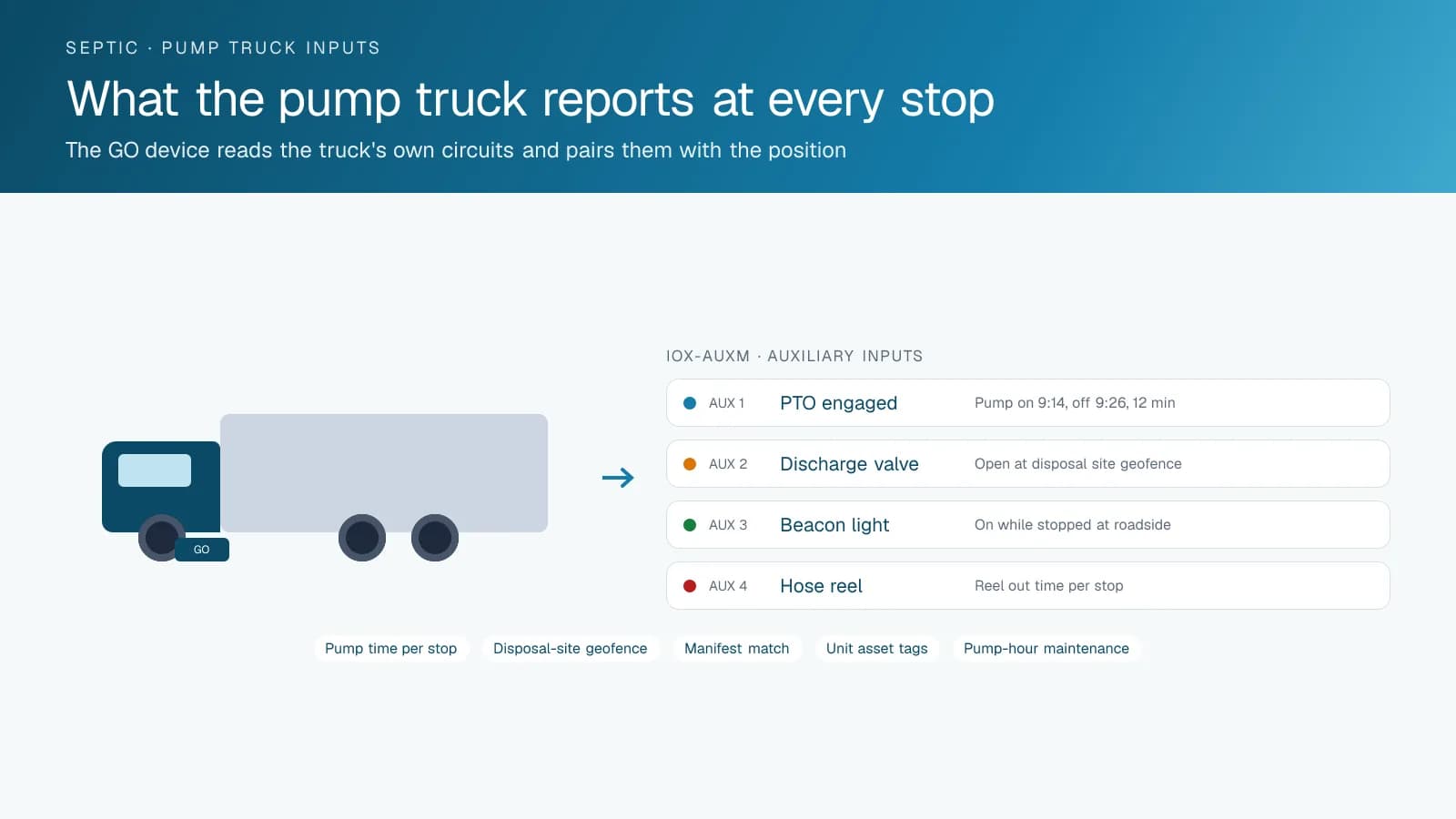
A septic and portable sanitation fleet is paid by the stop and regulated by the gallon. Every pump-out has to be done, has to be billed, and has to end up at a licensed disposal site with a manifest that matches. Every portable toilet has to be on the site the customer is paying for and serviced on the schedule they were promised. GPS tracking for septic and portable sanitation fleets records all of it from the truck. A Geotab GO device in each pump truck reports the position and the stops, and an IOX-AUXM auxiliary input on the PTO circuit records when the pump engaged and for how long at each address. A geofence around every disposal site writes an arrival and departure record that lines up with the manifest, and a stop with PTO time that never reached a disposal site stands out on its own report. Bluetooth asset tags on portable units show which trailer placed each one and which site it sits on. Route density comes from the same data: the platform shows where the fleet is driving between stops and where a second truck in the same subdivision is wasting a morning. Engine-hours maintenance covers the vacuum pump as well as the truck, electronic inspections in the Geotab Drive app cover the hoses and the tank, and driver scoring keeps a loaded truck out of trouble on rural roads. High Point GPS sets it all up around the way the routes actually run.
Common challenges
- Pump-outs done but never billed, because the ticket was lost or the driver forgot which stops were extra
- Disposal-site manifests that do not line up with the truck's day, and a regulator asking why
- No record of how long the pump actually ran at a stop, so a dispute over a partial pump-out rests on the driver's word
- Portable units placed on sites nobody wrote down, and units missing when the site closes
- Routes that send two trucks into the same subdivision on the same day and one truck across the county for a single stop
- Vacuum pumps that fail without warning because maintenance was tracked on truck mileage, not pump hours
How High Point GPS helps
- Pump engagement and run time at every stop, read from the truck's own PTO circuit through the GO device's IOX-AUXM auxiliary inputs
- Geofence arrival and departure records at each licensed disposal site, matched against the manifest for the load
- An exception report for stops with PTO time that were never followed by a disposal-site visit, and for disposal visits with no pumping before them
- Bluetooth asset tags on portable units, showing which site each unit sits on, when it was placed and when it was last serviced
- Route density reporting that shows drive time between stops by area and flags overlapping trucks on the same day
- Engine-hours maintenance on the truck and the vacuum pump separately, with fault codes sent to the shop as they appear
- Electronic pre-trip inspections in the Geotab Drive app with a checklist for hoses, valves, tank and lights
- Driver scoring set for loaded tank trucks on rural roads, with AI dash cams where the fleet wants the video
Pump Time at Every Stop, From the Truck's Own Circuit
A pump-out ticket says the tank was pumped. The PTO record says when the pump engaged, how long it ran and where the truck was when it did. An IOX-AUXM module on the GO device reads the truck's PTO circuit, and every stop in the trip record carries the pump-on and pump-off times beside the address. A residential pump-out that shows twelve minutes of pump time is a full tank; one that shows three minutes and a departure is the partial pump-out the customer will call about next month. High Point GPS builds the daily report so the office sees each stop, its pump time and whether a ticket was written for it.
That report is where the unbilled work turns up. A driver who pumped a second tank at a property, or stopped at a neighbour who flagged him down, has a stop with PTO time and no ticket, and the office bills it before the day is closed. The same records settle the other direction: a customer who says the driver never came has a stop, a pump time and a trip replay that says otherwise. Over a season, pump time per stop by area tells the dispatcher which routes are running tanks that are bigger than the schedule assumes.
Disposal Sites, Geofences and the Manifest
The regulator's question is simple: where did the load go? Each licensed disposal site is a geofence, and the platform writes an arrival and a departure every time a truck enters one. The PTO record shows the pump running to discharge, and the manifest for that load has a time-stamped truck visit to match. When the numbers on the manifest are checked against the truck's day, they line up, because both came from the same route.
The exception report is the part an owner reads first. A truck that logged pump time at six stops and then went home without visiting a disposal site is on it. So is a disposal-site visit from a truck that had not pumped anything that day, and a truck that stopped somewhere off the route with the PTO engaged. None of those is necessarily a problem, but each one is a question the owner would rather ask the driver than have a regulator ask the owner. Zone rules can also alert the office in real time when a truck with a load leaves the service area without heading for a disposal site.
Every Portable Unit on the Site It Belongs To
Portable toilets are the easiest asset in the fleet to lose. A construction site closes, the units get moved to the next phase, the customer disputes how many were on site, and the spreadsheet is three weeks behind. A Bluetooth asset tag on each unit reports to the GO device of the truck or trailer that delivered it, and the platform records the site where the unit stopped moving with the truck. From that point, the unit belongs to that site geofence, and a service truck entering the geofence writes the service visit for the units there.
The site inventory is then a report, not a memory. The office sees how many units are at each site, when each was placed, when it was last serviced and when the customer's rental ends. A unit that leaves a site on a truck that is not scheduled to pick it up raises an alert. At the end of the job, the pickup record shows every unit came back, and a unit that did not is listed with the last site it was seen on. Long-term event sites and festivals work the same way, with a service schedule tied to the geofence rather than to a driver's route sheet.
Route Density, Pump Hours and the Truck on the Road
Septic routes drift. A customer signs up here, a subdivision fills there, and two years later one truck spends more time driving between stops than pumping. The platform's trip and stop history shows drive time between stops by area and by day, and it flags days when two trucks were working the same area. Dispatchers rebuild the routes from the actual stops and the actual drive times rather than from the map on the wall, and the same tools schedule recurring pump-outs and portable-unit service by area. Fewer kilometres per stop shows up on the fuel report within a month.
The vacuum pump runs on its own clock. Maintenance reminders on PTO hours, separately from the truck's engine hours and mileage, get the pump serviced before it seizes on a hot day with a full route. Engine fault codes from the truck reach the shop as they happen. Electronic DVIR in the Geotab Drive app covers hoses, valves, the tank and the lights, and a defect logged at the yard goes to the shop before the truck leaves. Driver scoring set for a loaded tank truck, with tighter cornering and braking thresholds, keeps the driving record in line with the equipment.
Frequently asked questions
How does it record pump time at each stop?
An IOX-AUXM module on the GO device reads the truck's PTO circuit, and every stop in the trip record carries the time the pump engaged and how long it ran, beside the address. The daily report shows each stop with its pump time and whether a ticket was written, which is how unbilled work is caught.
Can it match disposal-site visits to the manifest?
Yes. Each licensed disposal site is a geofence, and the platform records every arrival and departure with the PTO time for the discharge. The manifest for the load has a time-stamped truck visit to match, and an exception report lists stops with pump time that were never followed by a disposal visit.
How are portable units tracked?
A Bluetooth asset tag on each unit reports to the GO device in the truck or trailer that carried it, and the platform records the site where the unit was set down. The site inventory shows how many units are there, when each was placed and last serviced, and flags a unit that leaves on an unscheduled truck.
Will it help tighten our routes?
Yes. The trip and stop history shows drive time between stops by area and flags days when two trucks worked the same area. Dispatch rebuilds routes from the actual stops and drive times, and recurring pump-outs and portable-unit service are scheduled by area from the same data.
Does maintenance follow the pump or the truck?
Both, separately. Maintenance reminders run on the truck's engine hours and mileage and on the PTO hours logged by the pump, with fault codes from the truck sent to the shop as they appear. The vacuum pump gets serviced on its own schedule rather than whenever the truck happens to be in.
Related solutions
Related guides
- PTO On/Off Reader: Proving the Winch Ran, for Tow Billing and Hydraulic Maintenance →
- What Is a Geotab IOX and What Does It Do? →
- How Geofencing Works for Fleet Tracking →
- GPS Asset Tags vs. Powered Trackers: Which to Use →
- Fleet Maintenance: Engine Hours vs. the Calendar →
- Route Optimization Software Explained →
Get a free quote
What are you looking for?