
GPS Fleet Tracking & Telematics
How to Build a Preventive Maintenance Program for Your Fleet
A fleet preventive maintenance program services vehicles on engine hours, mileage or time, whichever comes first, and turns DVIR defects into work orders.
What Is a Preventive Maintenance Program?
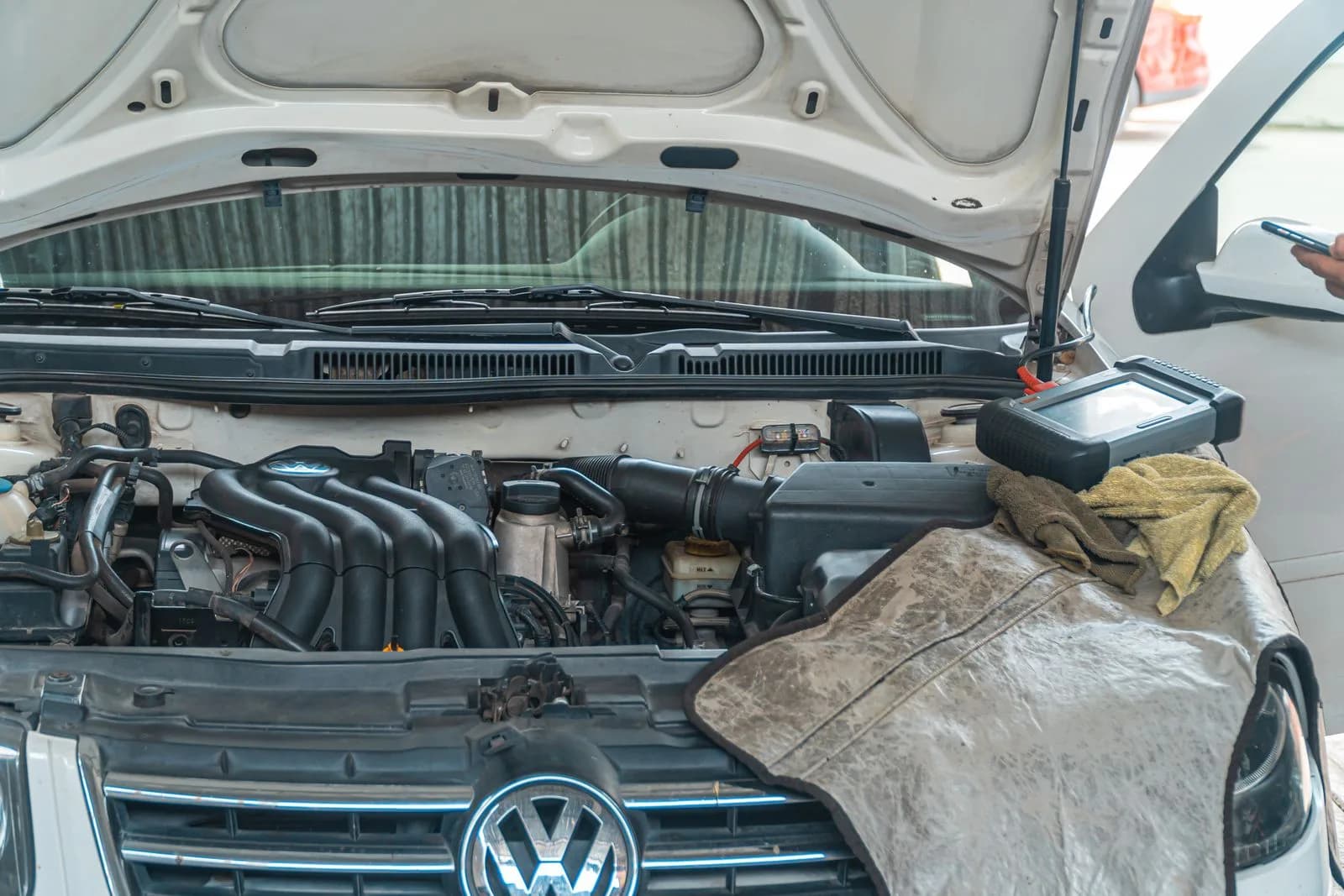
To build a fleet preventive maintenance (PM) program, you make four decisions: what to service, when to trigger each service, who does it, and how you record that it happened. The result is a repeating, documented schedule of inspections and service on a defined trigger (engine hours, mileage or calendar time, whichever comes first), so components get serviced before they fail. It replaces the habit of fixing things when they break with a plan that catches wear in your shop, on your schedule, instead of on the side of a highway during a delivery.
The aim is to service each vehicle at the right interval for how it is used, which is not the same as servicing more. Write the four decisions down and follow them consistently, and you have a program. Skip the last one, the record, and the plan falls apart in the first busy week, because nothing reminds anyone that a truck is due.
Which Service Triggers Should You Choose?
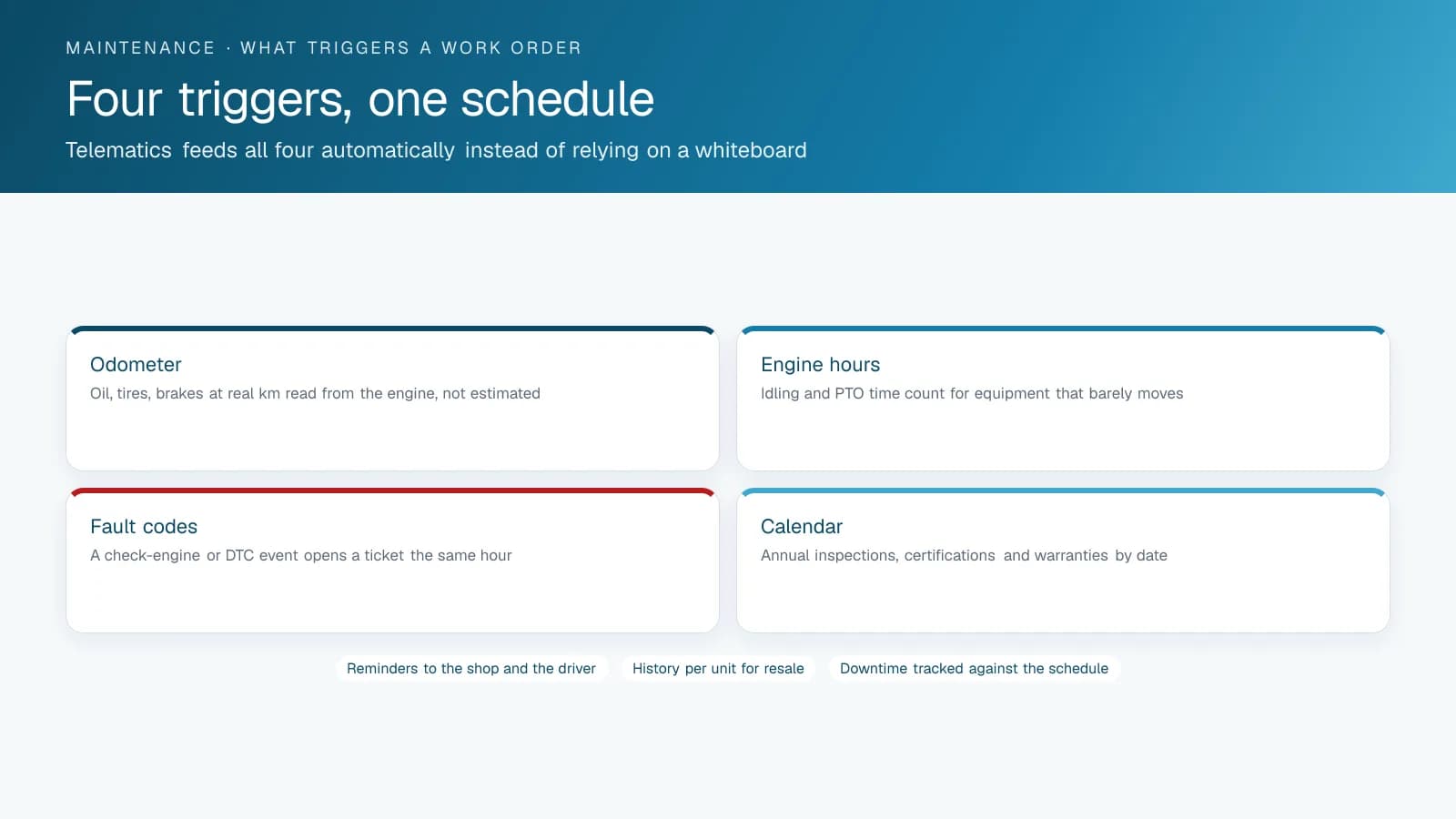
Fleets most often go wrong by scheduling everything on mileage alone. Mileage works for a long-haul truck. It badly under-services a vehicle that idles for hours or runs a PTO, such as a plow truck, a bucket truck or a service van parked at job sites, because those engines build up wear the odometer never sees. Engine hours capture that wear directly, so hour-based triggers, or hours and mileage combined, show far more honestly when a given vehicle is due. Set each PM interval on whichever trigger comes first: hours, miles, or a maximum time gap so a lightly used vehicle still gets seen.
Telematics makes this practical to run. A GPS tracking device reports each vehicle's engine hours and mileage automatically, so the High Point GPS platform can flag a truck as due the moment it crosses a threshold, without anyone having to notice. Engine fault codes feed the same system, which turns a developing problem into a scheduled task before it becomes a breakdown. A PM schedule on a whiteboard waits for someone to read it; one in the platform triggers on real usage.
How Do DVIRs and Work Orders Fit In?
Your drivers are the second input to a PM program, after the schedule. The Driver Vehicle Inspection Report (DVIR) a driver completes is your earliest warning of defects between scheduled services, and 49 CFR Part 396 makes it a regulatory requirement. The program only works if each reported defect becomes a tracked work order that someone owns and closes, instead of a note sitting in a stack. An electronic DVIR that flows straight into your maintenance records closes that loop and gives you the documentation an inspector or auditor will ask for.
Keep everything in one place. The schedule, fault codes, DVIRs and completed work orders belong where the vehicle's usage data already is, so a technician sees the full history and a manager can prove the vehicle was maintained. That consolidated record also protects your Vehicle Maintenance BASIC, since the out-of-service defects that hurt a CSA score are the ones a working PM program is designed to catch first.
What Does the FMCSA Require From a Maintenance Program?
Under 49 CFR 396.3, every motor carrier must systematically inspect, repair and maintain the vehicles it controls and keep their parts and accessories in safe working condition at all times. The rule sets no service intervals; it sets the records. For each vehicle it has controlled for 30 consecutive days, the carrier keeps an identification of the vehicle (company number if marked, make, serial number and year), a way to show the nature and due date of each inspection and maintenance task, and a dated record of the inspections, repairs and maintenance done. Those records stay where the vehicle is housed or maintained for 1 year, and for 6 months after the vehicle leaves the carrier's control.
On top of that, 49 CFR 396.17 requires a periodic inspection of every commercial motor vehicle at least once every 12 months, covering the parts listed in Appendix A to Part 396, with documentation carried on the vehicle. Each unit in a combination counts, so the tractor, the trailer and any converter dolly each need their own. A periodic inspection done under a Canadian province's program that meets Appendix A counts as the annual inspection for 12 months. A PM schedule in the High Point GPS platform keeps those due dates and the service history in one place.
How Does Quebec's PEP Replace the Mandatory Mechanical Inspection?
In Quebec, vehicles with a gross vehicle weight rating of 4,500 kg or more must pass a mandatory periodic mechanical inspection at an SAAQ-authorized inspection agent, every 12 months for most heavy vehicles and every 6 months for buses, minibuses and school transport vehicles. An owner can instead have its own preventive maintenance program, the PEP (programme d'entretien préventif), recognized by the SAAQ, and the vehicles in it are then exempt from the periodic inspection.
Recognition comes with minimum standards. Heavy vehicles of 4,500 kg or more (other than emergency vehicles) and tow trucks must be serviced at least every three months, or every six months when the vehicle travels less than 20,000 km a year. Mechanics working on vehicles of 7,258 kg or more must hold an SAAQ certificate of competence, the work needs a frost-protected shop in Quebec, every service goes on a signed maintenance sheet, and the owner affixes the compliance stickers. On the SAAQ's truck maintenance sheet, major defects must be repaired before the vehicle goes back on the road and minor ones within 48 hours.
The vehicle file holds the VIN and plate, the calendar of upcoming services, the signed sheet for each service since the program began or for the last 2 years (whichever is shorter), brake measurements for vehicles of 7,258 kg or more when the sheets do not include them, and proof of repairs. Annual distance sets the interval for some vehicles, so odometer readings logged by the platform turn the 20,000 km test into a report instead of an estimate.
A Starter Preventive Maintenance Schedule for a Mixed Fleet
Here is a first schedule you can load into the platform and refine. The intervals are illustrative: your manufacturer's manual and your fleet's duty cycle set the real ones, and the trigger is whichever comes first.
| Vehicle class | Service | Trigger |
|---|---|---|
| Light vans and pickups | Oil, filters, inspection | 8,000 km or 6 months |
| Light vans and pickups | Brakes and tires | 20,000 km or on harsh-braking frequency |
| Straight trucks, on-road | Oil and filters | 15,000 km or 300 engine hours |
| Vocational trucks with PTO | Oil and filters | 250 engine hours |
| Vocational trucks with PTO | Hydraulic system | 500 PTO hours |
| Tractors, long-haul | Oil and filters | 40,000 km, adjusted by idle percentage |
| All | Annual safety inspection | Date, 30-day reminder |
| All | Any active fault code above the shop's severity line | Immediate ticket |
| All | DVIR defect | Work order the same day; certify before dispatch |
Frequently asked questions
Should preventive maintenance be scheduled on mileage or engine hours?
Use whichever comes first, and add a maximum time interval. Mileage alone under-services vehicles that idle heavily or run a PTO, because their engines wear in ways the odometer never records. Engine hours capture that wear, so hour-based or combined triggers are more accurate for most mixed fleets.
How do DVIRs fit into a preventive maintenance program?
DVIRs are your earliest warning of defects between scheduled services, and 49 CFR Part 396 requires them. The program works only if each reported defect becomes a tracked work order that someone closes. An electronic DVIR that flows into your maintenance records closes that loop and creates the documentation auditors expect.
How does a preventive maintenance program affect my CSA score?
A working PM program catches the out-of-service defects that raise your Vehicle Maintenance BASIC, such as brakes, lights and tires, before a roadside inspection finds them. Consistent scheduled service, plus DVIRs that someone closes out, cuts the number of violations feeding that score in the first place.
What is the difference between preventive and predictive maintenance?
Preventive maintenance runs on a defined schedule of hours, miles or time. Predictive maintenance goes a step further and uses live fault-code and usage data to flag a specific vehicle at risk before its scheduled interval. Get a solid preventive program running first, since predictive tools build on it.
What is the PEP in Quebec?
The PEP (programme d'entretien préventif) is a preventive maintenance program that the SAAQ recognizes in place of the mandatory periodic mechanical inspection for heavy vehicles. Recognized owners service their vehicles at set minimum intervals, such as every three months for most heavy vehicles, use qualified mechanics, keep signed maintenance sheets and affix the compliance stickers themselves.
Does the FMCSA require an annual vehicle inspection?
Yes. Under 49 CFR 396.17, every commercial motor vehicle, including each trailer and converter dolly in a combination, must pass a periodic inspection at least once every 12 months, with documentation on the vehicle. A periodic inspection under a Canadian province's program that meets the federal minimum standards in Appendix A also counts, for 12 months.
Sources
- FMCSA: 49 CFR Part 396, Inspection, Repair, and Maintenance
- eCFR: 49 CFR 396.3 Inspection, repair, and maintenance
- eCFR: 49 CFR 396.17 Periodic inspection
- SAAQ: Programme d'entretien préventif (PEP)
- SAAQ: Vérification mécanique périodique obligatoire
- SAAQ: Fiche d'entretien préventif, camion
- Légis Québec: Règlement sur les normes de sécurité des véhicules routiers, section 209
Related solutions & products
Continue reading
- GPS Fleet Tracking & Management Software overview →
- Fleet Maintenance Schedule: Engine Hours vs Calendar and Mileage →
- What Is Fleet Maintenance Software (CMMS)? Preventive Service on Real Engine Hours and Kilometres →
- CVIP Inspections in Alberta and BC: Who Needs One, How Often and Where →
- How to Pass a DOT Inspection: Checklist and Inspection Levels →
- More in GPS Fleet Tracking & Telematics →
Get a free quote
- Over 500 fleets
- Since 2013
- 4.9 on Google (19 reviews)
What are you looking for?
Prefer to talk?Call 1-800-613-6323[email protected]