
Industries
School Bus GPS Tracking System Price: What a District or Contractor Pays Per Bus
A school bus tracking system costs a few hundred dollars per bus in the first year and less after, but the number depends on which pieces the operator turns on. Here's the price of each part — device, installation, data plan, parent app, ridership readers, cameras — and what a 40-bus fleet should budget.
The Parts of the Price
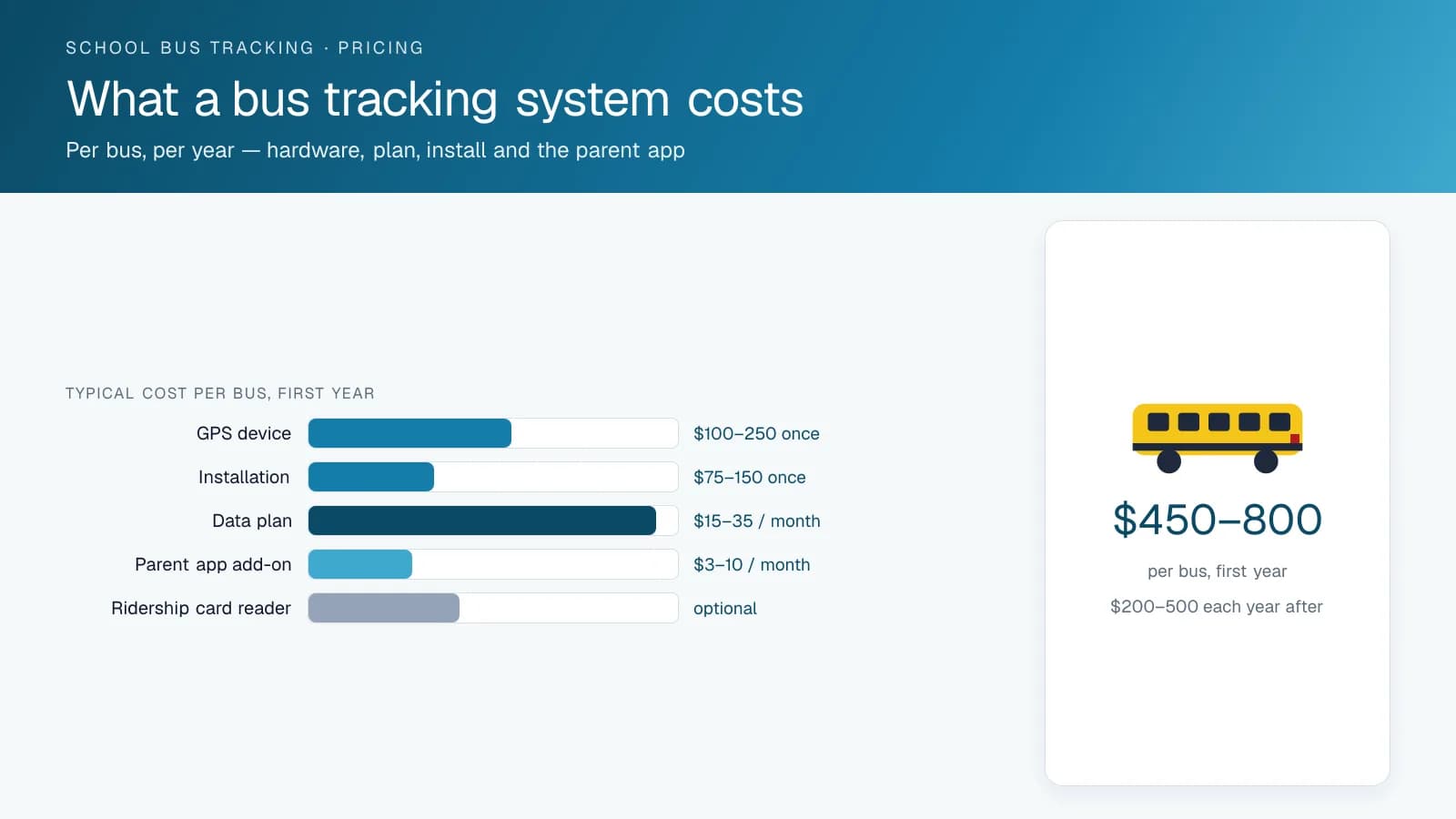
A school bus tracking system is priced per bus, and the invoice has up to five lines. The GPS device itself, a GO device installed in each bus, is a one-time purchase typically between $100 and $250 depending on model and volume. Professional installation runs $75 to $150 per bus when done at the operator's yard, less when many buses are done in one visit. The data plan, which pays for the cellular connection and the MyGeotab platform, is the recurring line at roughly $15 to $35 per bus per month depending on the features included. A parent-facing app or portal, where the operator wants one, adds a few dollars per bus per month. A student ridership reader, for the card-tap boarding record, is optional hardware in the low hundreds per bus.
Put together, a first year lands between about $450 and $800 per bus, and subsequent years between $200 and $500, with the plan as the main recurring cost.
What a 40-Bus Fleet Should Budget
For a contractor or transportation consortium with forty buses, that is roughly $18,000 to $32,000 in the first year and $8,000 to $20,000 a year after, before cameras. The spread depends on plan tier: a basic plan gives location, geofences and route progress; a fuller plan adds engine diagnostics, driver behaviour and the data a parent app needs. Volume pricing applies at that size, and multi-year agreements usually lower the monthly rate.
Cameras Are a Separate Line
Driver-facing and road-facing AI dash cams, stop-arm cameras and interior cameras are priced separately, at a few hundred dollars per camera for hardware and a monthly plan per bus for the video service. A bus with a dual dash cam and a stop-arm camera adds roughly $600 to $1,200 in hardware and $20 to $40 per month, and many operators phase cameras in after the tracking is running.
What the Money Buys Back
The costs are recovered in specific places: fewer phone calls to the transportation office on snow days, because the parent app answers them; route rebalancing from real completion times, which often removes a bus from the schedule; maintenance on engine hours rather than a calendar, which catches problems before an inspection does; and the stop-arm and incident footage that settles a complaint or a claim in an afternoon. High Point GPS quotes school bus deployments for boards, consortia and contractors in Quebec, Ontario and the northeastern US, with installation and parent-facing add-ins included.
Frequently asked questions
How much does a school bus GPS tracking system cost?
About $450 to $800 per bus in the first year, including device, installation and the data plan, and $200 to $500 per bus per year after. Cameras and ridership readers are extra.
What is the monthly cost per bus?
Roughly $15 to $35 per bus per month for the tracking plan, plus a few dollars for a parent app and $20 to $40 for cameras where used.
Is there a cheaper option for a small contractor?
Yes. A basic plan with location and route progress on a handful of buses costs a few hundred dollars a year each, and features can be added later.
Does the price include a parent app?
Not always. A parent-facing app or portal is usually an add-on of a few dollars per bus per month, enabled by the operator.
How do districts pay for it?
Through the transportation budget or the contractor's rate, and often through cooperative purchasing contracts that avoid a full tender.
Related solutions & products
Related terms
Continue reading
- Industries overview →
- Do School Buses Have GPS? How School Bus Tracking Works for Districts and Parents →
- Can You Track a School Bus? What Drivers, Dispatchers and Parents Each See →
- Bus Route Progress: The MyGeotab Add-In That Shows Which Buses Are On Route, Late or Parked →
- DIDCOM Passenger ID: Recording Every Student or Employee Boarding With a Card Tap →
- More in Industries →
Get a free quote
What are you looking for?