
Industry
GPS Fleet Tracking for Fuel & Propane Delivery
GPS tracking for fuel and propane delivery fleets that proves every drop, keeps bobtails and tank trucks on compliant routes, records PTO and pump time for billing, and gives dispatch the map it needs on the coldest day of the year.
Updated September 21, 2026
A fuel or propane delivery fleet has the hardest week of its year in the middle of a cold snap, when every customer on the will-call list is running low at once and the bobtails are out from before dawn. GPS tracking for fuel delivery puts every truck on one live map with its route and the stops left on it, so the dispatcher sees which truck can take the emergency delivery and tells the customer when it will arrive. Geofences at each tank site record the arrival and the departure, and a PTO or pump input on the Geotab GO device records how long the truck was pumping, which is the record the delivery ticket, the invoice and the degree-day forecast all rest on. The same platform holds the compliance file: hours of service through the ELD, electronic pre-trip and post-trip inspections, the route the truck actually took past the hazmat-restricted tunnel it was supposed to avoid, and the driver behaviour a carrier of a placarded load is held to. Maintenance runs on engine hours and PTO hours rather than mileage alone, because a delivery truck wears its pump as hard as its drivetrain.
Common challenges
- Will-call customers running out during a cold snap because dispatch could not see which truck was nearest
- Delivery tickets that show a drop but not the time on site or the pump time, so short-delivery disputes rest on the driver's word
- Trucks routed through hazmat-restricted tunnels or bridges with no record until a citation arrives
- Hours-of-service logs kept on paper on trucks that qualify for the ELD mandate
- Pumps and PTOs maintained by mileage while they wear by the hour
- Insurance renewals for a placarded fleet with no driver-behaviour evidence to offer
How High Point GPS helps
- Live location of every bobtail, tank wagon and transport on one map, with the route and the stops remaining
- Tank-site geofences that record arrival and departure for every delivery, feeding time on site to the ticket
- PTO and pump engagement read through the GO device's auxiliary inputs, so each stop carries its pump time
- Route replay that shows the road the truck took, with hazmat-restricted tunnels, bridges and zones set as geofences that alert when crossed
- ELD hours of service in the Geotab Drive app for the drivers and trucks that fall under the mandate
- Electronic DVIR with the tank-truck checklist, including hoses, valves and placards, routed to the shop the same morning
- Driver scoring set for a placarded load: speeding, hard braking and cornering weighted for a tank truck
- Integration with delivery-management and degree-day forecasting software so the route and the record share one system
Dispatch on the Coldest Day of the Year
Delivery fleets plan on degree days and get tested on the outliers. When the temperature drops and the will-call phone starts ringing, the dispatcher needs to see every truck, the stops it has left and the product it has on board, and to know which one can take the run-out call without stranding the rest of its route. With every truck on the live map and its route beside it, that decision takes a glance. The customer gets a real arrival time, and the driver gets the added stop in the app rather than over the radio.
High Point GPS connects the tracking to the delivery-management and degree-day software fuel and propane companies already plan with, so the planned route flows to the truck and the completed stops flow back with their times. The office works in one system, and the record of the day is the same record the delivery ticket, the invoice and the next forecast draw from.
Proving the Drop
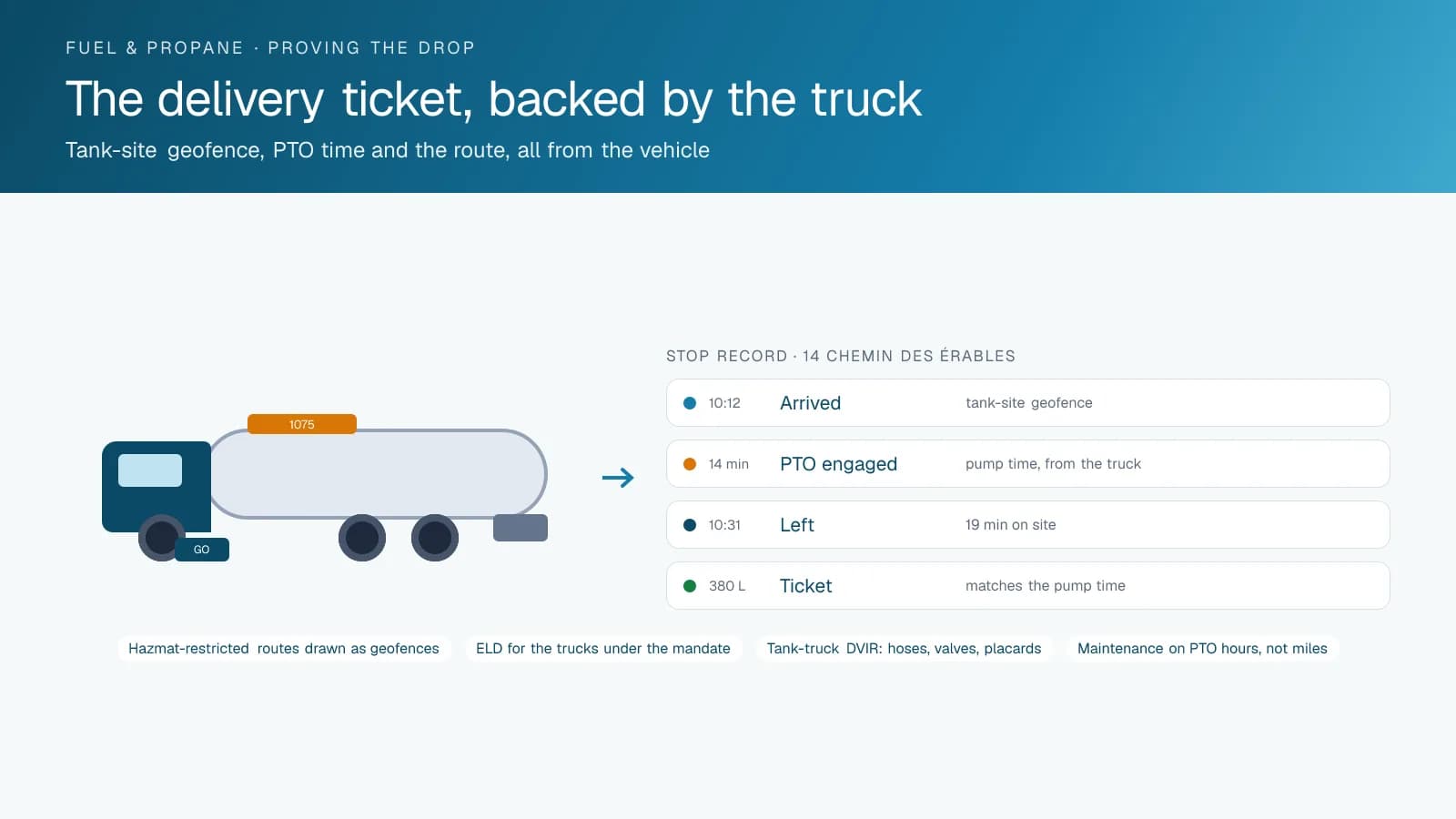
A delivery ticket says the truck delivered 380 litres. The customer says the tank does not look that full. The platform's record shows the truck inside the geofence at that address from 10:12 to 10:31, the PTO engaged for fourteen minutes of that, and the route in and out. That is the record that settles a short-delivery claim, and it is produced without the driver writing anything down. The PTO and pump inputs come from the truck's own circuits through an IOX-AUXM module on the GO device. The pump time is a fact from the vehicle rather than a line on a form.
The same records feed the office's other questions. Which deliveries took longest and why, which routes carried the most stops per hour, how long each truck spent at the bulk plant loading. Companies that pay drivers by the stop or by the hour use the record for both, and companies that bill commercial customers for a minimum delivery use it to show the minimum was met.
Compliance for a Placarded Fleet
A tank truck carrying propane or fuel oil is a placarded hazmat load, and the compliance file is longer than for any other delivery fleet. The trucks and drivers that fall under the ELD mandate log hours of service in the Geotab Drive app, with the device connected to the engine as the mandate requires. The pre-trip and post-trip inspections use a tank-truck checklist that includes hoses, valves, emergency shutoffs and placards, and a defect reaches the shop before the truck leaves the plant. High Point GPS builds the checklist with the company so it matches the one the auditor expects.
Routing restrictions are enforced by geofence. Tunnels, bridges and city zones that prohibit placarded loads are drawn once, and a truck that crosses one triggers an alert and a record. Driver behaviour is scored with a tank truck's physics in mind: a cornering event that would be minor in a van is a rollover risk with a half-full tank, and the score reflects it. AI dash cams add the road-facing view for the incident review and the driver-facing view for distraction and fatigue on the long rural routes.
Maintaining Pumps, PTOs and Trucks
A delivery truck's mileage understates its wear. The engine idles at every stop to run the pump, the PTO engages and disengages dozens of times a day, and the pump itself has an hour meter that mileage-based maintenance ignores. The GO device reads engine hours and, through the PTO input, PTO hours. MyGeotab then schedules pump service, PTO service and engine intervals on the hours that actually accumulate. Engine fault codes reach the shop as they are logged, which is how a charging fault is fixed at the plant rather than on a rural road in February.
Companies that run bulk transports alongside the bobtails put them on the same platform, with IFTA distance by jurisdiction reported from the same trip records for the trucks that cross state or provincial lines. One MyGeotab database holds the whole fleet, and the reports are built for each part of it.
Frequently asked questions
Can it record how long the truck was pumping at each stop?
Yes. An IOX-AUXM module on the GO device reads the PTO or pump engagement circuit, and each stop in the trip record carries the pump time alongside the geofenced arrival and departure. That is the record behind the delivery ticket and any short-delivery dispute.
Does it work with our delivery-management or degree-day software?
In most cases yes. The platform has an open API and High Point GPS builds the connection to the routing and forecasting tools fuel and propane companies use, so planned routes go to the truck and completed stops come back with their times.
Can it keep trucks off hazmat-restricted routes?
It records and alerts. Restricted tunnels, bridges and zones are drawn as geofences, and a truck that enters one triggers an alert to dispatch and a record in the trip history. Route planning in the connected dispatch software can also avoid them in advance.
Do our bobtail drivers need an ELD?
It depends on the vehicle weight, the range and the exemptions that apply, which differ between Canada and the United States. The same GO device supports ELD hours of service in the Geotab Drive app for the trucks and drivers that fall under the mandate, and High Point GPS helps determine which of yours do.
How does maintenance work for the pump and PTO?
Maintenance reminders run on engine hours and PTO hours read from the truck, not only on mileage, so pump and PTO service is scheduled on the hours they actually work. Engine fault codes are sent to the shop as the truck logs them.
Related solutions
Related guides
- PTO On/Off Reader: Proving the Winch Ran, for Tow Billing and Hydraulic Maintenance →
- What Is an ELD? A Plain-English Guide for Fleets →
- FMCSA ELD Exemptions: Does Your Fleet Need One? →
- Canada's ELD Mandate: How It Differs From the US →
- How Geofencing Works for Fleet Tracking →
- Fleet Maintenance: Engine Hours vs. the Calendar →
Get a free quote
What are you looking for?