
Industry
GPS Fleet Tracking for Oil, Gas & Energy
GPS tracking for oil and gas fleets: crew trucks and haulers logged on lease roads with no coverage, site speed limits enforced, field tickets that match.
Updated September 21, 2026
GPS tracking for oil and gas fleets from High Point GPS puts crew trucks, service rigs, vacuum and water haulers, and pickups on one live map, including on lease roads with no cell coverage. It is built for energy companies whose trucks work where the map runs out: unsigned lease roads, sites with their own speed limits and check-in rules, and crews who drive three hours each way before the shift starts. Out of coverage, the GPS tracking device stores every trip and uploads it once the truck is back in range. Geofences around each lease, site and camp record check-in and check-out for journey management. Each site's speed limit runs as a rule that alerts the supervisor and counts in the driver's score. On the haulers, PTO and pump inputs record load and unload time, so the field ticket matches what the truck did. The High Point GPS platform keeps the rest in the same database: ELD hours of service with the oilfield exemptions that apply set up correctly, electronic inspections, and the driver-behaviour and dash-cam records operators audit before they award the next contract. Engine-hours maintenance keeps trucks that idle through a twelve-hour shift on the road, and the open API feeds the company's ticketing, safety and journey-management systems.
Common challenges
- Crew trucks and haulers out of contact for hours on lease roads, with journey management done by phone
- Site and lease-road speed limits that are posted but go unenforced until an operator's safety audit
- Field tickets that disagree with the truck's real load and unload times and get disputed at invoicing
- Paper hours-of-service logs for drivers who switch between exempt and regulated work
- Trucks that idle through twelve-hour shifts and get serviced on mileage that understates the wear
- Operator contracts that ask for driver-behaviour, inspection and camera records the company cannot produce
How High Point GPS helps
- Crew trucks, service rigs, haulers and pickups on one live map, with trips stored offline and uploaded when coverage returns
- Lease, site and camp geofences that log check-in and check-out for journey management
- Site-specific speed limits run as rules, with an alert to the supervisor and an event in the driver's score
- PTO and pump engagement read through the GPS tracking device's auxiliary inputs, giving each stop its load and unload time for the field ticket
- ELD hours of service in the driver app, with the applicable oilfield exemptions set up for the drivers who use them
- Electronic DVIR with a truck- or rig-specific checklist, sent to the shop the same shift
- AI dash cams with driver-facing fatigue and distraction detection for long commutes and night shifts
- Engine-hours and PTO-hours maintenance, with engine fault codes sent to the shop as they appear
How does GPS tracking handle journey management for oilfield crews?
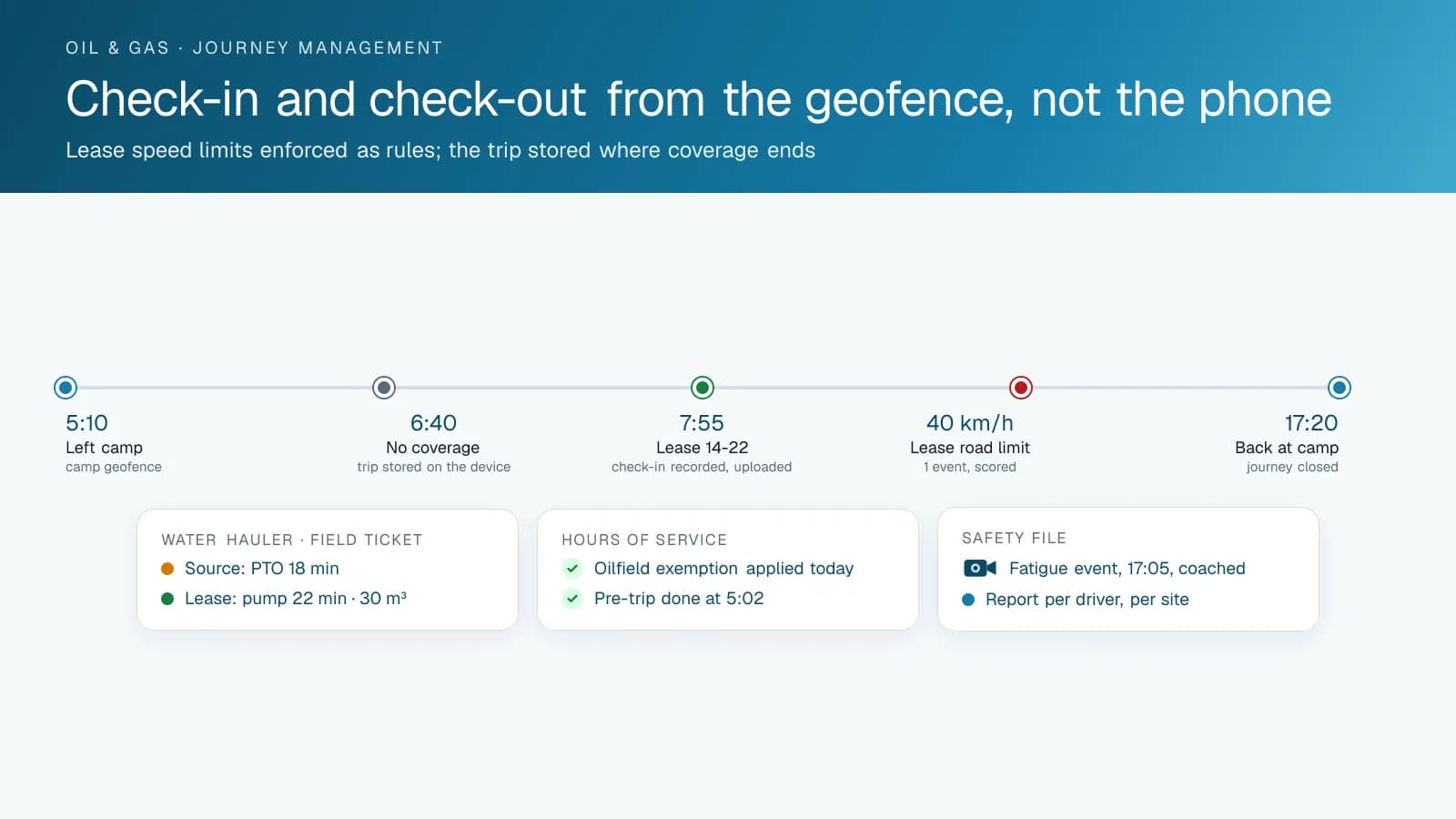
Geofences do the check-in for you. Without geofences, journey management runs on a spreadsheet and a phone call: the driver calls the office at the gate and again at the site, and someone writes down the time. With a geofence around each lease, site and camp, the High Point GPS platform logs arrival and departure on its own, and flags a truck that has not arrived by its expected time before anyone has to notice. Dispatch sees every truck on the live map. Where the map went dark for lack of coverage, the GPS tracking device stored the trip and uploaded it when the truck came back into range, so the journey record has no gaps.
High Point GPS connects that record to the journey-management and safety systems the operator or the company already uses. The check-in is logged once, and the exception report lands where the safety coordinator expects it. If you work for several operators, each one's rules run on the same database.
Speed on the lease road
A lease road has a posted limit, a site has a lower one, and an operator's safety audit asks how the company enforces both. The platform enforces them as rules: a geofence around the site carries its own speed limit, and a truck that exceeds it triggers an alert to the supervisor and an event in the driver's score. Speeding on the highway commute is scored the same way against the posted limit from the map. The report the operator asks for is a report the platform already produces, per driver and per site, and the coaching record behind it shows what the company did about each event.
AI dash cams complete the safety file. The road-facing camera records what happened in front of the truck; the driver-facing camera with fatigue and distraction detection matters most on the three-hour commute at the end of a twelve-hour shift. Events are retrieved by trip, and the retention and access rules are set by the company.
Field tickets that match the truck
A water hauler's ticket says it loaded at the source, delivered to the lease and unloaded 30 cubic metres. The platform's record shows the truck inside the source geofence from 6:40 to 7:05 with the PTO engaged for 18 minutes, the drive to the lease, and 22 minutes of pump time inside the lease geofence. When the ticket and the record agree, the invoice goes through; when they do not, the company finds out before the operator does. PTO and pump engagement are read from the truck's own circuits through an IOX-AUXM module on the GPS tracking device, so the times are facts from the vehicle rather than entries on a form.
The same records serve the company's own costing. Time at the source, time on the road, time at the lease and time waiting are separated per truck and per day, which shows where a hauling contract is making money and where it is not.
Hours of service, inspections and maintenance
Oilfield drivers move between exempt and regulated work in a way few other fleets do, and the hours-of-service rules in both Canada and the United States have oilfield-specific provisions for it (in Canada, through an oil well service vehicle permit issued by the province). The driver app supports those provisions, so the driver's log reflects the exemption that applied on each day, and High Point GPS sets the rule sets up for the drivers and trucks they cover. Electronic DVIR uses a truck- or rig-specific checklist, and a defect reaches the shop the same shift rather than at the end of the hitch.
Maintenance runs on engine hours and PTO hours, because a truck that idles through a shift to run its pump or heat its cab wears in ways its odometer does not show. Engine fault codes reach the shop as they are logged, and the shop schedules the repair for the truck's days off rather than discovering the problem on a lease road at two in the morning.
Frequently asked questions
Does it work where there is no cell coverage?
Yes. The GPS tracking device stores every trip and event while it is out of coverage and uploads them all when coverage returns, so the journey record stays complete. Live position is only as current as the last upload. On remote leases, journey management should allow for that delay.
Can it enforce site-specific speed limits?
Yes. A geofence around each site or lease carries its own speed limit, and a truck that goes over it sends an alert to the supervisor and adds an event to the driver's score. On the highway, speeding is scored against the posted limit from the map, so one report covers the commute and the site.
How does it support journey management?
Geofences around leases, sites and camps log check-in and check-out automatically, and the platform flags any truck that has not arrived by its expected time. Nobody has to phone the office from the gate. High Point GPS connects the record to the journey-management or safety system the operator requires, so exceptions reach the right person.
Does it handle the oilfield hours-of-service exemptions?
Yes. The driver app supports the oilfield-specific provisions in both Canadian and US hours-of-service rules. High Point GPS configures the rule sets for the drivers and trucks they cover, so each day's log shows the exemption that applied. Drivers who switch between exempt and regulated work keep one log in one app.
Can it produce the safety records an operator audits?
Yes. Driver scores, speeding and site-limit events, dash-cam events and how each was resolved, inspections and maintenance records all sit in one database. You can report them per driver, per truck and per site, in the format the operator asks for at audit time, without pulling records from separate systems.
Related solutions
Related guides
- FMCSA Hours of Service Rules (US): 11-Hour and 14-Hour Limits →
- Canada Hours of Service Rules: Cycles and the 13-Hour Limit →
- FMCSA ELD Exemptions: Does Your Fleet Need One? →
- PTO Tracker: The PTO On/Off Reader for Tow Billing and Hydraulic Maintenance →
- 4G Fleet Dash Cams as Driver Monitoring Cameras: How Behaviour Events Reach the Manager →
- Fleet Maintenance Schedule: Engine Hours vs Calendar and Mileage →
Get a free quote
- Over 500 fleets
- Since 2013
- 4.9 on Google (19 reviews)
What are you looking for?
Prefer to talk?Call 1-800-613-6323[email protected]