
Industry
GPS Fleet Tracking for Parks & Recreation Departments
GPS fleet tracking for parks and recreation departments: which mower, pickup and utility vehicle worked at each park today, and how long the deck ran.
Updated September 21, 2026
GPS fleet tracking for parks and recreation departments from High Point GPS shows which crew and which machine worked at each park, when they arrived and left, and how long the mower deck or sprayer actually ran there. It is built for municipal parks departments, which run one of the most varied fleets in a municipality: pickups, dump trucks, tractors, zero-turn mowers, sprayers, ice resurfacers, trailers and a long tail of small equipment that moves between sites every week. Most of it works alone, far from a supervisor, on a seasonal schedule that changes with the weather. Every vehicle sits on one live map, and each site visit becomes a record of the park, the crew, the arrival, the departure and the equipment time. A GPS tracking device covers the trucks and tractors, IOX-AUXM auxiliary inputs read the PTO, the deck and the spray pump, and Bluetooth asset tags or battery trackers cover the trailers and attachments that have no engine. When a resident says the soccer field was not cut before the tournament, the department answers with the date, the time and the minutes of deck engagement. When a councillor asks what the mowing program costs per park, the report already exists. Driver ID, engine-hours maintenance and fault codes keep seasonal staff, equipment loans between divisions and aging machines manageable, all in the same High Point GPS platform database the rest of the municipality may already use.
Common challenges
- Residents and councillors asking whether a park was mowed or a rink was flooded, with only the crew's word as an answer
- Seasonal and student staff driving department vehicles with no record of who had which truck on which day
- Mowers, sprayers and trailers that move between parks all week and cannot be found when another division needs them
- Mowing and irrigation programs costed by guesswork because nobody knows how many hours the equipment ran at each site
- Aging tractors and mowers that fail mid-season because engine-hours maintenance lives on a whiteboard, if anywhere
- Personal use, long lunches and off-route trips in municipal vehicles that nobody can confirm or rule out
How High Point GPS helps
- Every truck, tractor and utility vehicle on one live map, with a geofence around each park, sports field, cemetery and facility
- Arrival and departure records per site showing which crew was at which park, and for how long, on any day of the season
- Mower deck, PTO, spray pump and plow status read from the machine's own circuits through IOX-AUXM auxiliary inputs
- Bluetooth asset tags on trailers, aerators, line painters and attachments that report their location through any passing GPS tracking device
- Driver ID with the IOX-NFCREADERA, so every trip is attributed to the seasonal or permanent employee who drove it
- Engine-hours maintenance reminders for mowers and tractors, with fault codes sent to the shop before a machine stops in the field
- Idling, speeding and after-hours use reports for the fleet committee and the department's own vehicle policy
- Optional AI dash cams on the trucks that tow and plow, with event-based clips for incident review
How can a parks department prove a field was mowed?
A geofence drawn around each park records every vehicle's arrival and departure automatically, and the trip replay shows the path the mower took across the field. Say the mowing schedule has the ball diamonds at a given park cut every Tuesday, and a complaint comes in that they were not cut before Saturday's tournament. Without tracking, the supervisor asks the crew, the crew remembers being there, and the resident does not believe it. With the geofence record, the supervisor answers the complaint with a date, a time and a duration instead of an apology.
High Point GPS builds the zone list from the department's own site inventory: parks, sports fields, cemeteries, arenas, community centres, boat launches and the yard. Reports then run by site instead of by vehicle. A weekly report shows every park visited, how long the crew stayed and which parks on the schedule were skipped. A parks manager uses that report to plan the next week, and a director uses it to show council what the maintenance program delivered at each site over the season.
What did the equipment do while it was there?
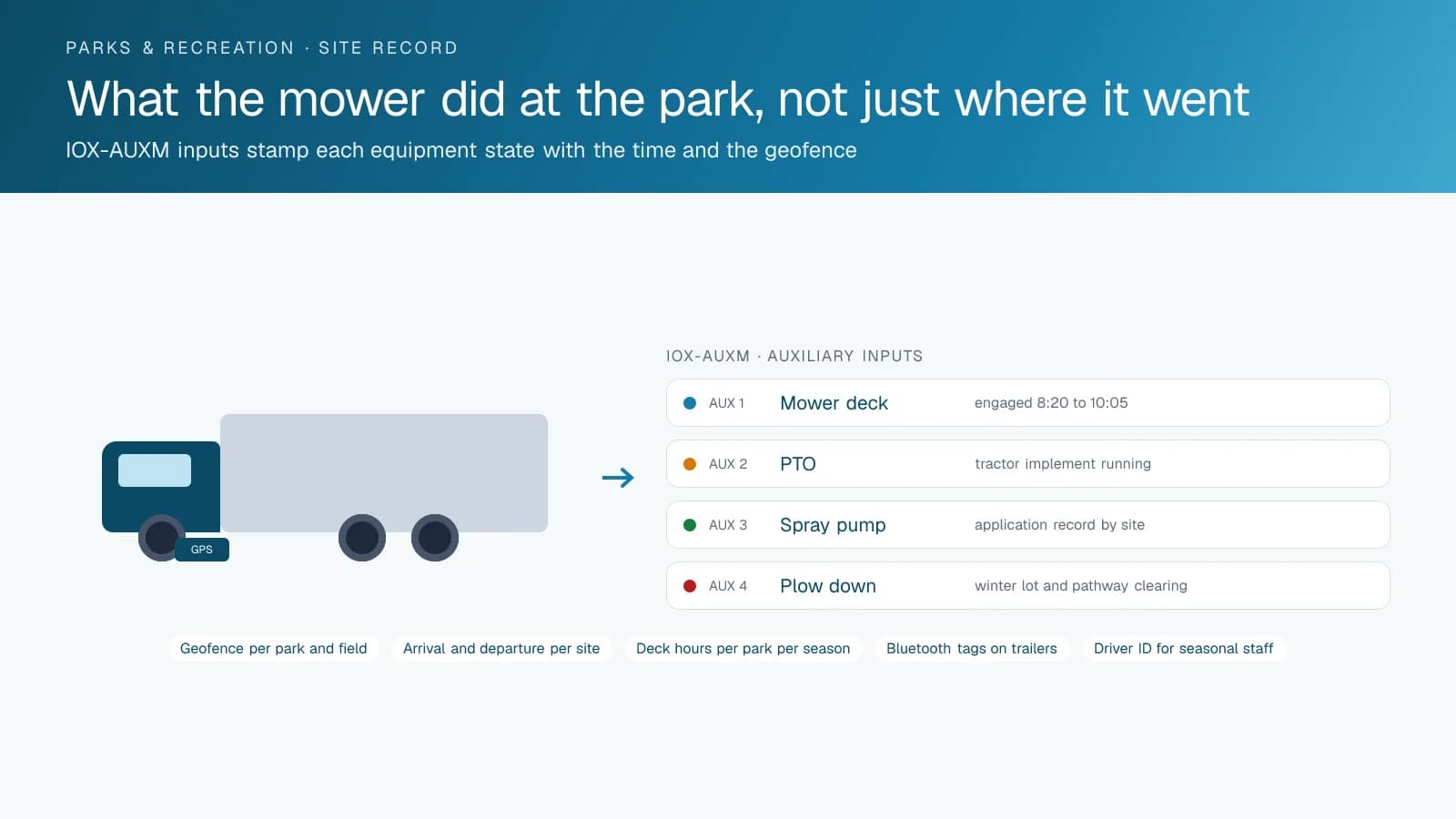
A pickup parked at a park for two hours might mean two hours of work or two hours of lunch. The difference sits in the equipment's own circuits. An IOX-AUXM module on the GPS tracking device reads whether the mower deck was engaged, the PTO was turning, the spray pump was running or the plow was down. Each state change is stamped with time and location. The site record now reads: arrived 8:12, deck engaged 8:20 to 10:05, departed 10:11. That is the difference between a visit and a service.
The same inputs feed the cost side. Deck hours per park across a season tell the department what mowing costs at each site and which fields would justify a larger machine. Spray-pump hours with the location trail form the application record for pesticide reporting where it applies. Plow-down time on the trucks that clear parking lots and pathways in winter goes into the same report that the roads division already uses, if the municipality runs one High Point GPS platform database for all its fleets.
Trailers, attachments and the things that wander between parks
Half of a parks fleet has no engine: trailers, aerators, top dressers, line painters, portable pumps, sprayers on skids and the utility trailers that carry them. They get dropped at a park on Monday and needed by another crew on Wednesday, and the search for them is a daily radio conversation. Bluetooth asset tags from High Point GPS fix that. Each tag reports its identity to any GPS tracking device that passes within range, and the platform shows the last park where each attachment was seen and which truck last moved it.
For higher-value equipment that sits at remote sites, a battery-powered tracker reports on its own schedule without a vehicle nearby, and a movement alert fires if it leaves the site outside working hours. Theft from parks yards and open sites is a recurring line in municipal insurance claims, and a tracker that reports the trailer's route to the recovery address is the difference between a claim and a recovery. High Point GPS matches the tag or tracker to each type of asset and to how far it travels.
Seasonal staff, aging machines and the vehicle policy
Parks departments hire in May and lay off in October, and the summer roster drives vehicles the department does not want to lose track of. An IOX-NFCREADERA reader in each truck attributes every trip to the person who tapped in, and the driver scoring reports speeding, hard braking and idling by employee rather than by vehicle. A supervisor coaches a specific student on a specific trip. At the end of the season the department has a record that supports rehiring the good drivers and declining the others.
The shop carries the other burden. Tractors and mowers run on engine hours, not kilometres, and a machine that misses its service in July is the machine that breaks in August when every field is growing. Engine-hours reminders in the High Point GPS platform schedule service from actual use, and fault codes from the trucks and tractors reach the shop when they appear. Electronic DVIR in the driver app replaces the clipboard inspection at the yard, and a reported defect becomes a work order instead of a note on the dash.
Frequently asked questions
Can it track mowers and tractors, not just trucks?
Yes. Tractors and larger mowers with a 12 or 24 volt system take a GPS tracking device, often the rugged GPS tracking device version built for dust, vibration and weather. Smaller machines and anything without power take a Bluetooth asset tag or a battery-powered tracker. High Point GPS matches the hardware to each machine in the fleet inventory.
How do we prove a park was actually mowed?
A geofence around the park records the arrival and departure of every vehicle, and an IOX-AUXM input on the mower reports when the deck was engaged. The site record then shows the date, the time the crew arrived and the minutes the deck ran, and the trip replay shows the mower's path across the field.
Can we see who was driving a vehicle on a given day?
Yes. With an IOX-NFCREADERA reader in the vehicle, each employee taps a card or fob when they start, and every trip that day is attributed to them. Seasonal staff get their own cards, and the report shows trips, speeding and idling by person instead of by truck, which gives a supervisor a specific trip to coach from.
Our trailers and attachments get lost between parks. Does this help?
Yes. A Bluetooth asset tag on each trailer or attachment reports to any GPS tracking device that passes nearby, and the High Point GPS platform shows the last park where it was seen and which truck last moved it. High-value equipment at remote sites can carry a battery tracker that sends a movement alert after hours.
Does this work with the rest of the municipality's fleet?
Yes. Parks vehicles can sit in the same High Point GPS platform database as roads, water and other divisions, with groups and permissions so each department sees its own fleet. Reports, zones and maintenance rules are shared or kept separate as the municipality prefers, and High Point GPS sets up the structure and permissions.
Related solutions
Related guides
- Municipal Fleet Tracking: A Buyer's Guide for Cities, Counties and Public Works →
- What Is Geofencing? How It Works in Fleet Tracking →
- IOX Meaning: What Is an IOX Port and What Does It Do? →
- Asset Tracker Tags vs. Powered GPS Trackers for Equipment →
- Fleet Maintenance Schedule: Engine Hours vs Calendar and Mileage →
- IOX-NFCREADERA: Driver ID by NFC Tap, So Every Trip Has a Name on It →
Get a free quote
- Over 500 fleets
- Since 2013
- 4.9 on Google (19 reviews)
What are you looking for?
Prefer to talk?Call 1-800-613-6323[email protected]