
Industry
GPS Fleet Tracking for Pool Service & Maintenance
GPS fleet tracking for pool service routes: time on site for every visit, seasonal drivers tied to their routes, and trucks maintained on engine hours.
Updated September 28, 2026
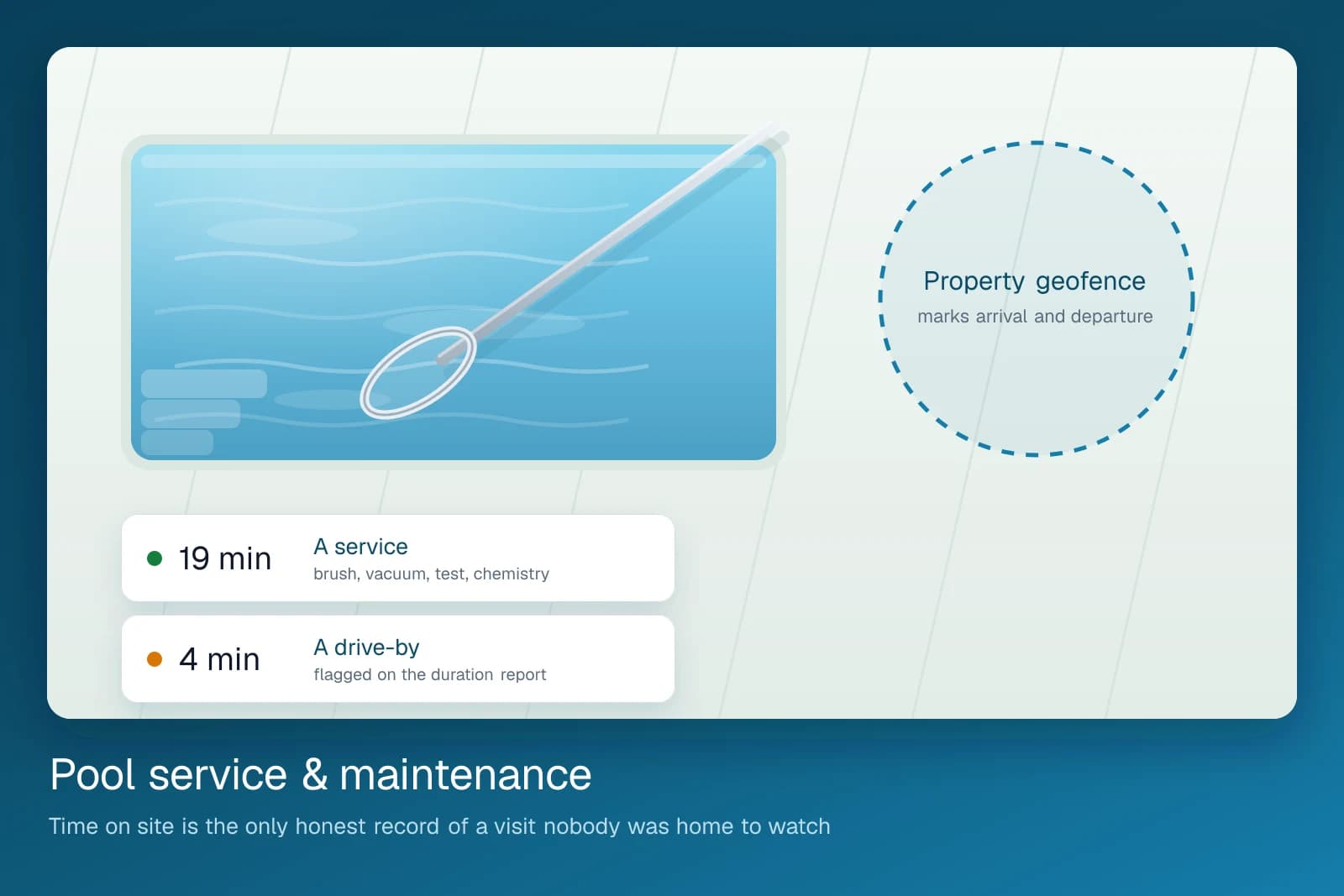
GPS fleet tracking for pool service from High Point GPS gives every stop on a route an arrival time, a departure time and a duration on site. It is set up for pool companies whose customers are rarely home, whose crews double in summer and whose trucks carry chemical racks and trailers. A pool route repeats weekly: a technician tests the water, brushes and vacuums, adjusts the chemistry and leaves. The customer almost never sees it, so the most valuable thing a pool company can produce is a credible record that the visit happened and lasted long enough to count. A geofence around each property marks arrival and departure without a technician pressing anything with wet hands. Across a route of eighteen to twenty-five stops a day, those durations are the most honest quality signal a manager has, and a four-minute visit is a water test and a wave. The business is sharply seasonal in most of Canada and the northern US, so a fleet can double its drivers between May and September and run trucks hard for five months. Driver ID through an NFC reader keeps each route attributed to the person who ran it as trucks and staff are reassigned. Maintenance runs on engine hours as well as mileage, because a truck doing twenty short stops a day wears on cycles. High Point GPS scopes the install around the route book, fits trucks with chemical racks and trailers alike, and picks up the phone when a route manager has a question in the middle of a July week.
Common challenges
- Customers who are never home during the visit and only find out it was missed when the water turns
- Technicians skipping or shortening stops late on a hot afternoon, found out only when a pool goes green
- Seasonal drivers hired in May with no record of how they drive a loaded truck through residential streets
- Routes that were dense in April and ragged by July, as new accounts go wherever there is room
- Chemical racks, trailers and cleaning equipment that walk off a truck or a job site with no way to trace them
- Trucks that run hard for five months and sit for seven, on maintenance schedules that fit neither pattern
How High Point GPS helps
- A geofence at each property that records arrival, departure and time on site for every scheduled visit
- Visit-duration reports by technician and by route that show short stops before a customer's pool does
- A live map of every truck for the mid-afternoon callback that has to fit in today
- Driver ID through an IOX-NFCREADERA reader, so a route belongs to a person even when trucks change weekly
- Driver scoring set for residential streets, aimed at the seasonal drivers who joined three weeks ago
- Bluetooth asset tags on trailers, vacuums and equipment carried between properties
- Maintenance reminders on engine hours and mileage, with fault codes sent to the shop the day they appear
- Visit records available through the open API for your pool-service or field-service software
How does GPS tracking prove a pool visit happened?
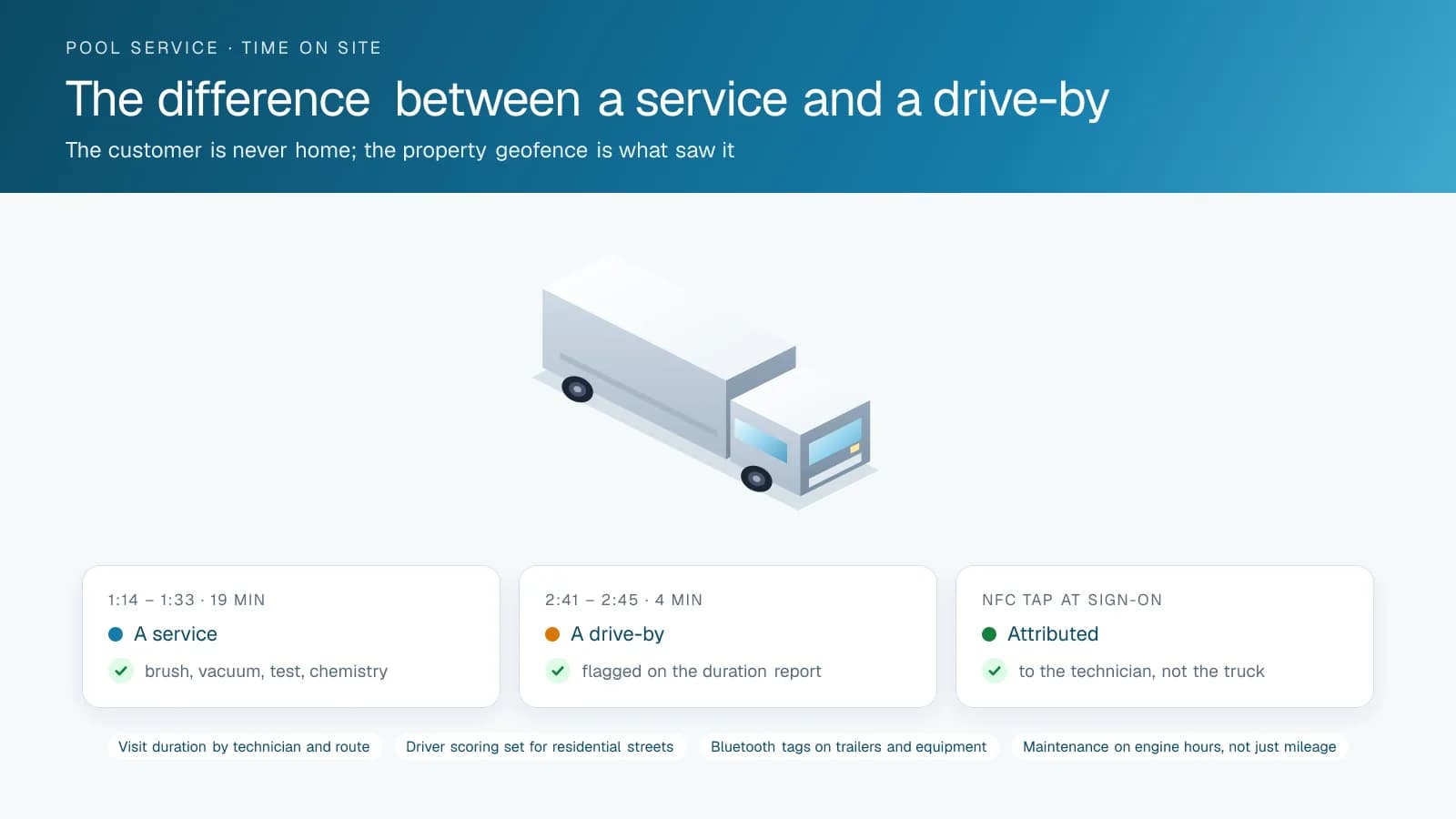
A geofence around each property records when the truck arrived and when it left, so every pool visit has a time and a duration the customer can trust. Pool service is bought on trust and lost on suspicion. The customer is at work when the technician comes, the gate is unlocked, the work takes twenty minutes, and the only evidence is a tag on the equipment pad and clear water a few days later. When the water is cloudy, the customer assumes nobody came. The geofence settles it: the truck entered at 1:14 and left at 1:33, nineteen minutes on site, and the trip replay shows the vehicle at the address. Nothing depends on a technician checking in on a phone with chemical on their hands, so the record is as complete at the end of the season in August as it was in April.
The same data is more useful pointed at your own crew. Over a route of twenty stops, visit durations form a pattern, and the exceptions deserve a look. A technician whose stops run nineteen, twenty-two and eighteen minutes through the morning, then four, five and four after two o'clock, has shown a route manager a problem in time to act on it. Better to have that conversation in July from a report than in August with an angry customer. High Point GPS draws the geofences from your existing property list and keeps them current as accounts are added and dropped through the season.
The seasonal fleet problem
Few industries change shape as fast as pool service does in May. A company running six trucks through the winter may be running fourteen by June, with drivers hired weeks earlier who have never driven a loaded service truck through a residential subdivision. The exposure is real and it is concentrated in the first month: speed on streets with children, harsh braking, tight turns with a trailer, and the low-speed damage that happens in driveways. Driver scoring reports speeding, harsh braking and harsh cornering by driver and by route, which gives a supervisor something concrete to raise with a new hire in week two instead of a general reminder to everyone at a season-opening meeting.
Driver ID makes that possible on a fleet where the truck a person drives changes weekly. An IOX-NFCREADERA reader in each vehicle lets a technician tap a card at the start of the day, and every trip, stop and event is attributed to them from then on regardless of which truck they are in. When a complaint arrives about a service truck taking a corner badly on a residential street, or a curb is clipped, or a mailbox is caught, the record answers who was driving without a manager having to reconstruct a dispatch sheet. AI dash cams are available where a company wants the road-facing view, and High Point GPS sets the scoring thresholds for residential route work rather than leaving highway defaults that would flag every technician equally.
Trucks, trailers, chemicals and equipment
A pool truck carries things worth stealing and things that are dangerous to carry badly. Chemical racks, vacuums, pumps, poles and a trailer represent real money, and they move between properties all day with the truck unlocked more often than anyone would like. Bluetooth asset tags read by the GPS tracking device report which tagged equipment is aboard which vehicle and when it was last seen, which turns the end-of-season inventory from an argument into a list, and gives a supervisor a last-known location when a trailer goes missing from a job site. For the trailer itself, a powered or battery tracker gives its own position rather than an inference from the last truck it was near.
The vehicles themselves live an unusual life: driven hard for five months, largely parked for seven. Neither a pure mileage schedule nor a pure calendar one describes that well. The GPS tracking device reads engine hours, odometer and fault codes from the vehicle, and the High Point GPS platform schedules on whichever comes first, so a truck doing twenty short stops a day in August gets serviced on the wear it is accumulating rather than on a distance interval set for a highway fleet. Fault codes reach the shop the day they appear, which in the middle of a season with no spare truck usually decides whether a repair happens on a Saturday or strands a route on a Wednesday. Electronic inspections in the driver app cover the things that matter on this equipment: the trailer lights and coupling, tire condition, and the security of the chemical load.
Keeping a route dense through the season
A pool route is at its best in April, when it was planned, and degrades from there. New accounts are slotted into whatever day has capacity, cancellations leave holes, and by midsummer a technician can be crossing the same town twice in an afternoon. Because each stop is short, the driving is where the time actually goes, and it is the part nobody measures. The High Point GPS platform reports kilometres driven, kilometres between stops, stops per day and time on site by route, which makes the shape of a route visible and a re-cut possible partway through a season rather than only at the start of the next one.
The live map does the simpler daily work. A customer calls at two o'clock about a pump that is not running, and the question is which technician can be there before five without wrecking the rest of their afternoon. Seeing the trucks answers it in seconds. The timeline map replays a full day when a route manager wants to understand where an afternoon went, and it commonly reveals sequencing rather than effort as the problem. Where a company already runs pool-service or field-service software, the trip, stop and geofence records are available through the open API so the visit history in the office system matches what the trucks actually did. High Point GPS sets the reports up around your route book and stays available through the season, which is when the questions come.
Frequently asked questions
How does it prove a technician actually serviced a pool?
A geofence around the property records the truck's arrival and departure on its own, so every visit has a time and a duration, and the timeline map replays the route to show the vehicle at the address. The technician never checks in by hand, so the record stays complete through the busy weeks of the season as well as the first ones.
Can we see when stops are being cut short?
Yes. Visit-duration reports by technician and by route show the pattern, so a run of four-minute stops late on a hot afternoon appears in a report while a route manager can still deal with it. Without that report, the first sign is usually a customer calling weeks later because the water has turned.
We double our drivers every May. Does that work with this?
Yes. Driver ID through an IOX-NFCREADERA reader ties a route to the person who tapped in, whatever truck they drive, so reassigning vehicles weekly causes no gaps. Driver scoring gives a supervisor something specific to raise with a new seasonal hire in their second week, with thresholds set for residential route work instead of highway defaults.
Can we track trailers and equipment as well as trucks?
Yes. Bluetooth asset tags on vacuums, pumps, poles and racks report which tagged equipment is aboard which vehicle and when the system last saw it. A trailer can carry its own powered or battery tracker, so it reports its own position directly instead of a location guessed from the last truck it was near.
Our trucks run hard for five months and sit for seven. How is maintenance scheduled?
On engine hours and odometer together, whichever comes first, which fits a duty cycle that neither a mileage interval nor a calendar interval describes well. Fault codes reach the shop the day they appear. In mid-season with no spare truck, that often decides whether a repair is booked for the weekend or strands a route.
Related solutions
Related guides
- What Is Geofencing? How It Works in Fleet Tracking →
- Asset Tracker Tags vs. Powered GPS Trackers for Equipment →
- IOX-NFCREADERA: Driver ID by NFC Tap, So Every Trip Has a Name on It →
- Driver Safety Scorecard: How Driver Scoring Works for Fleets →
- Fleet Maintenance Schedule: Engine Hours vs Calendar and Mileage →
- Route Optimization Software: What It Does and When It Pays →
Get a free quote
What are you looking for?