
Industry
GPS Fleet Tracking for School Buses & Student Transportation
GPS tracking for school bus fleets that shows dispatch and parents where every bus is, records each stop and each student boarding, and gives the transportation office the evidence it needs when a route runs late or a complaint comes in.
Updated September 21, 2026
A school bus fleet runs the same routes every day under the closest scrutiny any fleet gets: parents at the stop, a district office answering the phone, and a board that asks why the buses cost what they do. GPS tracking for school buses puts every bus on one live map for the transportation office, with the route it should be on, the stops it has made and the time it made them. The same Geotab GO device that reports position records the door opening, the stop arm deploying and the flashing lights through its auxiliary inputs, so the record of a stop is the record of what the bus actually did there. A student ID reader at the door adds who boarded and where they got off. When a parent calls about a late bus, dispatch sees where it is and why; when a complaint arrives about a bus that did not stop, the trip replay settles it in minutes. Driver-behaviour reporting held to a school-bus standard, engine-hours maintenance and electronic pre-trip inspections round out a platform that a district or a contractor runs from one MyGeotab database, with a parent app on top if the district wants one.
Common challenges
- Parents calling the office to ask where the bus is, with no better answer than a radio check
- Late-bus and missed-stop complaints with no record of where the bus actually was
- No proof of which students boarded or where they got off when a child is reported missing from a bus
- Stop-arm and flashing-light use that is never recorded, so a violation report rests on memory
- Pre-trip inspections on paper that do not reach the shop until the bus is already on the road
- Substitute and contractor drivers who do not know the route and the stops the way the regular driver does
How High Point GPS helps
- Live location of every bus on one map for the transportation office, with the planned route and stops beside it
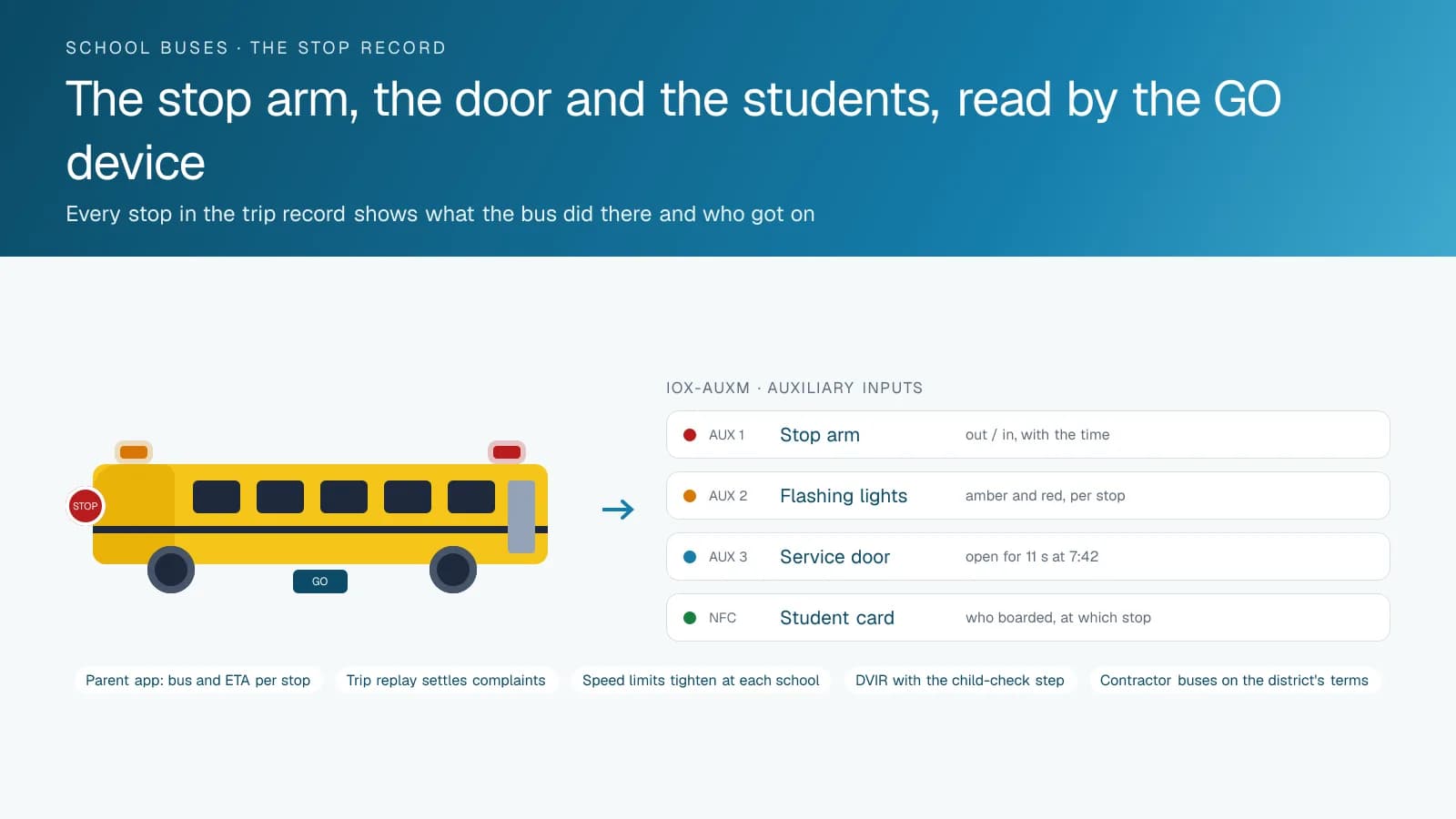
- Stop-arm, door and flashing-light status read from the bus's own circuits through the GO device's auxiliary inputs
- Student boarding and alighting records from an NFC or RFID card reader at the door, tied to the stop and the time
- A parent-facing bus location and ETA option through a Marketplace app, with the district deciding what is shared
- Trip replay that shows the route, the speed and each stop for any bus on any day, for complaint and incident review
- Driver-behaviour scoring set for school buses: speeding near schools, hard braking with students aboard, idling at the stop
- Electronic pre-trip and post-trip inspections in the Geotab Drive app, with the child-check reminder at the end of the run
- Maintenance reminders on engine hours and mileage, with fault codes from the engine sent to the shop as they appear
Answering "Where Is the Bus?" Without a Radio Call
The transportation office's busiest hour is the one when buses run late. With every bus on a live map, the person answering the phone sees the bus, the stop it is approaching and how far behind schedule it is, and can say so. The planned route and stop list sit beside the live position, so an off-route bus is visible before anyone reports it. Districts that want to go further give parents the same view: a Marketplace bus-tracking app shows a parent their child's bus and an arrival estimate for their stop, and the district chooses whether parents see the whole route or only the stops that matter to them.
The record behind that view is the same one that answers complaints. A parent says the bus did not come; the trip replay shows the bus at the stop at 7:42, the door opening for eleven seconds and the stop arm out. A neighbour says a bus was speeding on their street; the replay shows the speed on every segment. High Point GPS sets the reports up so that a supervisor can pull the answer in the time it takes to keep the caller on the line.
Recording the Stop, the Door and the Students
A school bus has circuits no other fleet vehicle has: the stop arm, the crossing gate, the amber and red flashing lights and the service door. An IOX-AUXM module on the GO device reads whether each is on or off, so every stop in the trip record carries the arm-out, lights-on and door-open times. That is the evidence a district needs when it reports a stop-arm violation by a passing motorist, and it is the evidence that shows the driver followed procedure when a parent says otherwise.
A card reader at the door adds the students. Each student taps a card when boarding and again when leaving, and the platform logs who was on the bus, at which stop they boarded and where they got off. When a child is reported missing after the afternoon run, the office sees in seconds whether the child boarded and where the door opened for them. The same records support ridership counts for route planning and state reporting without a driver keeping a tally sheet.
Driving Standards Written for Buses, Not Delivery Vans
The rules High Point GPS configures for a school bus fleet reflect how a bus is meant to be driven. Speed thresholds tighten in school zones and around the schools the fleet serves, through geofences around each one. Hard braking and fast cornering are weighted more heavily when the student count from the card reader shows children aboard. Idling at the school loop is reported separately from idling on the road, because one is often unavoidable and the other rarely is. The driver's score reflects the driving that matters, and the coaching conversation starts from a specific trip on a specific day.
AI dash cams add the view from the cab when a district wants it. A road-facing camera records what happened in front of the bus, and a driver-facing camera with distraction and fatigue detection flags the moments a supervisor should see. Video is retrieved by trip and by event, so an incident review is a few clips rather than a day of footage, and the district sets the retention and access policy.
Inspections, Maintenance and the Contractor Question
The pre-trip inspection is a legal requirement and, on paper, the most-ignored one. Electronic DVIR in the Geotab Drive app walks the driver through the bus-specific checklist, time-stamps each item and routes a defect to the shop before the bus leaves the yard. The post-trip inspection carries the child-check step, so the record shows the driver walked the bus after the run. Maintenance reminders run on engine hours and mileage, and engine fault codes reach the shop as the bus logs them, which is how a cooling or charging problem gets fixed before it strands a bus on a route.
Districts that contract their busing put the same tracking in the contractor's buses, on the district's terms. High Point GPS sets up the MyGeotab database so the district sees its routes, the contractor sees its fleet, and the contract's on-time and safety reporting comes from the same records both parties trust. When the contract changes hands, the data and the parent app stay with the district.
Frequently asked questions
Can parents see where the bus is?
Yes, if the district chooses to offer it. A bus-tracking app from the Geotab Marketplace shows parents their child's bus and an arrival estimate for their stop. The district controls what is shared, and the transportation office always has the full live map regardless.
How does the system record student boarding?
An NFC or RFID card reader at the door logs each student's tap when boarding and leaving, with the stop and the time. The platform then shows who is on which bus and where each student got off, which answers a missing-child call and supports ridership reporting.
Does it record the stop arm and flashing lights?
Yes. An IOX-AUXM module on the GO device reads the stop arm, the crossing gate, the flashing lights and the service door through the bus's own circuits, so every stop in the trip record carries those states and their times.
Will it work with our contractor's buses?
Yes. High Point GPS sets up the database so the district sees its routes and reporting while the contractor manages its fleet. The on-time and safety records come from the same data, and they stay with the district if the contract changes.
What does the driver have to do differently?
Run the pre-trip and post-trip inspection in the Geotab Drive app on a tablet or phone instead of on paper, and log in so trips are attributed to them. Tracking, stop recording and the student reader work without any driver input.
Related solutions
Related guides
- Do School Buses Have GPS? How School Bus Tracking Works for Districts and Parents →
- Can You Track a School Bus? What Drivers, Dispatchers and Parents Each See →
- School Bus GPS Tracking System Price: What a District or Contractor Pays Per Bus →
- Passenger ID: Recording Every Student or Employee Boarding With a Card Tap →
- What Is a Geotab IOX and What Does It Do? →
- Geotab DVIR: How Digital Vehicle Inspection Reports Work →
Get a free quote
What are you looking for?