
Industry
GPS Fleet Tracking for Street Sweeping
GPS tracking for street sweeping fleets: streets swept with the broom down, curb-kilometres by route and shift, and a log for the stormwater permit.
Updated September 21, 2026
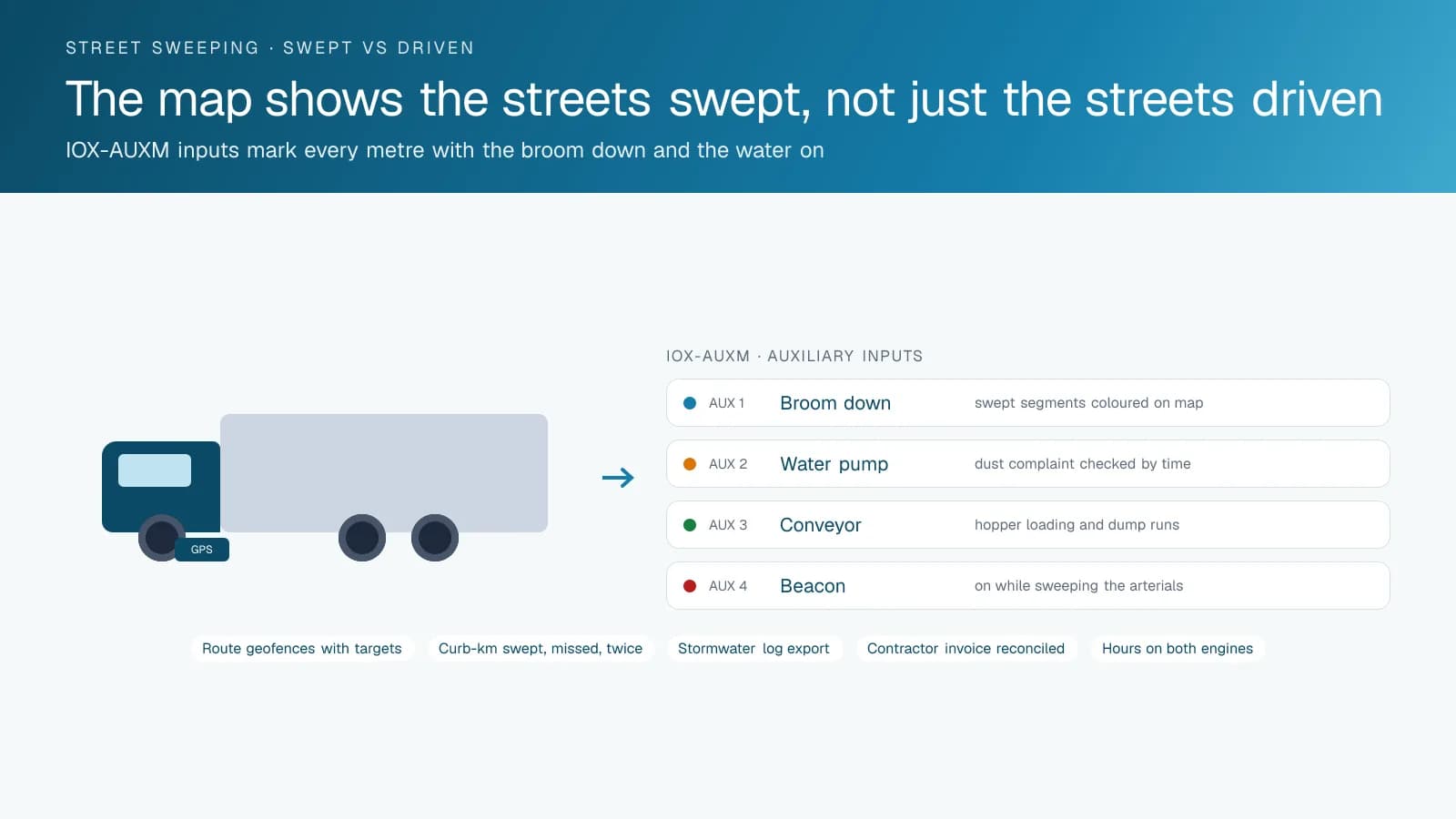
Street sweeping is judged by what is visible the next morning and reported on what nobody can see. Was the broom down on the block that was signed for sweeping? Was the water on when the dust complaint came in? How many curb-kilometres did the program cover this season? GPS tracking from High Point GPS puts every sweeper on one live map for the public works office and writes each shift as a sweeping record rather than a driving record. A GPS tracking device covers the sweeper, and IOX-AUXM auxiliary inputs read the broom, the water pump, the conveyor and the beacon through the machine's own circuits. The trip replay then shows which streets were swept and which were only driven. Routes are drawn as geofences and the coverage report shows every curb-kilometre swept, missed or swept twice. When a resident says their street was skipped on sweeping day, the map answers. When a councillor asks what the program delivered, the season's curb-kilometres are a report. When a stormwater permit asks for sweeping records, the log exists with dates, streets and equipment states. Contractor sweepers carry the same device on the municipality's terms. Engine-hours maintenance on the sweeping engine and the chassis engine, fault codes to the shop, electronic pre-shift inspections and driver ID for the seasonal operators round out the platform. It fits in the municipality's High Point GPS platform database next to the plows and the garbage trucks.
Common challenges
- Residents who say their street was skipped on sweeping day, with no record beyond the operator's route sheet
- Sweepers that drive a route with the broom up because of a full hopper or a shortcut, counted as swept
- Curb-kilometres for the season reported from route lengths rather than from what was actually swept
- Dust complaints with no record of whether the water system was running on that block at that time
- Stormwater permits and audits that ask for sweeping records the department keeps on paper, if at all
- Contractor sweepers billed by the route or the hour with nothing to reconcile the invoice against
How High Point GPS helps
- Every sweeper on one live map for the public works office, with the sweeping routes drawn as geofences
- Broom, water pump, conveyor and beacon status read from the sweeper's own circuits through IOX-AUXM auxiliary inputs
- Trip replay that colours the streets swept with the broom down apart from the streets only driven
- Coverage reports by route and by shift showing curb-kilometres swept, missed and swept twice
- Sweeping logs with dates, streets and equipment states, exported for stormwater permits and audits
- Contractor sweepers on the same database on the municipality's terms, with invoices reconciled against the record
- Engine-hours maintenance for both engines, with fault codes sent to the shop as they appear
- Electronic pre-shift inspections in the driver app and driver ID for seasonal and night-shift operators
Swept, not just driven
A sweeper's GPS trail looks the same whether the broom is down or up. That is the problem with tracking a sweeper like a truck: the map shows every street it drove and says nothing about which ones it cleaned. An IOX-AUXM module on the GPS tracking device reads the broom-down circuit, the water pump, the conveyor and the beacon, and stamps each state change with the time and the location. The trip replay then draws the swept segments in one colour and the driven segments in another, and the operator's route sheet is replaced by a map that shows the work.
That distinction is what answers the resident. A street that was signed for sweeping and driven with the broom up because the hopper was full is a missed street on the report, not a swept one. The supervisor sees the miss the same day and schedules a return before the complaint arrives. A dust complaint from a block at 6:40 is checked against the water pump state at 6:40. High Point GPS wires the inputs to each sweeper model in the fleet, including the ones with two engines and the ones with a separate hydraulic circuit for the broom.
Curb-kilometres the department can stand behind
The sweeping program is measured in curb-kilometres, and most departments report it from the planned route lengths. The record from the sweeper is different: it counts the distance actually covered with the broom down, by route, by shift and by season. When the council asks what the program delivered, the department reports what was swept rather than what was scheduled. When the budget conversation turns to whether a third sweeper is needed, the coverage report shows how many curb-kilometres the two existing machines reach before the season ends.
Routes drawn as geofences make the report readable. The spring cleanup, the residential cycle, the arterials and the downtown night route each have their own zone and their own target. The coverage report for the week shows each route's swept distance against its target, the segments missed and the segments swept twice because two operators overlapped. The supervisor adjusts the routes from that report, and the seasonal summary goes to the director with the miss rate and the curb-kilometres per shift by operator.
The stormwater file and the contractor invoice
Municipalities with a stormwater permit are asked to show that street sweeping happened as a pollutant control, with dates, streets and frequencies. A paper log kept by the operator is the record most departments have, and it is the record an auditor questions. The sweeping log from the High Point GPS platform carries the date, the route, the streets covered with the broom down, the water state and the operator, and exports on a schedule to the file the environmental office keeps. The department answers the permit question with a report rather than a binder.
The same record reconciles the contractor. Municipalities that contract some or all of their sweeping receive an invoice by the route or by the hour. The sweeping record from a GPS tracking device in the contractor's machine, installed on the municipality's terms, shows the curb-kilometres swept with the broom down and the hours on site. The invoice is checked against the record, and the contract's performance clauses are enforced from data both parties can see. High Point GPS sets up the database so the contractor sees its machines and the municipality sees the work.
Two engines, night shifts and the season's operators
A sweeper is two machines in one: a chassis engine that drives it and an auxiliary engine that runs the broom, the blower and the conveyor. Maintenance runs on the hours of each, and a shop that tracks only the chassis misses the engine that fails first. Engine-hours reminders in the High Point GPS platform cover both, and fault codes from the chassis reach the shop when they appear. Electronic DVIR in the driver app walks the operator through the pre-shift check of the brooms, the water system and the hopper, and a reported defect becomes a work order before the shift starts.
Sweeping is night work and seasonal work, and the operators change. Driver ID through the IOX-NFCREADERA attributes each shift to the operator who tapped in, and the coverage and miss reports run by person. Speeding on the arterials with the beacon off, idling at the dump site and a hopper run that took an hour longer than it should all show up on the operator's report. The supervisor coaches from a specific shift, and the season's summary informs which operators are asked back next year.
Frequently asked questions
Can it tell whether the broom was down?
Yes. An IOX-AUXM module on the GPS tracking device reads the broom-down circuit, the water pump, the conveyor and the beacon through the sweeper's own wiring, and stamps each state change with the time and location. The trip replay shows swept streets in one colour and driven streets in another.
How does it report curb-kilometres?
Routes are drawn as geofences, and the coverage report counts the distance covered with the broom down by route, by shift and by season, against each route's target. It also shows the segments missed and those swept twice, which is what the supervisor uses to adjust the routes.
Does it produce records for a stormwater permit?
It does. The sweeping log carries the date, the route, the streets swept with the broom down, the water state and the operator, and exports on a schedule. High Point GPS sets the report up to match the format the municipality's environmental office or the regulator asks for.
Can we track our contractor's sweepers?
Yes. A GPS tracking device in the contractor's machine, installed on the municipality's terms, produces the same sweeping record, and the invoice is reconciled against curb-kilometres swept and hours on site. The database is set up so the contractor sees its machines and the municipality sees the work.
Does it handle the sweeper's auxiliary engine?
Yes. Engine-hours maintenance reminders can run on the auxiliary engine's hours as well as the chassis engine's, read through an auxiliary input or the machine's own hour meter. The shop schedules service for both engines from actual use rather than from the calendar, and the reminder reaches the shop before the season's peak.
Related solutions
Related guides
- Municipal Fleet Tracking: A Buyer's Guide for Cities, Counties and Public Works →
- What Is an IOX Port and What Does It Do? →
- How Geofencing Works for Fleet Tracking →
- Fleet Maintenance: Engine Hours vs. the Calendar →
- Timeline Map: Replaying a Trip Minute by Minute to Settle a Dispute →
- IOX-NFCREADERA: Driver ID by NFC Tap, So Every Trip Has a Name on It →
Get a free quote
What are you looking for?