
Industry
GPS Fleet Tracking for Truck Leasing & Rental
GPS fleet tracking for truck leasing and rental fleets: daily odometer and engine hours for billing, maintenance across customers and overdue-unit alerts.
Updated September 21, 2026
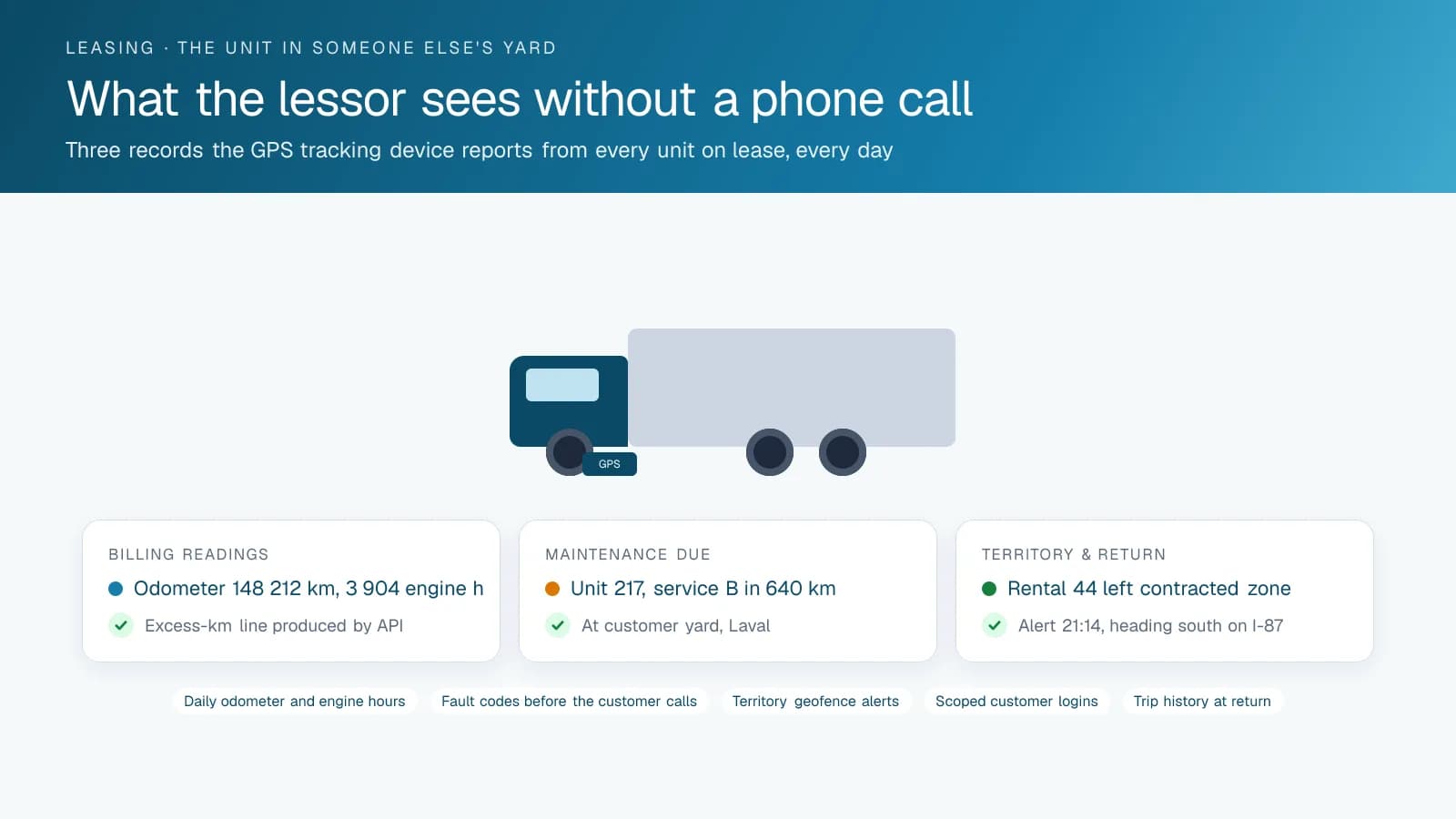
A lessor's fleet is unusual in one way: the trucks are earning money in someone else's yard. A unit on a full-service lease, a rental van out for the weekend and a tractor sub-leased to a customer's own customer are all assets the lessor owns, insures and maintains without seeing them for weeks at a time. High Point GPS installs the GPS tracking device in every unit before it goes out. The lessor's High Point GPS platform database then reports odometer and engine hours on every truck without a phone call, which is the number the billing system needs for a mileage-based lease. Maintenance reminders run on the same readings across every customer, and the shop knows which units are due before the customer does. When a rental is overdue or a lease goes into default, the live map shows where the truck is and a geofence alert reports the moment it leaves the region it is contracted to. At return, the trip history and the fault-code log settle whether the transmission fault was there when the customer took delivery or arrived during the term. Customers who want their own view get a scoped login to see their units and nothing else. Driver behaviour data, IOX-AUXM inputs on specialty bodies and the open API into the lessor's billing and fleet-management systems round out a platform built for owning trucks that other people drive.
Common challenges
- Mileage and engine-hours billing that depends on the customer reporting readings, late and sometimes wrong
- Preventive maintenance that slips because units on lease are due at different times in different cities
- Rentals that do not come back on the due date, with no idea where the truck is or who is driving it
- Damage and drivetrain faults discovered at return that the customer says were already there
- Units the customer has sub-leased or moved out of the contracted territory without telling the lessor
- Customers asking for tracking of their own, leading to two devices in the same truck and two bills
How High Point GPS helps
- Odometer and engine hours reported daily from every unit, feeding mileage-based and hour-based lease billing automatically
- Maintenance schedules across the whole leased fleet, with due dates by unit and by customer location for the shop and the mobile technicians
- Live location of every unit, and geofence alerts when a truck leaves its contracted region or a rental crosses a border
- Engine fault codes as they appear, so a lessor sees a developing problem before the customer calls or the warranty expires
- Trip history and fault log at delivery and at return, the record that settles a condition dispute
- Theft and non-return recovery from the live position, with after-hours movement and long-idle alerts on units in storage
- Scoped customer logins so a lessee sees its own units, trips and driver behaviour without touching the rest of the fleet
- Open API into lease billing, fleet-management and ERP systems, with custom add-ins for the lessor's own workflows
Billing on what the truck actually did
A mileage-based lease is only as accurate as the odometer reading behind the invoice. Chasing customers for readings at month end produces numbers that arrive late, get transcribed wrong and are sometimes rounded in the customer's favour. The GPS tracking device reads the odometer and engine hours from the truck's own engine data every day, and the High Point GPS platform reports them by unit, by customer and by billing period. High Point GPS connects that report to the lessor's billing system through the High Point GPS API, and the invoice line for excess kilometres or engine hours is produced from the same figure the customer can see in their own login.
The same daily readings show which units are earning and which are sitting. A lessor with two hundred tractors on lease sees the ones running six hundred kilometres a day and the ones that have not moved in a month, and a conversation about right-sizing the customer's lease or repositioning an idle unit starts from evidence. Rental fleets use the readings to close a contract without a walk-around at the counter: the kilometres, the engine hours and the fuel level are already in the record when the keys come back.
Maintenance across customers and cities
Preventive maintenance on a leased fleet is scheduled against readings the lessor does not normally have. With the GPS tracking device reporting kilometres and engine hours daily, maintenance reminders fire by unit regardless of whose yard it sits in, and the shop sees a list of what is due this week sorted by customer and by location. A mobile technician's route through three customer yards is planned from that list. Engine fault codes arrive as the truck logs them, which is how a lessor catches an aftertreatment or a cooling problem while the unit is still under warranty and before the customer reports a breakdown.
The record of what the shop did, and when, is attached to the unit for the life of the lease. When a customer says a truck has been in for the same fault three times, the maintenance history and the fault-code log show whether that is true and what was replaced each time. Electronic DVIR through the driver app lets the customer's drivers report defects into the lessor's shop directly, with the photo and the time. That is faster and better documented than a dispatcher relaying a complaint by email two days later.
Overdue rentals, defaults and stolen trucks
A truck that is not returned on the due date is either late, kept or stolen, and the lessor cannot tell which from the rental agreement. The live map tells. A rental due back Monday that is sitting at a job site on Wednesday gets a phone call; one that is moving south on the interstate gets a different response. High Point GPS sets a geofence around the contracted territory for each lease, and a unit that crosses it produces an alert with the time and place. Border crossings, out-of-province moves and a tractor that has quietly been sub-leased to a third party all surface the same way, with the record to support a contract conversation.
For a genuine theft, the current position feeds directly to the police report and to the recovery agent, and the trip history shows where the unit has been since it left. Trips are stored on the device when coverage drops and uploaded when it returns; a truck parked in an underground garage still reports its route the moment it moves again. Units in storage between leases carry after-hours movement alerts, and Bluetooth battery trackers on trailers and specialty bodies cover the assets that do not have an engine to power a GPS tracking device, reporting their position on a schedule from the lot.
Condition at return and the customer's own view
The return inspection is where lease relationships turn sour. The customer's driver says the clutch was slipping at delivery; the lessor says it was fine. The record decides. The trip history for the term shows how the unit was driven, the fault-code log shows when the first transmission code appeared, and driver-behaviour data shows the harsh-shift and over-rev events that preceded it. A hook-up on a tow-body or a PTO on a specialty unit through an IOX-AUXM input shows how many hours the equipment was actually worked during the term. The condition conversation moves from opinion to a timeline, and the invoice for repairs beyond normal wear rests on that timeline rather than on the inspector's memory.
Customers increasingly ask for tracking of their own, and a second device in the lessor's truck is a wiring problem and a billing one. High Point GPS sets up scoped logins in the lessor's High Point GPS platform database so a lessee sees its units, trips, driver scores and maintenance status and nothing belonging to another customer. The lessor controls what is shared and keeps the master record, and a customer that later buys the unit or moves to its own database can be transferred cleanly. The tracking becomes part of the lease offer rather than a competitor's device on the lessor's asset.
Frequently asked questions
Can the odometer readings feed our lease billing directly?
Yes. The GPS tracking device reports odometer and engine hours from the engine data daily, and the High Point GPS platform summarizes them by unit and billing period. High Point GPS connects that report to the lessor's billing or ERP system through the High Point GPS API, so excess-kilometre and engine-hour lines are produced without the customer submitting readings.
Can our customers see their own units?
Yes. Scoped logins in the lessor's High Point GPS platform database show a lessee its own units, trips, driver behaviour and maintenance status and nothing belonging to another customer. The lessor decides what is shared and keeps the master record, which avoids a second tracking device and a second bill in the same truck.
How does it help when a rental is not returned?
The live map shows where the unit is, and a geofence around the contracted territory produces an alert when it leaves. For a theft, the position and the trip history go to the police report. Trips are stored on the device when coverage drops and uploaded when it returns, so the route is never lost.
Will it show whether damage happened during the lease term?
The trip history, the engine fault-code log and the driver-behaviour events for the term give a timeline of how the unit was driven and when a fault first appeared. That record, with the delivery and return inspections in the driver app, is what settles a condition dispute at return.
Do we need a different device for trailers and specialty bodies?
Powered units take the GPS tracking device. Trailers, storage containers and bodies without an engine use Bluetooth asset tags or battery-powered trackers that report through nearby GPS tracking devices or on their own schedule. Specialty equipment on a powered unit, such as a PTO or a lift, is read through IOX-AUXM inputs.
Related solutions
Related guides
- Fleet Maintenance: Engine Hours vs. the Calendar →
- Equipment Theft Recovery: How GPS Gets Stolen Machines and Trailers Back →
- GPS Tracking for Equipment Rental Fleets →
- In-House Fleet Tracking vs. Full-Service Fleet Leasing: Which Fits Your Business? →
- The High Point GPS API: What You Can Actually Build →
- GPS Asset Tags vs. Powered Trackers: Which to Use →
Get a free quote
What are you looking for?