
Industry
GPS Fleet Tracking for Bottled Water & Water Cooler Delivery
GPS fleet tracking for bottled water delivery: a stop record that settles a missed-delivery call, route density a dispatcher can actually see, and coolers accounted for on customer sites.
Updated September 28, 2026
A water delivery route lives or dies on density. The same truck that makes ninety stops on a Tuesday in a tight suburb makes fifty on a Thursday spread across three towns, and the difference between those two days is most of the margin in the business. GPS fleet tracking for bottled water delivery puts every truck on one live map, records each stop with the time it arrived and the time it left, and turns a day's driving into the numbers a route manager needs: stops per hour, kilometres between stops, time on site, time in traffic. The GPS tracking device plugs into the diagnostic port and reports on its own. Geofences around each account, residential and commercial, mark arrival and departure without the driver touching anything, so when an office calls on Friday to say the bottles never came, the answer is a timestamp and a duration rather than a phone call to a driver halfway through his route. Driver ID through an NFC reader attributes each route to the person who ran it, which matters on a fleet where trucks and drivers are reassigned week to week and where a driver is handling product and, in many operations, payment. Maintenance reminders run on engine hours and mileage, because a bottle truck doing a hundred short stops a day ages on hours and stop-start cycles, not on highway kilometres. High Point GPS scopes the install around the route book you already run, fits the hardware to side-loaders, box trucks and cargo vans alike, and stays on the phone afterward.
Common challenges
- Missed-delivery calls that come in days later, with no record of whether the truck stopped at all or how long it was there
- Routes built years ago and never re-cut, where a dispatcher cannot see which days are dense and which are bleeding kilometres between stops
- Coolers, crocks and racks that belong to the company but live on customer premises, written down on a spreadsheet that has drifted from reality
- Drivers running the route out of sequence, so the commercial accounts with delivery windows get hit at the wrong end of the day
- Summer peaks that add temporary drivers to the fleet with no record of how any of them drive
- Box trucks doing short-stop work all day whose maintenance is scheduled on odometer intervals that do not reflect the wear
How High Point GPS helps
- Every truck on one live map, with the day's completed and remaining stops beside it
- Geofences on each account that record arrival and departure automatically, giving a proof-of-service record per stop
- Stops per hour, time on site and kilometres between stops, by route and by day, so route density can be measured rather than guessed
- Driver ID through an IOX-NFCREADERA reader, attributing every route and every event on it to the driver who ran it
- Trip replay that settles a missed-delivery or damage dispute from the record instead of from memory
- Maintenance reminders on engine hours as well as mileage, with engine fault codes routed to the shop the day they appear
- Driver scoring and optional AI dash cams, aimed at the reversing and driveway incidents that dominate this work
- Route data available to your billing or route-accounting system through the open API, so stop records reach the invoice
The stop record that answers a missed-delivery call
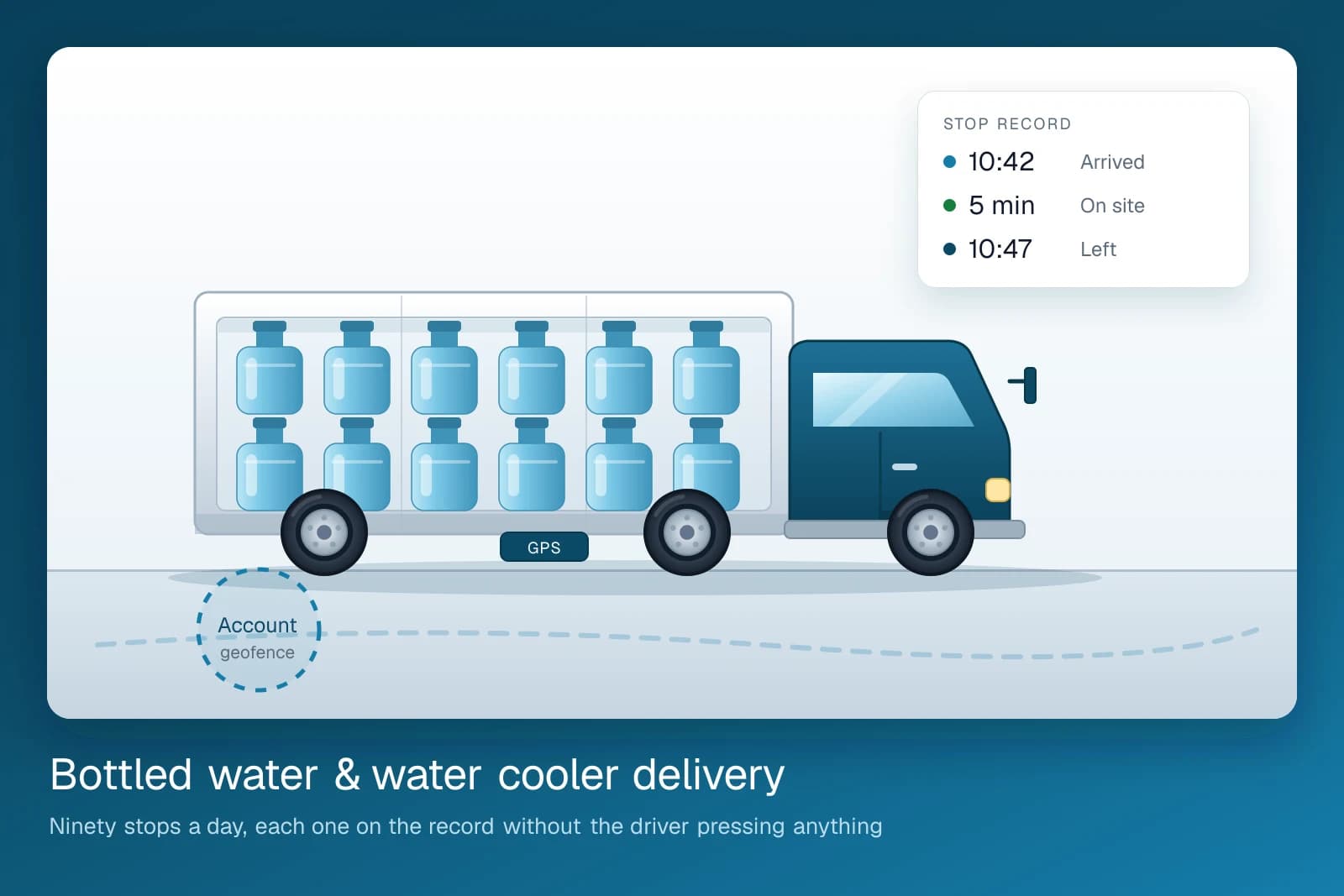
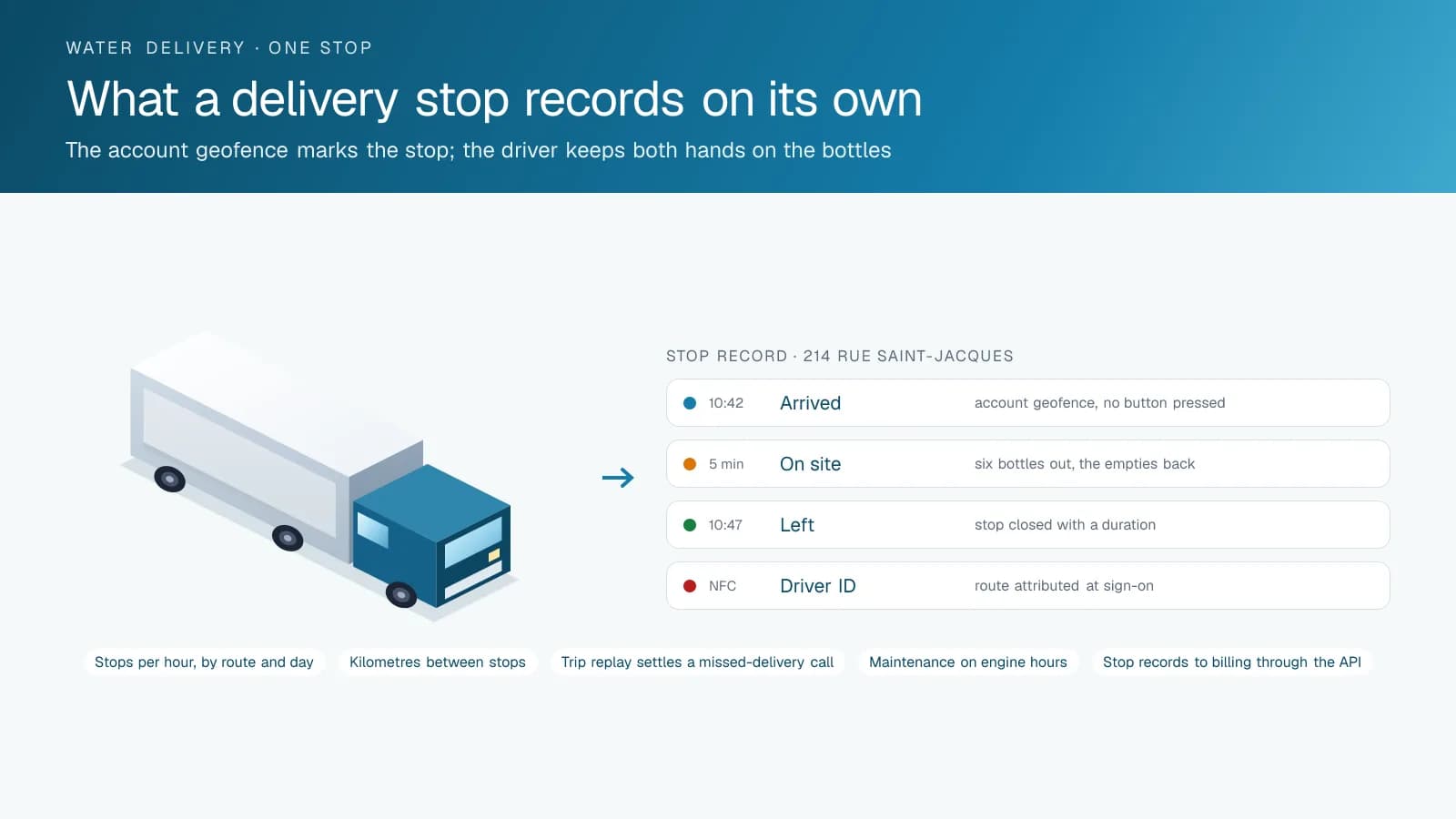
The call that costs a water company money is rarely about the water. It is an office manager on Friday afternoon saying nobody came on Wednesday, and a route manager with no way to answer except to ring the driver, who ran ninety stops that day and remembers none of them individually. With a geofence drawn around each account, the record exists before anyone asks for it. The truck entering the geofence at 10:42 and leaving at 10:47 is five minutes on site, which is a delivery. The truck passing the address without entering is a stop that did not happen, and it is visible the same afternoon rather than two days later. Neither requires the driver to press anything, which matters on a route where the driver's hands are full of bottles all day.
Duration is the part that does the real work. A stop that lasted ninety seconds did not include carrying six bottles up a flight of stairs and taking the empties back, and a route manager who sees a run of ninety-second stops has found something worth asking about before the customer complaints arrive. The same record answers the opposite question just as well: when a customer disputes a charge for a delivery that was made, the arrival time, the departure time and the trip replay showing the truck at the address are on file. High Point GPS draws the geofences from your existing account list rather than making anyone place them one at a time, and adds new accounts to the map as they are set up.
Seeing route density instead of guessing at it
Most water routes were cut years ago and have been patched ever since: an account added here, a cancellation there, a new subdivision absorbed into whichever day had room. The result is a route book that nobody can see the shape of. The High Point GPS platform reports the measurements that describe it, by route and by day: total stops, stops per hour, kilometres driven, kilometres between stops, time on site and time driving. A Thursday route that covers 180 kilometres to make fifty stops and a Tuesday that covers 60 to make ninety are both profitable-looking on a delivery count and completely different on a cost per stop, and the difference only becomes visible when someone is measuring the driving rather than the deliveries.
That data is what makes a re-cut possible. Once you know where the kilometres are going, accounts can be moved between days deliberately, and the effect shows up in the same report the following week. The timeline map replays an entire route, which often reveals the simpler problem first: a driver running the book in the order it was printed rather than the order the geography suggests, doubling back across a town twice a day. Where you already run routing software, the trip and stop records are available through the open API so the two systems see the same day. High Point GPS configures the reports around your route book, and the numbers arrive weekly by email if you want them to.
Drivers, product and payment on a route fleet
A water route driver is alone with company product and, in many operations, with customer payments. Driver ID through an IOX-NFCREADERA reader ties every route to a person: the driver taps a card at the start of the shift and each trip, stop and event from then on is attributed to them. On a fleet where trucks and drivers are reassigned week to week, and where summer brings temporary drivers who may be in three different trucks in a month, this is the difference between a fleet record and a vehicle record. When a parking ticket, a curb strike or a complaint about the way a truck was driven on a residential street comes in, the question of who was driving is already answered.
The safety exposure in this work is specific and it is mostly at low speed. Water trucks reverse into driveways, loading docks and tight commercial lots dozens of times a day, and the resulting damage is the kind that gets discovered later and disputed. Driver scoring reports speeding, harsh braking and harsh cornering by driver and by route, which is a fair basis for a conversation with a seasonal driver who has been in the truck three weeks. AI dash cams are available where an operator wants the road-facing and reversing view, and the footage settles the driveway claims that would otherwise be paid on the customer's account of them. High Point GPS sets the scoring thresholds for short-stop urban work rather than leaving highway defaults in place, where every delivery route scores badly and the report stops being read.
Trucks that age on hours, not kilometres
A bottle truck making a hundred stops a day might cover ninety kilometres and accumulate eight hours of engine time, much of it at idle in summer with the driver in and out of the cab. Scheduling its service on an odometer interval borrowed from a highway fleet gets the intervals wrong in both directions. The GPS tracking device reads engine hours, odometer and fault codes from the vehicle itself, and the High Point GPS platform schedules reminders on whichever comes first. Brakes on a truck doing that many stop-start cycles wear on a different clock from the one the mileage suggests, and the reminders can be set to reflect it.
Fault codes reach the shop the day they appear rather than at the next scheduled service, which on a single-shift route fleet is often the difference between a repair booked for Saturday and a truck stranded mid-route with product aboard. Electronic vehicle inspections in the driver app give the driver a short pre-trip list built for this equipment: the lift gate, the bottle racks and load restraints, tires, lights. Defects are time-stamped and routed to whoever handles repairs, and the inspection history is on file. Idling reports matter more here than on most fleets, because a summer route spends a lot of the day with the engine running for air conditioning while the driver is at a door, and that fuel is visible per truck and per driver once someone is looking at it.
Frequently asked questions
Can it prove a delivery was made when a customer says it was not?
Yes. A geofence around the account records the truck's arrival and departure automatically, so the stop has a start time, an end time and a duration without the driver pressing anything. The timeline map replays the route to show the vehicle at the address. That record is usually enough to settle a missed-delivery or disputed-charge call the same day.
Will it help us re-cut routes that have not been touched in years?
That is the most common reason water operators put it in. The platform reports stops per hour, kilometres driven, kilometres between stops and time on site for each route and day, which is what makes density visible. Once you can see which days are spending kilometres rather than making stops, accounts can be moved deliberately and the effect measured the following week.
How do we know which driver ran which route?
An IOX-NFCREADERA reader in each truck lets the driver tap a card at the start of the shift, and every trip, stop and event from then on is attributed to them. Trips without a tap can be flagged. This matters on a fleet where trucks and drivers are reassigned weekly and where summer adds temporary drivers.
Our trucks do short stops all day. Does mileage-based maintenance still make sense?
Often not, which is why the platform schedules on engine hours as well as odometer and triggers on whichever comes first. A truck doing a hundred stops a day accumulates engine hours and stop-start cycles far faster than its mileage suggests, and brake and driveline intervals can be set to reflect that.
Can stop records reach our billing or route accounting system?
Yes. Trips, stops, geofence arrivals and departures are available through the open API, so the delivery record your drivers generate can feed the system that produces the invoice. High Point GPS scopes that integration with whoever supports your route accounting software.
Related solutions
Related guides
- How Geofencing Works for Fleet Tracking →
- Route Optimization Software Explained →
- IOX-NFCREADERA: Driver ID by NFC Tap, So Every Trip Has a Name on It →
- Fleet Maintenance: Engine Hours vs. the Calendar →
- GPS Fleet Tracking for Small Business: What a 3 to 20 Vehicle Fleet Needs →
- Timeline Map: Replaying a Trip Minute by Minute to Settle a Dispute →
Get a free quote
What are you looking for?