
Dispatch & Routing
Free Open-Source vs Commercial Route Optimization Software: What You Get
Free open-source route optimization software gives you a capable solver. Commercial route planning software adds maps, traffic, driver apps and live data.

What Does Free Open-Source Route Optimization Software Give You?
Open-source route optimization software gives you a capable solver at no licence cost, and the open-source routing world is mature. Road-network engines built on OpenStreetMap data compute drive times and turn-by-turn routes between any two points. Vehicle routing solvers built on top of them take a set of stops, vehicles and constraints and return optimized routes, and general-purpose optimization libraries let a developer model almost any rule a fleet can describe. Real logistics companies run these solvers in production, and a developer can optimize a forty-stop problem on a laptop in an afternoon.
What Does Open Source Leave You to Build?
You build everything around the solver. Someone has to download the map data, keep it current and host it, and the engine needs a server that someone maintains. Historical and live traffic are not in the free data, so drive times are averages. You get no dispatcher screen and no driver app that shows the next stop and captures proof of delivery. Customer notifications and a live view of where the vans are also fall to you. When a truck breaks down, nothing re-sequences the afternoon, because the solver does not know where the trucks are. Each piece is a project, and the fleet becomes a software company with a routing product to maintain and a developer it cannot lose.
Building on open source is the right call for a fleet with an engineering team and an unusual problem, such as a rule no product supports or a scale where per-vehicle licensing hurts. For a fleet without developers on staff, the first year of development can easily cost more than the licence money it saves.
What Does Commercial Route Planning Software Add?
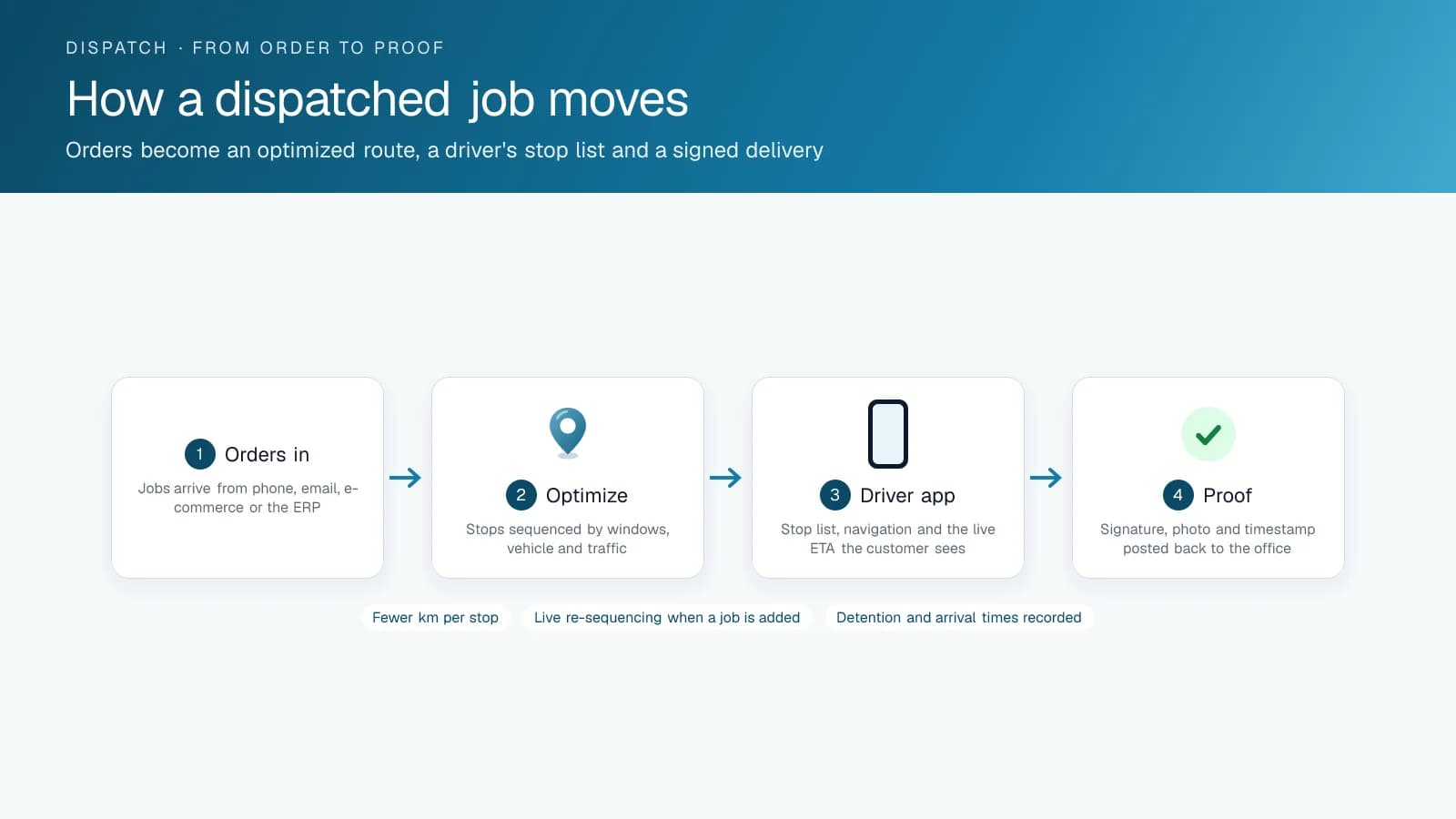
A commercial routing product, especially one on the High Point GPS add-on library, arrives with the pieces you would otherwise build: maintained maps with traffic, a planning screen for the dispatcher, a driver app with proof of delivery, and customer ETAs. The piece that matters most is the live connection to the vehicles. The optimizer knows where every van is and how long stops take, based on geofence data, so it can replan in the middle of the day. You pay per vehicle per month and the vendor keeps it running. Your developer, if you have one, works on order-system integrations instead of routing.
Can You Combine Open Source and Commercial Routing?
Some fleets run both. They use an add-on library routing tool for daily dispatch and an open-source solver for strategic questions like territory design, depot location and fleet sizing, which an analyst runs a few times a year instead of a dispatcher every morning. The same telematics data feeds both. High Point GPS integrates commercial routing tools with the High Point GPS platform and builds custom add-ins for fleets whose routing needs fall outside what the products offer.
What You Build Versus What You Buy
The parts of a working routing system, and where each one comes from under the two approaches.
| Component | Open source | Commercial tool on the add-on library |
|---|---|---|
| Optimization solver | Included, mature | Included |
| Road network and map hosting | Download, host and update yourself | Included, maintained |
| Traffic, historical and live | Not in free data; averages only | Included |
| Dispatcher planning screen | Build | Included |
| Driver app with proof of delivery | Build | Included |
| Customer notifications and ETAs | Build | Included |
| Live vehicle positions and mid-day replanning | Build the telematics integration | Included through the platform |
| Learning from actual stop durations | Build | Included |
| Cost | No licence; a developer and a server | Per vehicle per month |
| Best for | Engineering teams with unusual rules or very large scale | Fleets without an in-house development team |
Frequently asked questions
Is free open-source route optimization software any good?
Yes. Open-source routing engines and vehicle routing solvers are mature, and logistics companies use them in production. What they lack is everything around the solver: maps with traffic, a dispatcher screen, a driver app and live vehicle data, all of which a fleet then has to build itself.
What does it cost to run open-source routing?
There is no licence fee, but you still pay for a server, current map data and a developer. That developer builds and maintains the dispatch screen, driver app and vehicle tracking link the solver lacks, and the fleet comes to depend on that one person.
When does open source make sense for a fleet?
Open source makes sense when you have an in-house engineering team and a problem commercial products do not handle, such as an unusual constraint no product supports or a scale where per-vehicle licensing costs more than development. Without developers on staff, a commercial tool usually costs less.
What does a commercial routing tool add?
It adds maintained maps and traffic, a dispatcher planning screen, a driver app with proof of delivery, and customer ETAs. It also keeps a live link to the vehicles, so it knows where each van is and can replan during the day.
Can I use both?
Yes. Many fleets run a commercial tool for daily dispatch and an open-source solver for occasional strategic analysis, such as territory design or depot location. The same telematics data feeds both, so the analyst and the dispatcher work from one record of the fleet.
Sources
Related solutions & products
Continue reading
- Dispatch & Routing overview →
- How Route Optimization Software Integrates with GPS Fleet Tracking →
- Multi-Stop Route Planner Software for Last-Mile Delivery: Route Optimization Explained →
- Route Optimization: How It Works, With a Worked Example for a 40-Stop Day →
- Route Optimization Software for Small Business: Twelve Stops, Two Vans, One Morning →
- More in Dispatch & Routing →
Get a free quote
- Over 500 fleets
- Since 2013
- 4.9 on Google (19 reviews)
What are you looking for?
Prefer to talk?Call 1-800-613-6323[email protected]