
Industry
GPS Fleet Tracking for Paving & Asphalt
GPS tracking for paving and asphalt contractors that follows every dump truck from the plant to the paver, records each cycle and the tonnage it implies, keeps temperature-critical loads moving, and tracks engine hours on pavers and rollers for maintenance and billing.
Updated September 21, 2026
An asphalt crew lives by the cycle. The plant loads a truck, the truck drives to the paver, the paver takes the load while it is still hot enough to compact, and the truck heads back for the next one. When a truck is late, the paver stops, the mat cools and the joint that results is the one the inspector will find. GPS tracking from High Point GPS puts every truck in the cycle on one map for the foreman at the paver and the dispatcher at the office. Geofences at the plant and around the paving zone record each truck's load time, travel time, wait at the paver and return, and the cycle count for the day becomes the tonnage delivered without anyone tallying tickets. Trucks that sit at the plant for forty minutes or take a longer route show up in the cycle-time report the same afternoon. The paver, the rollers and the milling machine carry a GO RUGGED device that records engine hours, idle time and fault codes, and the rollers' hours on the mat are the hours the estimator compares against the bid. Night paving on a highway closure adds fatigue and a tight window; driver ID, dash cams and hours-of-service records cover the trucks, and the trip history shows the closure was cleared on time. When a municipality disputes the tonnage placed or an owner-operator disputes the loads paid, the cycle record answers both.
Common challenges
- Trucks arriving in bunches at the paver, then a gap that stops the machine and cools the mat
- Daily tonnage reconciled from paper plant tickets days after the mat was laid
- No record of how long each truck waited at the plant or at the paver, so cycle time cannot be improved
- Hired trucks paid by the load with no independent count of the loads they actually delivered
- Rollers and pavers whose engine hours are read off the gauge once a month, if at all
- Night paving on a highway closure with tired drivers and no record of when the closure was cleared
How High Point GPS helps
- Live map of every truck in the cycle: at the plant, en route, waiting at the paver or returning
- Plant and paving-zone geofences that record load time, travel time, dump time and return for each cycle
- Cycle count per truck per day, multiplied by load weight, as the day's delivered tonnage
- Cycle-time report that shows which trucks waited longest and where the delay sat
- GO RUGGED devices on pavers, rollers and milling machines for engine hours, idle time and fault codes
- Roller hours on the mat and paver hours per job for the estimator and for equipment billing
- Driver ID, driver scoring and AI dash cams on trucks that run the same loop dozens of times a day
- Hours-of-service records in Geotab Drive for night paving crews on closures
The Cycle from Plant to Paver, Recorded Every Time
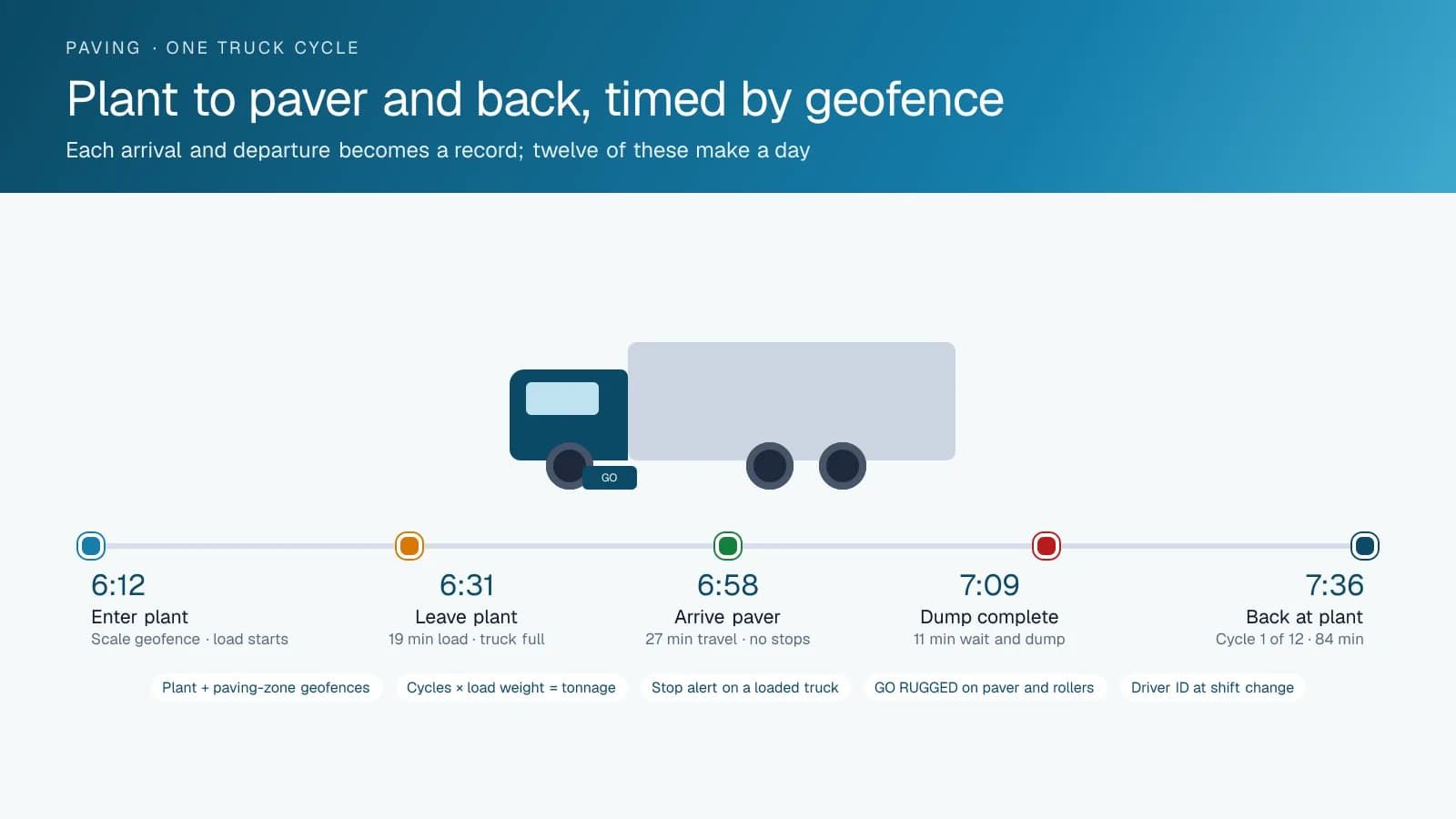
The paving foreman's day is a series of arrivals. A geofence around the plant scale and another around the paving zone turn each arrival into a record: the truck entered the plant at 6:12, left at 6:31, reached the paver at 6:58, left the zone at 7:09 and was back at the plant at 7:36. Across a day that is twelve cycles for one truck and a hundred and forty for the fleet, each one timed. The foreman watching the live map sees three trucks queued at the paver and none on the road, and calls the plant before the gap opens. The dispatcher sees a truck that has been at the plant for forty minutes and finds out why.
The cycle-time report at the end of the day shows where the minutes went: load time at the plant, travel each way, and wait time at the paver. When the average wait at the paver is eighteen minutes, the crew has too many trucks; when the paver is stopping, it has too few or the plant is slow. High Point GPS builds the report so that the numbers for each truck, each driver and each day are on one page, and the same page shows what happened when a job ran long.
Tonnage from Cycles, Not from a Stack of Tickets
Every load that leaves the plant has a ticket, and every ticket ends up in a folder that someone reconciles at the end of the week. The cycle record gives an independent count the same day: each truck's arrivals at the paving zone, multiplied by the truck's load weight, is the tonnage delivered. When the owner disputes the quantity placed, the contractor shows the count of cycles with timestamps and positions rather than a stack of tickets a clerk added up. When a hired truck's invoice shows twenty-two loads and the geofence record shows nineteen, the conversation with the trucking broker is short.
The record also keeps a temperature-critical load from becoming a rejected one. A truck that leaves the plant and stops for thirty minutes on the way is a truck whose load has cooled, and the trip record shows the stop. High Point GPS sets an alert for a loaded truck that stops outside the plant and the paving zone for longer than a set number of minutes, so the foreman knows before the truck arrives whether that load is still within spec. The same alert catches a driver who took a lunch break with a full load in the box.
Engine Hours on Pavers, Rollers and Milling Machines
A paver and a pair of rollers are the most expensive equipment on the job, and the hours they run are the hours the estimator priced. A GO RUGGED device on each machine records engine hours, idle time, fault codes and position, and the hours are read automatically instead of off a gauge when someone remembers. Maintenance reminders run on those hours: a roller due for service at 250 hours generates a work order when it gets there, not when the drum bearing fails on a highway job with a closure permit that expires at 5 a.m.
The same hours feed the job cost. Rollers on the mat for nine hours against seven in the estimate is a number the estimator sees the next morning, with the fault codes and the idle time that explain it. A paver that idled for two hours waiting on trucks is a paver whose cost went to waiting, and that cost sits beside the cycle-time report that shows why. Equipment moved between jobs by lowboy carries its record with it, so the hours on each job are the machine's hours inside that job's geofence.
Night Paving, Closures and the Drivers Who Run Them
Highway paving happens at night under a closure with a hard end time. The trip history of every truck and every machine shows when the crew arrived, when the last load was placed and when the equipment left the closure, and that is the record a contractor produces when the agency asks why the lane opened late. Drivers on night shifts run under hours-of-service rules, and the Geotab Drive app records their duty status on the same tablet they use for the electronic DVIR on the truck at the start of the shift.
The loop from plant to paver is the same road dozens of times a night, and the driver who has done it thirty times is the one who nods off on the thirty-first. Driver-facing AI dash cams flag fatigue and distraction, and the road-facing camera records what happened in front of the truck. Driver scoring records hard braking and speeding on the loop, with an NFC driver ID tying each trip to the driver at the wheel even when trucks change hands at shift change. When a car enters a closure and hits a truck, the footage, the speed and the position are in one file for the insurer.
Frequently asked questions
How does the system count loads and tonnage?
Geofences at the plant and the paving zone record each truck's arrival and departure. Each arrival at the paving zone is one cycle, and cycles multiplied by the truck's load weight give the day's delivered tonnage. The count is independent of plant tickets and available the same day, per truck and per driver.
Can it show me where the cycle time is being lost?
Yes. The cycle-time report breaks each cycle into load time at the plant, travel each way and wait time at the paver. You see which trucks waited longest, whether the plant or the paver was the bottleneck, and how the average changed through the day, which is how the truck count for the next job gets set.
Does it track the paver and the rollers?
A GO RUGGED device on each machine records engine hours, idle time, fault codes and position, and maintenance reminders run on those hours. The hours inside each job's geofence are the hours the estimator compares against the bid and the hours used for equipment billing, and a machine idling while it waits on trucks shows up as idle time.
Can it tell me a load has been sitting too long?
High Point GPS sets an alert for a loaded truck that stops outside the plant and the paving zone for longer than a set number of minutes. The foreman knows before the truck arrives that the load has been sitting, and the trip record shows where the stop happened and for how long.
What about hours of service for night paving crews?
Drivers on trucks that fall under the ELD mandate log duty status in the Geotab Drive app on the same tablet used for the electronic DVIR. The records are ready for a roadside inspection, and the dispatcher sees remaining hours before assigning a driver to a second closure the same night.
Related solutions
Related guides
- How Geofencing Works for Fleet Tracking →
- Fleet Maintenance: Engine Hours vs. the Calendar →
- Telematics for Construction and Heavy Equipment: Tracking Machines, Not Just Trucks →
- Dispatch Software for Construction and Concrete Fleets →
- Hours of Service Rules Explained: The 11 and 14 Hour Limits →
- IOX-NFCREADERA: Driver ID by NFC Tap, So Every Trip Has a Name on It →
Get a free quote
What are you looking for?