
Industry
GPS Fleet Tracking for Pest Control
GPS tracking for pest control fleets that proves each service stop with an arrival and departure record, tightens route density across recurring accounts, keeps chemical inventory tied to the van, flags after-hours use and gives technicians a driving score they can act on.
Updated September 21, 2026
A pest control company sells recurring visits, and its reputation rests on whether those visits happened. A customer on a quarterly plan calls to say no one came; a property manager wants the log for every unit on the contract; a technician's day ends at 3 p.m. with twelve stops done when the schedule said sixteen. GPS tracking for pest control puts every van on one live map and turns each stop into a record with an arrival time, a time on site and a departure time, created by a geofence around the customer's address rather than by a technician remembering to tap a button. High Point GPS builds those records into a proof-of-service report the office can send with an invoice or read to a customer on the phone. The same trip data shows where routes overlap, where a technician drives forty minutes between two stops in the same suburb and where an account could move to a denser day. Chemical inventory stays tied to the vehicle; the office knows which van carries which products and can answer a regulator or a customer who asks what was applied. After-hours and weekend driving shows up on an exceptions report, and each technician's driving is scored on speeding, hard braking and idling, with a coaching report that starts from a specific trip. Recurring-service scheduling ties into dispatch, and the open API carries stop records into the company's service software.
Common challenges
- Customers on a recurring plan who say the technician never came, with nothing but the technician's word to answer them
- Routes built by habit that send two technicians into the same neighbourhood on the same day
- Property-management contracts that require a per-unit service log the office assembles by hand from paper tickets
- No record of which chemicals were in which van when a customer or a regulator asks what was applied
- Company vans used on evenings and weekends with no way to see it until the fuel bill arrives
- Technician driving that costs the company in fuel, brakes and insurance claims with no data to coach from
How High Point GPS helps
- Live position of every van with the day's stop list beside it, so the office sees who is ahead and who is behind by mid-morning
- A geofence around every customer address that records arrival, time on site and departure without any input from the technician
- Proof-of-service reports by customer, by contract and by date that go out with the invoice or answer a missed-visit call
- Route density analysis from real trip data: distance between stops, drive time per stop and accounts that belong on a different day
- Chemical inventory tied to the vehicle through driver ID and vehicle assignment, so the office knows what each van carries
- After-hours, weekend and out-of-territory driving on an exceptions report with the trip and the driver attached
- Technician driving scores for speeding, hard braking, cornering and idling, with coaching reports built from specific trips
- Recurring-service scheduling and stop records passed to the company's service software through the open API
Proof of Service Without a Button to Press
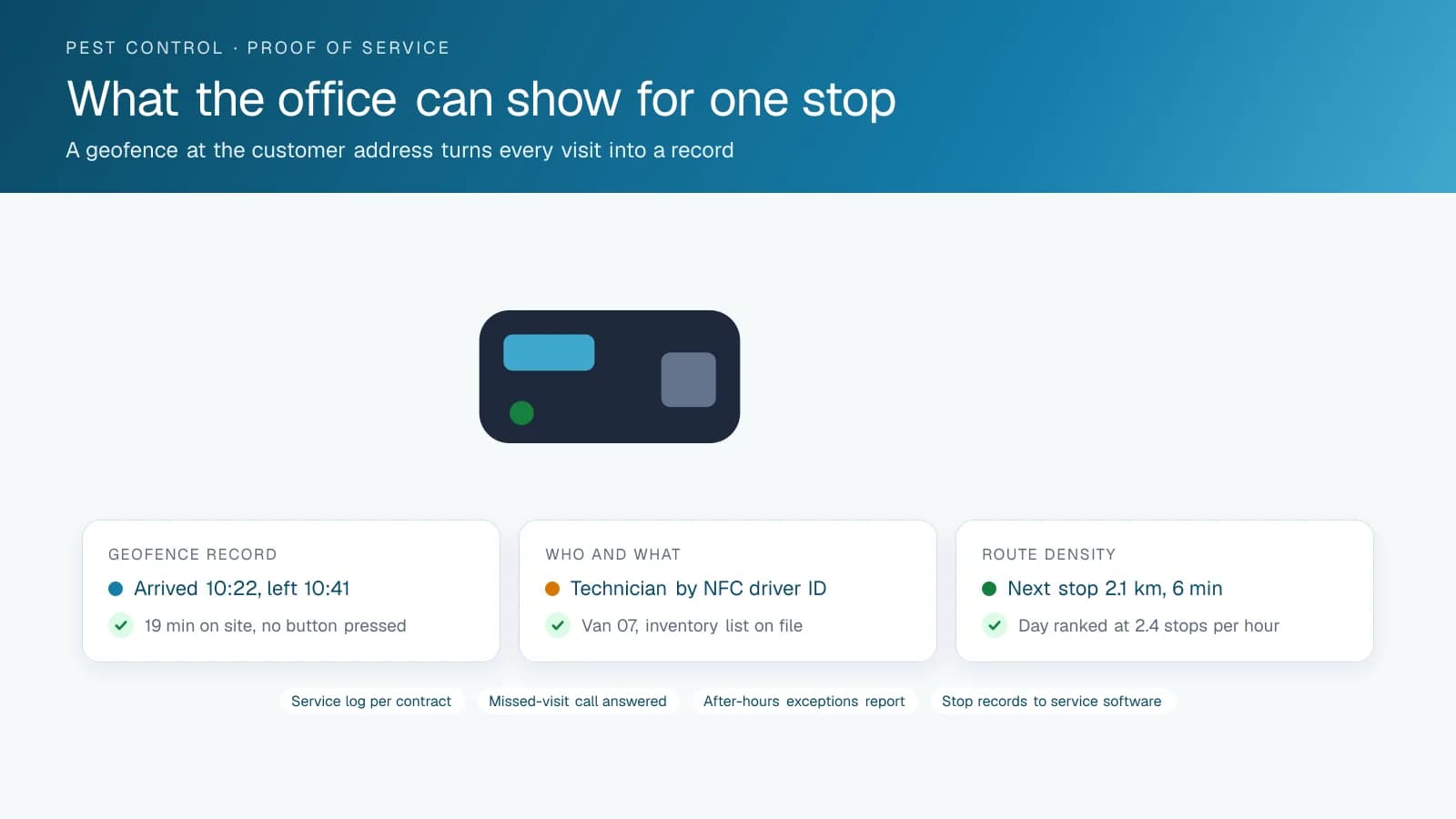
The most damaging call a pest control office takes is the one where a customer on a quarterly plan says nobody came. High Point GPS sets a geofence around every customer address in the account list, and the GO device records the van's arrival, the minutes it stayed and its departure. The record exists whether or not the technician remembered to close the ticket. When the customer calls, the office sees the van at the address on the 14th from 10:22 to 10:41 and says so. When the technician did skip the stop, the office sees that too and deals with it before the customer becomes a former customer.
For commercial and property-management accounts, the same records become the contract's service log. A report by property and date lists each visit with its arrival and departure time, ready to attach to the invoice or to hand over at contract renewal. A restaurant chain asking for proof of monthly service at forty locations gets one report instead of forty paper tickets, and the office produces it in minutes. Residential customers get the same treatment in smaller form: an office that can read a visit time to a caller settles most complaints before they become cancellations.
Route Density and the Forty-Minute Gap
Pest control routes accumulate over years as accounts are added wherever the salesperson signed them. The result is a technician who drives from one side of the city to the other twice a day while a colleague works the same streets. Trip data shows the real cost of that: distance between consecutive stops, drive time as a share of the day and the stops where a technician spent longer driving than working. High Point GPS builds a route density report that ranks each technician's day by stops per hour and flags the accounts that would fit better on another route or another day.
Recurring-service scheduling is where the fix happens. When the office moves an account to a different day, the dispatch view shows the new stop list on the map and the drive time it saves. Seasonal work, one-time treatments and callbacks slot into the existing routes based on where the vans already are, and a technician who finishes early is visible to the office before the next callback comes in. Over a season, the report shows whether the changes held and where the next set of accounts should move, and the branch manager reads it as a single page rather than a map of pins.
What Is in the Van and Who Is Driving It
A pest control van is a rolling chemical store, and the office needs to know which products are in which vehicle. Vehicle assignment in MyGeotab ties each van to its inventory list and each trip to a technician through the IOX-NFCREADERA driver ID reader. When a customer calls about a reaction after a treatment or a regulator asks what was applied at an address, the office can say which technician was there, which van they drove and what that van was stocked with. The GO device's trip record shows the visit; the assignment record shows the rest.
Company vans do not belong at the lake on a Saturday. Zone rules and time-of-day rules put after-hours, weekend and out-of-territory trips on an exceptions report with the trip replay attached. Most weeks the report is empty, which is the point. Where an owner suspects a van is being used for side work, the report either confirms it or clears the technician, and either outcome is better than a suspicion. Where a technician does need the van at home between an early stop and a late one, the office sets the exception for that route and the report stops flagging it.
Technician Scoring and the Cost of a Heavy Right Foot
A pest control van carries a technician, a sprayer and a tank of product through residential streets all day. Speeding, hard braking and fast cornering cost fuel and brakes, spill product in the back and show up in the insurance renewal. High Point GPS configures driver scoring for the work: speed limits per zone, with tighter thresholds in the residential areas where most stops are, and idling reported separately at the customer's driveway and on the road. Each technician sees their own score, and the branch manager sees the ranking, with each event tied to a trip they can replay.
Maintenance reminders run on mileage and engine hours, and engine fault codes reach the office as the van logs them. A pre-trip inspection in the Geotab Drive app takes the place of a paper checklist and puts a defect in front of the shop before the van leaves the yard. Fuel-card integration matches each fill to the van and the driver, which is how a fuel bill that has crept up finds its explanation. Maintenance and fuel data sit beside the driving score, and a technician whose van burns more fuel than the route explains is a technician whose trips are worth a look.
Frequently asked questions
Does the technician have to check in at each stop?
No. A geofence around each customer address records arrival, time on site and departure automatically from the GO device. Technicians can still close tickets in the company's service software, and the geofence record stands on its own when a customer disputes a visit.
Can it produce a service log for a commercial contract?
Yes. High Point GPS builds a report by property, contract and date that lists each visit with its arrival and departure time. The office can attach it to an invoice, send it at renewal or produce it for a property manager who asks for the log on a single unit.
How does it help with route density?
Trip data shows distance and drive time between consecutive stops for every technician every day. A route density report ranks each day by stops per hour and flags the accounts that would fit better on another route or day, which is where the office starts when it rebuilds the schedule.
Will it show after-hours use of the vans?
Yes. Time-of-day and zone rules put trips outside working hours, on weekends or outside the territory on an exceptions report with the driver and the trip replay attached. The owner sees the exceptions rather than searching through every trip.
Does it connect to our pest control software?
The open Geotab API carries stop records, arrival times and vehicle position to the company's service or scheduling software. High Point GPS builds the connection or a custom add-in when the vendor has no ready integration, and the office works from one system.
Related solutions
Related guides
- GPS Fleet Tracking for Small Business: What a 3 to 20 Vehicle Fleet Needs →
- How Geofencing Works for Fleet Tracking →
- Route Optimization Software Explained →
- IOX-NFCREADERA: Driver ID by NFC Tap, So Every Trip Has a Name on It →
- Driver Safety Scorecards: How Fleet Behavior Scoring Works →
- How to Reduce Fleet Fuel Costs →
Get a free quote
What are you looking for?