
Industry
GPS Fleet Tracking for HVAC, Plumbing & Electrical
GPS tracking for HVAC, plumbing and electrical fleets that sends the closest technician to the next job, proves arrival and time on site for the invoice, and keeps the vans, the tools and the after-hours driving under control.

Updated September 21, 2026
A trades company sells time, and most of that time is spent in a van between jobs. GPS tracking for HVAC, plumbing and electrical fleets puts every van on one live map so the dispatcher sends the closest available technician to the emergency call, tells the customer an honest arrival window, and fills a cancelled slot with the next job on the board. Geofences around each customer site record the arrival and the departure, so the invoice's time on site comes from the record rather than the technician's memory, and a disputed bill is settled with a trip replay. The same Geotab GO device reports idling, speeding and after-hours use of a van that is supposed to be parked, and Bluetooth asset tags on the expensive tools and test equipment show which van each one is in. Maintenance reminders keep a fleet of high-mileage vans on the road, and the whole platform connects to the field-service software the company already dispatches from, so the office works in one system rather than two.
Common challenges
- Emergency calls dispatched to whoever answers the radio first rather than the technician who is actually closest
- Customers given a four-hour window because the office does not know when the technician will really arrive
- Time-on-site disputes on invoices, with nothing to show but the technician's own notes
- Vans driven home and used on weekends, with the fuel and the wear showing up in the accounts
- Expensive tools and test equipment that go missing between vans and job sites
- Vans that miss oil changes and brake work because nobody tracks the mileage until something fails
How High Point GPS helps
- Live location of every van on one map, with the technician logged in and their current job status
- Closest-technician dispatch for emergency calls, with the drive time shown before the call is assigned
- Customer-site geofences that record arrival and departure for every job, feeding time-on-site to the invoice
- Arrival notifications to the customer, sent from the platform or from the field-service software it connects to
- After-hours and weekend use alerts, with the trip and the destination in the record
- Bluetooth asset tags on tools, meters and test equipment, showing which van or site each one is in
- Idling, speeding and harsh-driving reports per technician, for coaching and for the insurance renewal
- Maintenance reminders on mileage and engine hours, with fault codes sent to the shop as the van logs them
Dispatching the Closest Technician
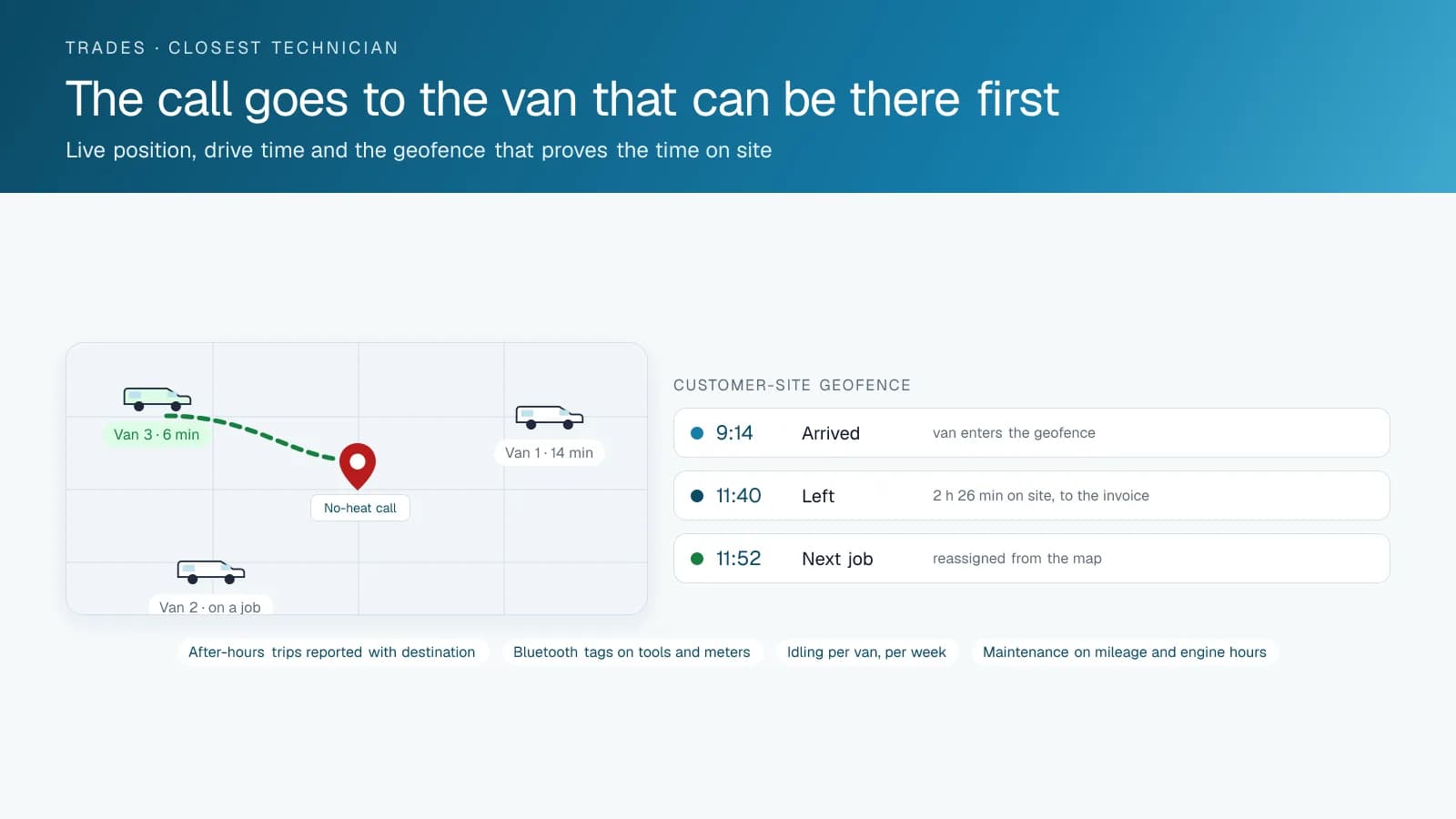
A no-heat call in January or a flooded basement on a Saturday is won or lost on how fast someone arrives. With every van on the live map, the dispatcher sees which technicians are on a job, which are finishing and which are driving, and assigns the call to the one who can be there soonest rather than the one who answered first. The drive time is shown before the assignment is made, so the customer hears a real window. When a job cancels, the van's position shows which job on the board it can take next, and the technician's day is rebuilt without a phone tree.
High Point GPS connects the tracking to the field-service software the company already uses, whether that is a dispatch board built for the trades or a general scheduling tool. Job status flows one way, live position flows the other, and the dispatcher stays in one screen. For companies that run on paper or a whiteboard, the platform's own dispatch and messaging tools cover the same ground from day one.
Proving the Time on Site
A geofence around each customer address records the moment the van arrives and the moment it leaves. That gives the invoice a time on site that came from the record rather than from a technician filling in a timesheet at the end of the day. When a customer questions a bill, the office pulls the trip: the van arrived at 9:14, left at 11:40, and the route in between shows it did not go anywhere else. Most disputes end there.
The same records feed payroll and job costing. Drive time, time on site and the return to the shop are separated for each technician, which shows where the day actually goes and which jobs are more travel than work. Companies that bill by the hour and companies that bill by the job both use it, the first to defend the hours and the second to see which jobs are priced too low.
Vans, Fuel and After-Hours Driving
Trades vans are often taken home, which is convenient for the early call and expensive when the van becomes the family vehicle. The platform reports after-hours and weekend trips with the route and the destination, and the company sets the policy it wants: a simple report, an alert when a van moves outside working hours, or a geofence around the technician's home that only flags trips that leave it. Idling reports show the vans left running in a driveway or at a supplier, which on a fleet of vans is a fuel line item on its own.
Driving behaviour is scored per technician, with speeding, hard braking and cornering events in the record. That matters for two reasons: the company's name is on the side of the van, and the insurer asks for it. Fleets that show an insurer a year of clean driver reports and a dash-cam programme have something to negotiate with at renewal.
Tools, Equipment and Maintenance
A trades van carries thousands of dollars of tools, gauges, pressure testers and meters, and every company has a story about the one that walked. Bluetooth asset tags on the expensive items report to the GO device in whichever van they are in, so the office sees which van has the recovery machine or the pipe threader and which job site it was last near. When a tool is left on a site, the record shows where.
The vans themselves are the fleet's biggest asset and the easiest to neglect. Maintenance reminders run on mileage and engine hours per van, and engine fault codes are sent to the shop or the dealer as the van logs them, so a charging or emissions fault is booked before it strands a technician on the highway. Electronic DVIR, if the company wants it, gives each technician a two-minute walk-around in the app instead of a form nobody fills in.
Frequently asked questions
Does it work with our field-service or dispatch software?
In most cases yes. The platform has an open API and standard connectors for the field-service tools trades companies commonly use, and High Point GPS builds the connection when no connector exists. Job status flows to the map and live position flows to the dispatch board.
Can it prove how long a technician was on site?
Yes. A geofence around the customer address records arrival and departure times for every visit, and the trip replay shows the route in between. That time on site goes to the invoice and settles disputes.
How do we control after-hours use of the vans?
The platform reports every trip outside the hours you set, with the route and the destination, and can alert a manager when a van moves after hours. Many companies use a simple weekly report rather than alerts, and the driving stops once technicians know it is recorded.
Can we track tools and equipment, not just the vans?
Yes. Bluetooth asset tags on tools and test equipment report to the GO device in the van they are in, so the office sees which van or job site each item is at. Larger equipment can carry its own battery-powered tracker.
Is it worth it for a fleet of five vans?
Usually. A small trades fleet loses time and money in exactly the places tracking fixes: a wrong dispatch, a disputed invoice, a van used on the weekend. High Point GPS installs plug-in devices in a morning and prices per van, so a five-van fleet pays for five.
Related solutions
Related guides
- GPS Fleet Tracking for Plumbing, HVAC and Electrical Contractors →
- HVAC and Plumbing Dispatch Software →
- GPS Fleet Tracking for Small Business: What a 3 to 20 Vehicle Fleet Needs →
- Geotab IOX-BT and Bluetooth Asset Tags: How They Work and What to Tag →
- How Geofencing Works for Fleet Tracking →
- How to Reduce Fleet Fuel Costs →
Get a free quote
What are you looking for?